Cat Garrity
AfterburnCat Garrity’s role in the air war is defined by the demanding duality of combat aviation: she must interpret uncertain information quickly, act as part of a tightly coordinated crew, and live with the personal consequences when a mission strains that coordination. A helicopter encounter leaves her and Dixie at odds over what was seen and what it meant. Her refusal to fly with him again is followed, not by a permanent separation, but by a return to his back seat and a combat mission in which the two operate as a team.
Identity and Flight Role
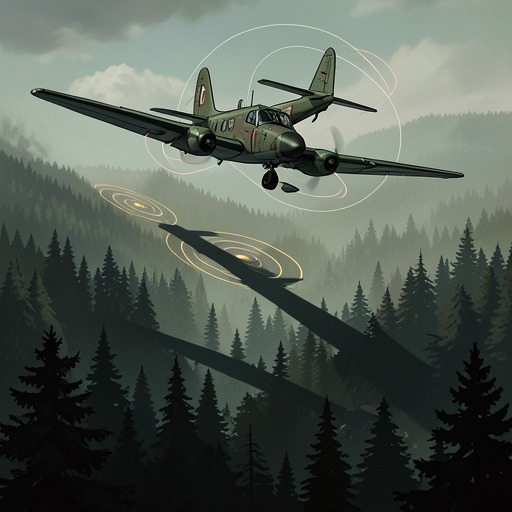
Cat Garrity is an F-14 crew member who flies in the back seat, working the aircraft’s systems and supporting the pilot in combat. In an earlier engagement, she is aboard the F-14 flying with Mason while the crew tracks an enemy aircraft and a United Nations helicopter among multiple contacts. When Mason asks whether she agrees with his assessment, Cat explains that her attention has been occupied by the dense cluster of contacts among the rocks and that she did not see the helicopter clearly. The exchange establishes both the practical demands of her position and a limit on what she can personally confirm: she is an active participant in the encounter, but not an all-seeing witness to it.
That distinction matters later, when the helicopter becomes the focus of a dispute. Cat’s judgment is not presented as certainty where she lacks a clear view. She acknowledges what she did not see, even as Dixie is convinced by his own interpretation. Her professional value lies partly in that candor: in a situation where mistaken identification can carry grave consequences, she does not claim knowledge she does not have.
The Helicopter Incident and Separation
The encounter changes Cat’s working relationship with Dixie. After the helicopter incident, she tells him plainly that she will not fly with him again. In the days that follow, he is paired with a succession of other radar intercept officers. The decision is more than a momentary disagreement: it removes a familiar crew partnership from the cockpit and leaves Dixie flying with replacements.
Their disagreement concerns the limits of perception under pressure. Cat tells Dixie that she did not get a good look at the helicopter during their pass. When he insists that he knows what he saw, she recognizes that he is convinced, but does not adopt his certainty as her own. Later, in a briefing about the encounter, the commander asks whether she saw the helicopter. Cat again says that she did not; her head had been down. The repetition gives her account a consistent boundary. She neither supplies confirmation she cannot offer nor treats Dixie’s belief as proof.
The wider operational setting makes that uncertainty especially consequential. The force is operating under a no-fly-zone mission in which aircraft may appear threatening without being easy to identify; a Black Hawk could be mistaken for an armed aircraft, while failing to act against a genuine threat could leave a United Nations helicopter exposed. Cat voices the bind with a wry observation that the crew cannot win either way. The humor briefly eases the tension in the room, but it does not resolve the underlying problem: the aircrew must make decisions with incomplete information and bear the consequences of either error.
Renewed Partnership
Cat’s refusal to fly with Dixie does not become the final word on their partnership. Later, she is back in his F-14 as his rear-seat crew member. The return is made explicit in a small, personal detail: Dixie is glad to have her riding with him again. Their renewed pairing follows the earlier rupture rather than erasing it, giving the reunion weight as a change in their working relationship.
When Dixie is being lifted from his cockpit on a Stokes stretcher, Cat runs to him, throws her arms around his neck, and kisses him quickly and forcefully. The gesture is public, occurring in front of the people at the rescue scene, and sharply contrasts with her earlier insistence that she would not fly with him. It confirms the depth of her attachment without making the earlier professional conflict disappear: her decision to step away had consequences, and her return to him is an active choice.
Combat and Narrative Significance
The renewed crew partnership is tested in action. During a later engagement, Cat calls the radar lock and works with Dixie to bring their aircraft’s weapons to bear. She arms the F-14’s AIM-54C missiles, reports a target lock on the lead aircraft, and calls the launch. The sequence gives her a concrete, technically consequential role in the attack: she is not simply present in the cockpit, but participates in identifying and engaging the target.
Cat’s arc links the intimate scale of trust between two crew members to the larger uncertainty of combat. The helicopter incident exposes how quickly an aircrew’s shared picture can fragment: one member is occupied with the display, another believes he saw something decisive, and the available account cannot immediately settle the disagreement. Cat’s later return to Dixie’s back seat, followed by their coordinated weapons engagement, shows the partnership functioning again under pressure. Her story does not offer certainty as a cure for the fog of war; instead, it makes trust, candor about what one has actually seen, and the difficult possibility of working together again central to the crew’s survival.