Belgrade
LimonovBelgrade is the book’s hinge between political observation and Limonov’s pursuit of war. A place he first enters as a visiting author becomes a recruiting ground, a meeting point with Arkan, and the last urban stop before journeys toward the front. Its significance lies not in a single battle fought within the city, but in the way its hotels, military contacts, and increasingly isolated capital connect Limonov to conflicts beyond it.
Capital and wartime gateway
In November 1991, Limonov is invited to Belgrade for the launch of one of his books. During a signing, uniformed men ask what he knows about the Serbian enclave in eastern Croatia. They explain that Serbs unwilling to remain within independent Croatia have declared their own secession, that the Croats have opposed it, and that war has followed. Vukovar, a key city in the conflict, has just fallen. The visitors invite Limonov to see the situation for himself.
Belgrade is introduced through this encounter as both a literary destination and a point of access to military events. Limonov initially has other plans and says that developments in his own country interest him more than disputes between Balkan peasants. Yet the prospect of reaching a war zone changes his priorities. He thinks that he will soon be fifty and has never experienced war, an experience he believes a man must have sooner or later. He accepts the invitation and is so excited that he does not sleep that night.
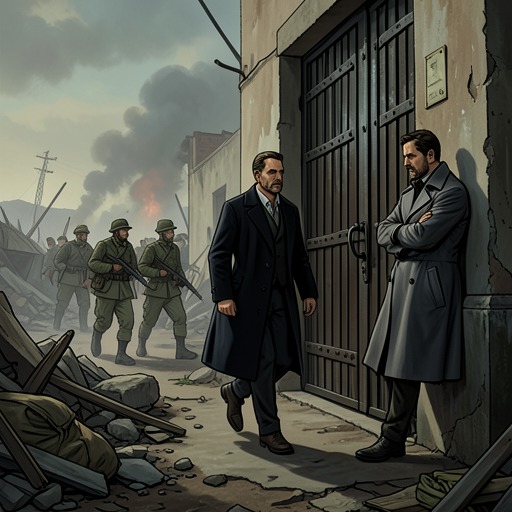
At dawn, two officers collect him from his hotel. Their route follows the highway linking Belgrade with Zagreb, the Croatian capital. The road has not seen private vehicles since hostilities began; checkpoints and roadblocks interrupt the journey, and armed soldiers keep their rifles trained on travelers while checking identification. Limonov’s Russian identity suggests to the soldiers that he is Orthodox and pro-Serbian, but his French passport complicates their assumptions: they associate France with Catholicism and support for Croatia. The tension eases after he attacks Franjo Tuđman and Hans-Dietrich Genscher, whom the Belgrade officers regard as an advocate of Croatian independence, and drinks with them to seal their understanding.
From book launch to Arkan’s circle
Belgrade also gives Limonov access to the people and organizations around the Serbian war effort. When he later meets Arkan at the latter’s headquarters in Erdut, near Vukovar, the bond is not merely professional. The two drink slivovitz and find common ground in their hostility toward Mikhail Gorbachev, Boris Yeltsin, Franjo Tuđman, and Genscher, as well as in their belief that Russia needs a revolution. Limonov asks whether he can volunteer as a Russian fighter; Arkan replies that everyone is welcome. A fast friendship begins.
That encounter makes the city’s function as a gateway personal as well as geographical. Belgrade is where Limonov’s status as a visiting writer can be converted into contact with a militia and the possibility of going to the front. Months later, news of an Arkan-led victory over Bosnian Muslims brings Limonov to tears. He takes out a photograph of himself and Arkan posing with the militia’s little tiger mascot and feels a radiant nostalgia for the possibility of returning to the war in the Balkan mountains. The photograph preserves the friendship as an image, while the longing it provokes points back toward Belgrade as the place from which that wartime connection was made.
The isolated capital and the Hotel Majestic
When Limonov returns, Belgrade has become more isolated. The account traces his journey from Budapest on a nearly empty bus that travels all night; since the embargo, air traffic to and from the Serbian capital has stopped and the airport is closed. The country is described as ostracized by Europe and sinking into isolation and paranoia. Limonov is not looking for the reasonable Serbs who despair of Slobodan Milošević’s campaign. He wants war, and at this point regards throwing himself into it, even at the risk of losing himself, as his only salvation.
His plan is to leave his bag at the Hotel Majestic and visit an improvised embassy representing the self-proclaimed Serbian Krajina's breakaway republic. He offers himself not as a journalist but as a simple soldier. The representatives tell him that reaching Krajina is difficult and that he must wait to be contacted, so he returns to the hotel. The delay makes the hotel a threshold: Limonov has declared his intention, but must wait for the military relationships that can carry him out of the capital.
The narrator, working from Limonov’s description, imagines the Hotel Majestic as resembling the Hotel Lutetia in Paris during the German occupation. Its piano bar and mixture of people dealing in foreign currency, sex workers, gangsters, journalists, and politicians give it the character of a wartime crossroads. Limonov likes the place. A teenage admirer approaches him, having read his books and articles; after he signs books for her mother, the mother turns a blind eye when he sleeps with her daughter. The episode shows the hotel not simply as a place to arrange travel, but as a setting where celebrity, sexual appetite, nationalist politics, and proximity to violence coexist.
Departure for the front
After three days, the barman tells Limonov that Arkan has heard he is in Belgrade and wants to see him. Arkan receives him in a suite at the top of the hotel, in uniform and among his men. He asks whether Limonov has yet made a revolution in Russia. Limonov answers that he has tried: he was among those defending the White House against Boris Yeltsin’s tanks and was wounded in an attempt to take Ostankino. He now wants to fight in Krajina. Arkan explains that access is difficult because the corridor between the enclave and Belgrade is repeatedly cut by Croat and Muslim forces and by the United Nations peacekeeping force, but says a group is leaving the next day. Limonov agrees immediately.
At five the following morning, Limonov is the first person aboard a minibus waiting outside the hotel. The vehicle collects men from Belgrade’s outer districts and leaves at sunrise. Its passengers look like peasants, but they are Arkan’s militiamen returning to the front after leave, and weapons fill the cargo space. The route runs through Herzegovina on roads edged with burned-out villages and truck wreckage. Front lines divide villages, and changes in language, religion, currency, and national allegiance make the landscape difficult to read from one stretch of road to the next. Belgrade’s connection to the front is thus material: the city supplies the meeting place and departure point for a disguised military journey.
Narrative significance
Belgrade changes function across these episodes without losing its role as a point of passage. In 1991, a book launch brings Limonov into contact with officers who take him toward Vukovar; later, the Hotel Majestic reconnects him with Arkan and makes possible his departure for Krajina. The city’s literary and political life is never wholly separate from the war beyond it. Limonov moves through both worlds as an author whose public identity opens doors, and as a would-be combatant who increasingly wants to leave the role of observer behind.
The contrast between his two journeys is especially telling. On the first, Belgrade leads into a landscape where he can imagine himself inside a war he has long wanted to experience. On the later return, the closed airport and empty bus register Serbia’s isolation, while the hotel’s crowded, unstable social world offers another route outward. Belgrade does not resolve Limonov’s divided position between writer and soldier; it repeatedly gives that division a direction, sending him from the city toward the front.