Lefortovo Prison
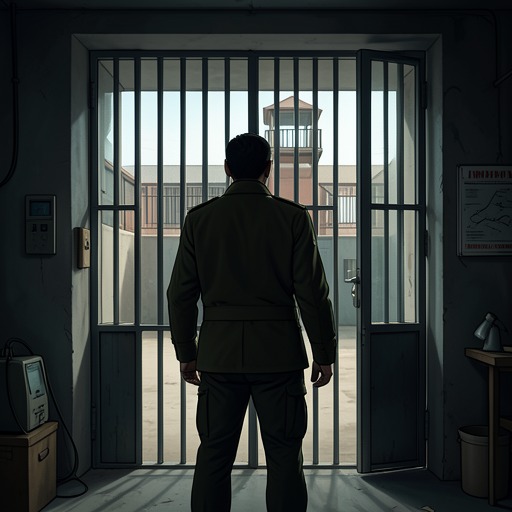
LimonovLefortovo Prison is a highly secretive detention center near Moscow, associated with the state’s most dangerous political adversaries and with a distinctive form of isolation. Eduard Limonov spent fifteen months there before being transferred to Saratov for trial. The prison’s relative cleanliness and order do not make it humane: its control of movement, conversation, information, and time creates a different severity, one that Limonov counters with a daily regimen of exercise and sustained writing.
Identity and reputation
Lefortovo is presented as a fortress of the state, a place where the Soviet Union and later Russia confined major political prisoners and high-level terrorists. The institution’s secrecy is literal as well as symbolic: situated near Moscow, it does not appear on maps, and Limonov initially has no clear knowledge of the accusations against him. He has not seen a lawyer or received visitors, and cannot tell when a trial might begin, whether anyone outside knows of his arrest, or what is being said about it. The uncertainty extends beyond the facts of the case to the basic question of whether his imprisonment is publicly known.
The prison’s reputation reaches beyond its walls. For the thousands, perhaps tens of thousands, of young admirers who regard Limonov as a living legend, Lefortovo is part of the story that gives his image its force. He has endured confinement without complaint or capitulation, written several books, and helped fellow prisoners, who came to regard him as both a kingpin and something like a saint. On the day of his release, inmates and guards dispute who will carry his suitcase. In this account, Lefortovo is not simply where he was detained; it is where the endurance on which his later reputation rests became visible to others.
Isolation and the daily regime
Unlike many Russian prisons, Lefortovo is not dirty or overcrowded, and prisoners are not subjected there to rape or beatings. Its defining punishment is strict isolation. Prisoners are not required to work, but neither can they work even if they wish to. The cells are private, white, and sterile, each equipped with a television that can be watched from morning until night. Rather than relieving confinement, this abundance of screen time encourages a dulling dependence that can lead into apathy and depression.
Exercise is permitted only in a sharply restricted form. Prisoners are taken to the roof early in the morning and assigned a fenced-off square of only a few square yards. Loudspeakers blast music to prevent conversation between the separate exercise enclosures. A prisoner can shout without being able to hear his own voice. The exercise is optional, and many stay in bed, turn toward the wall, and stop breathing outdoor air altogether. In winter, when the mornings are dark and bitterly cold, no one goes out. The guards are accustomed to returning to their warm locker room after the wake-up call and are astonished when Limonov insists on using his allotted time outside, even at minus twenty-five degrees.
Limonov goes out every day for half an hour. He runs across his small patch of concrete, does push-ups and sit-ups, and boxes the icy air. The guards resent having to leave their heated room for a single prisoner, but they are also impressed. His politeness, even temper, and education earn him the nickname Professor. The contrast between the tiny fenced square and the intensity of his exertion gives the routine its particular force: he cannot change the dimensions of the space, but he refuses to let the prison decide whether his body will remain inactive.
Turning confinement into work
For Limonov, the central danger of Lefortovo is wasted time. The prison leaves its inmates to their own devices, while the hours pass without shape or direction. He rises at five in the morning and organizes his day until bedtime. On television, he restricts himself to the news, avoiding films and variety shows, which he regards as the start of moral decay. In the library, he rejects easy novels meant to kill time and reads dry volumes of Vladimir Lenin’s correspondence instead, sitting upright at his table and noting ideas in a notebook.
His requests to the guards are modest and practical: a table, a bright lamp, and a notebook. They grant them with increasing admiration. Working at this pace, he writes four books in one year, including a political autobiography and The Book of Water, which the narrator considers his best work since Diary of a Loser. A broader account of his imprisonment says that he produces seven or eight books during the period as a whole. Writing does not remove the conditions of isolation; it gives the otherwise shapeless hours a purpose that the institution has not supplied.
The prison also permits him to let his hair grow. As he writes, it swishes across the table and threatens eventually to reach the floor. The detail makes his appearance another small consequence of the rules: unlike prisoners who are forced to shave or cut their hair, he can allow it to become conspicuous. The growing hair evokes Edmond Dantès in The Count of Monte Cristo, though the comparison ultimately points toward Abbé Faria, Dantès’s fellow prisoner in the Château d’If. Confinement thus brings literary images into the account without making Limonov’s actual prison life a romantic escape from its restrictions.
Transfer and the contrast with other prisons
After fifteen months in Lefortovo, Limonov is flown to Saratov on a government Antonov aircraft under an escort so elaborate that it suggests the transport of an exceptionally notorious prisoner. Saratov is chosen because it is the Russian jurisdiction closest to Kazakhstan, where he is alleged to have committed the crimes. The move changes the governing pressure of imprisonment. At Lefortovo, isolation defines the experience; Saratov is marked instead by overcrowding, with cells built for four often holding seven or eight people. On arrival, Limonov finds every bed occupied and lays his mattress on the floor without protest, accepting that the latest arrival should be the least comfortable.
The comparison continues in the later transfer to the labor camp at Engels on the Volga. There, the inmates call the new, architecturally polished establishment Eurogulag: its appearance does not make it more livable than a traditional barbed-wire camp. Its steel sinks remind Limonov of the designer interiors at a New York hotel where his American publisher had lodged him. The thought draws together his sharply different lives as a prisoner and as a fashionable writer. Lefortovo is one part of that divide, a place where the absence of forced labor gives him room to write but where isolation is the prison’s central instrument.
Narrative significance
The account treats Lefortovo’s orderliness as a contrast, not a reassurance. White cells and clean surfaces coexist with enforced separation, television-induced passivity, and an exercise yard designed to prevent even the sound of one prisoner reaching another. The institution disciplines not only the body but also the uses of time and the possibility of contact. Limonov’s response is correspondingly specific: he keeps moving in the cold, selects what he will watch and read, and turns a table, lamp, and notebook into the means of producing books.
That response helps explain why Lefortovo becomes central to the legend around him. Admirers see a man who passes through a notorious prison without buckling; the narrative also shows the ordinary mechanisms by which he does so, from waking at five to exercising in a square of concrete and refusing to let idle hours dictate his reading. The prison’s power lies in isolation, while the achievement associated with Limonov lies in imposing a form on the time it seeks to leave empty.