Sarajevo
LimonovSarajevo occupies two roles in the account: it is a city under siege, exposed to bombardment and sniper fire, and a symbol onto which observers project rival ideas of Europe, justice, and political innocence. The contrast between the city’s idealized image and the violence around it becomes especially sharp when the narrative follows foreign visitors into the besieged streets, then turns to footage of Eduard Limonov firing toward the city from Serbian positions above it.
A European ideal under siege
When fighting between Serbs and Croats paused and shifted to Bosnia in the spring of 1992, Sarajevo became central to a moral story told in France and elsewhere. Many observers saw Slobodan Milošević and Radovan Karadžić as the villains and Bosnian Muslims, represented by Alija Izetbegović, as the victims of aggression. Sarajevo, in turn, stood for the harmonious, multiethnic Europe they wished to defend. The people most readily associated with that ideal were described as blond and blue-eyed, listeners to classical music who lived among books; their appeal reflected not only concern for a besieged population but also the particular image of tolerance that French observers hoped to recognize in the city.
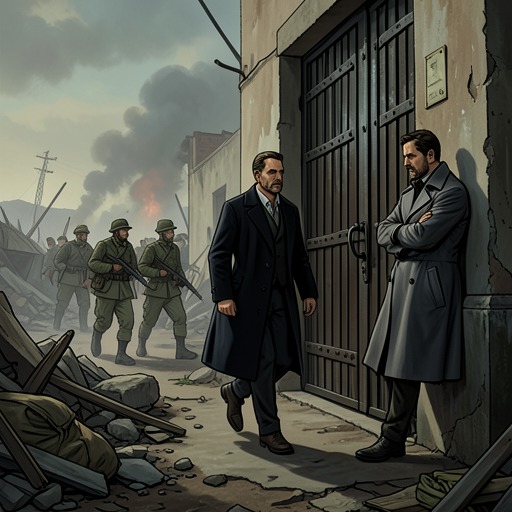
That ideal carried people into danger. Friends of the narrator made regular journeys to Sarajevo, slept in bombarded buildings without being able to bathe, and zigzagged across shattered streets under sniper fire. The prospect that any day might be their last could heighten the experience: they got drunk and sometimes fell in love amid the danger. Jean Hatzfeld’s injury made the risks concrete. A Kalashnikov round cost him a leg, and his experience helped explain why the narrator, when invited to go, held back. Fear played a part, but so did wariness of sacred political missions, especially those embraced by people in his own circle.
Choosing where to witness
The narrative does not treat sympathy for Sarajevo as proof that every assumption made in its name was correct. After spending a year in hospital, Hatzfeld returned to investigate the shooting that had injured him. His inquiry led him to conclude that the shots had come from Bosnian militiamen, not Serbian snipers as he had initially believed. That discovery complicates the first account of his injury, but it does not make the besieged and besieging sides interchangeable. The narrator distinguishes correcting a mistaken belief from retreating into the claim that both sides are equally culpable.
During the siege, the choice of where to report was also a choice of position. In the early days, crossing from one side to the other by car was still possible, though frightening. Later, a journalist could follow events from inside the city under fire or from the positions firing on it. Hatzfeld and Jean Rolin chose the besieged side: the principle was to go where the shells fell, not where they were launched. The account also acknowledges that sympathy can shift as power and danger shift. Rolin experienced satisfaction when Serbs were themselves taking fire; later reporting could attend to the harsh conditions of defeated Serbs in Kosovo. The city’s history thus becomes part of a larger warning about how readily victims and perpetrators can exchange positions, and how necessary it is to keep choosing a standpoint without pretending that every side is the same.
The view from the heights
The geography of Sarajevo makes the distinction between the city and the positions above it crucial. Set at the bottom of a basin, it was exposed to Serbian batteries on the surrounding heights. A BBC documentary made by Pawel Pawlikowski brought that geography into view while examining the Serbian side of the conflict. Pawlikowski filmed musicians playing hurdy-gurdies by soldiers’ tents, songs about defeat on earth and victory in heaven, and children singing martial ditties while carrying Kalashnikovs. The documentary also showed Karadžić and Ratko Mladić bent over maps, moving borders and discussing what territory and populations could be conceded. Their decisions echoed diplomatic negotiations elsewhere, but on screen the war leaders themselves marked the map.
In this setting, Limonov appeared at Pale, the ski resort built for the Sarajevo Olympics that served as the capital of the Bosnian Serb Republic. At the officers’ mess, he wore a People’s Army overcoat over a leather jacket and carried a 7.65 pistol; Pawlikowski saw the weapon as part of a disguise. The film then placed Limonov with Karadžić on the heights from which Serbian batteries bombarded Sarajevo. Karadžić defended his forces as seeking to recover territory they regarded as historically theirs. Limonov answered with admiration for Serbian resistance to the countries aligned against them. The city below was not an abstraction in this scene: the nearly continuous mortar fire came from positions overlooking it.
The machine-gun footage and its afterlife
While a soldier greased his machine gun, Limonov watched with fascination. The soldier invited him to try it. Limonov took his place behind the weapon, followed the soldier’s instructions, and fired a magazine in the direction of the besieged city. The sequence is presented as a moment of boyish excitement under the encouragement of the soldiers around him. Its force comes from the distance between the playful manner and the weapon’s direction: toward Sarajevo, whose inhabitants were enduring the siege.
The footage later circulated in France with a more definite and more damning reputation: people said that it showed Limonov shooting people in Sarajevo’s streets. When asked about it fifteen years later, he denied aiming at people, while acknowledging that he had fired toward the city. A wide shot establishes that he was on the heights, far from the streets where snipers shot people; it does not show him firing at a particular person. But a closer view of the city follows the firing scene in a misleading reverse-angle transition, making the two locations seem more immediately connected. The film therefore supports a distinction between firing toward Sarajevo and demonstrably shooting at people in its streets, while leaving open whether Limonov had shot at people in other circumstances.
The images and the stories surrounding them changed how Limonov’s former Paris acquaintances saw him. The charming adventurer they had once admired now seemed to them close to a war criminal. For the narrator, however, the film’s most unsettling effect was not proof of a crime: it was the spectacle of Limonov looking ridiculous, a would-be tough guy playing at war. That reaction interrupted work on the book for more than a year. Sarajevo’s significance in the account lies partly in this collision between real siege and mediated spectacle: the city is both the place toward which a weapon is aimed and the absent, suffering population whose presence gives the scene its moral weight.