Ostankino Television Tower
LimonovOstankino Television Tower is presented as a strategic communications target during the October uprising against Boris Yeltsin. Its importance lies not only in its physical place in the city but in the possibility that control of television could alter how the confrontation was understood and who appeared to hold power.
Strategic Target and Assault
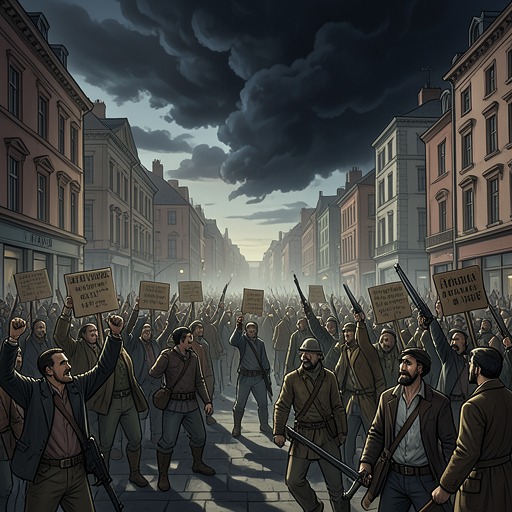
After demonstrators were beaten and arrested outside the Moscow White House, General Rutskoy urged the crowd to march on the Kremlin and seize Ostankino. The tower mattered because control of the news might change the course of the uprising. Eduard Limonov and the young Ukrainian student Taras Rabko joined armed men travelling across an almost deserted Moscow in buses and cars. Several hundred people set out from the White House, but several thousand reached the hill at Ostankino; barely one in ten carried a weapon. OMON units were waiting. As the arrivals came off the buses, the forces opened fire and charged with batons, turning the attempt to capture the broadcast center into a massacre. Limonov threw himself to the ground, and the Irish journalist who had been interviewing him fell on top of him, already dead. Limonov was then struck by a bullet in the shoulder. Rabko dragged him to trees in the park, tore his shirt to dress the wound, and helped him evade the sweep of the police. They spent the freezing night hidden in bushes while officers rounded up demonstrators. The tower thus marks the point where the insurgents’ attempt to seize the means of public communication met armed state force, and where Limonov’s political adventure became a struggle to survive.
The Broadcast Front
Rutskoy’s command to “Take Ostankino!” made the tower a point where military action and political messaging converged. The insurgents believed that control of television could change the balance: seizing the broadcast center might let them redirect the news and, with it, the public account of who held legitimate power. On the bus bound for Ostankino, Eduard Limonov told an Irish journalist that the struggle was not over and that his people were beginning to hold their heads high. The tower’s importance in the narrative therefore rests not on its architecture but on what the insurgents hoped its broadcasts could do: turn a failing rebellion into a visible claim to authority.
Failed Seizure and the Rebellion’s Collapse
The assault did not give the insurgents control of the television tower. The forces waiting there broke up the arriving crowd with gunfire and baton charges; Limonov and Taras Rabko escaped only by taking cover in a park and hiding through the night. At dawn, they reached a subway station and learned that tanks had surrounded the Moscow White House. The shift from a hoped-for seizure of the broadcast center to news of the White House’s encirclement makes Ostankino a failed turning point: the insurgents had set out to change the public account of the crisis, but instead encountered the force that would end their resistance. Alexander Rutskoy surrendered that afternoon; the account gives 150 casualties by then, underscoring the human cost of the rebellion’s collapse.
The City as a Measure of Support
The route from the Moscow White House to Ostankino crossed a city nearly emptied by fear: buses and cars carried the armed men through deserted streets, while the few bystanders who watched them pass answered with V-for-victory signs. That brief gesture offered a fragile image of public sympathy, but it could not establish how broadly the insurgents were supported. At the tower, the contrast between the cheering signal and the waiting forces gave the journey its sharpest reversal: a march that had imagined itself as a demonstration of popular momentum ended in an assault that scattered and killed its participants.