Romania
LimonovRomania is presented as a country emerging from dictatorship into a political reality where truth, justice, and public authority are difficult to distinguish from their imitations. The televised execution of Nicolae Ceauşescu and Elena Ceauşescu, the false reports of mass graves at Timișoara, and the miners’ assault on Bucharest make the country more than a setting: it is the place where revolution’s promise is repeatedly unsettled by spectacle, concealed continuities, and violence conducted under the language of liberation.
Revolution, trial, and execution
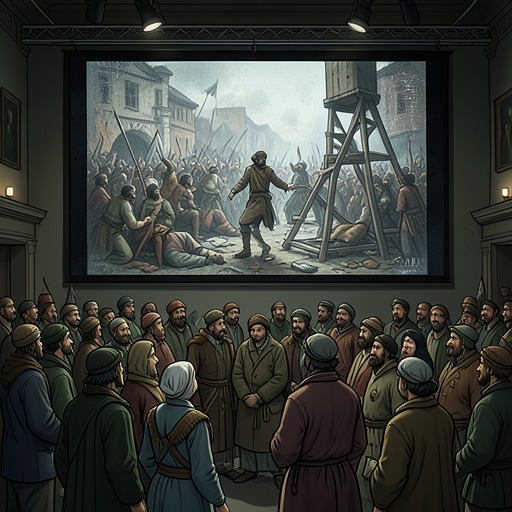
The book first brings Romania into focus through the trial and execution of the Ceaușescus. Romanian television filmed the proceedings, and French television broadcast them on the evening of December 26, 1989. The scene is described as strangely unreal: Nicolae Ceauşescu refuses to recognize the tribunal’s legitimacy, fingers his chapka, and occasionally checks his watch. His wife sometimes loses her temper and argues; he calms her by placing a hand on hers. Viewers interpreted his glances at the watch as evidence that he expected troops to arrive, but no rescue came. After half an hour, the broadcast cuts from the couple to their bloody bodies on a pavement whose precise location cannot be identified.
Emmanuel Carrère saw the footage before leaving for Prague for New Year’s; Eduard Limonov watched it after returning from Moscow with Natasha. Limonov responded by writing about the couple’s tenderness in the face of death, treating their exchanged looks and touch as a scene of tragic, enduring love. Carrère does not share that lyrical judgment of the Ceaușescus’ crimes, but the execution leaves him deeply uncomfortable. The proceedings meant to demonstrate exemplary justice instead resemble a summary execution, and the dignity of the accused unsettles the intended moral staging. Romania’s revolution therefore opens not with an uncomplicated image of justice restored, but with a televised scene in which the perpetrators’ deaths make the new order’s claim to moral authority uneasy.
The Timișoara reports and an uncanny aftermath
In the months after the revolution, Romania’s new account of its recent past is itself shown to be unstable. The revolution was said to have claimed thousands of martyrs in a final massacre by the dying regime. Reports from mass graves at Timișoara intensified the alarm: figures rose from four thousand to 4,630, and then to seventy thousand in a French television report. Images of bodies in striped pajamas, exhumed from hurriedly dug graves and covered in mud, prompted talk of international intervention against a continuing genocide by the Securitate.
The supposed evidence did not withstand scrutiny. The bodies shown to cameras at Timișoara Cemetery numbered only a few dozen at most; they had been buried after natural deaths. Meanwhile, people presented as killers for the Securitate had become officials of the National Salvation Front, led by the new president, Ion Iliescu. Though the Communist Party was banned and accused of every imaginable crime, it had, in effect, survived under a new name and leader. Its sizable victory in the March 1990 election sharpened the contradiction: the book describes Romanians as the only people in history to freely elect Communists. Carrère’s assignment to report from Romania that spring follows from this puzzle, in which revolutionary change and political continuity coexist.
His reporting gives the country the quality of the uncanny: the familiar world seems to have become profoundly alien. Rumors described underground passages dug by the secret police, a network through which people disappeared. In Bucharest, tens of thousands of stray dogs competed for scraps with tens of thousands of children, yet Carrère found the city’s human atmosphere more disturbing: hatred, suspicion, and slander seemed to dominate daily encounters. One writer, celebrated with prizes and official appointments for two decades, described his inward resistance to the former regime but declined to name other resisters. He invoked discretion and mercy, explaining that supposed opposition figures had been among the Securitate’s most zealous informers. Carrère’s interlocutors who prized political subtlety agreed that the writer was right. In this account, even the distinction between dissident and informer cannot be assumed to remain clear.
A Romanian exile who had lived in France for thirty years and recently returned gave Carrère a less analytical measure of the rupture. He saw poverty and dirt in the streets, but was more shaken by the bitterness, suspicion, and fear visible on people’s faces. He felt that the people before him were no longer his people. His response recalls the terror of Invasion of the Body Snatchers: familiar faces remain, while the people behind them seem to have been replaced. Romania’s postrevolutionary strangeness is thus registered both through political rumor and through the intimate shock of a returning exile who cannot recognize his own countrymen.
Bucharest and the miners’ attack
Near the end of Carrère’s stay, Ion Iliescu and Prime Minister Petre Roman called on workers to defend democracy against an alleged neofascist plot. The plot, in Carrère’s account, was as imaginary as the supposed Securitate genocide at Timișoara; the mobilization that followed was not. The National Salvation Front chartered buses and trains to bring twenty thousand miners to Bucharest on June 14, 1990. Galvanized by intense political indoctrination and armed with iron bars, they terrorized the city for two days. They first beat people suspected of belonging to the opposition and then, finding few such targets, attacked people indiscriminately.
Carrère was reporting in the Carpathian Mountains and returned to Bucharest only as the episode was ending. Congratulated by Iliescu, the miners began leaving as journalists arrived and crowded into the Hotel Intercontinental. Carrère stayed there for three days, delaying his departure while waiting for events to resume, following rumors, and watching crowds gather and disperse. The hotel became a vantage point shaped by uncertainty: leaving might mean missing the next development, while staying risked running out of reasons to remain.
An American journalist whose face had been badly beaten shared Carrère’s interest in paranoid science fiction. Their conversations led them to Philip K. Dick’s The Penultimate Truth, in which people hidden underground are told by television that a war still rages above them, though powerful figures may be concealing its end. The novel’s fear of manipulated reality gave them a frame for the miners’ hatred as they arrived to save democracy. The comparison does not turn the attack into fiction; it emphasizes how political language, media accounts, and visible violence seemed to belong to incompatible versions of reality.
Political meaning and narrative role
Romania’s episodes are linked by a recurring reversal between the stated purpose of power and what its actions reveal. A trial intended to legitimate a revolution ends in an execution that troubles the claim of justice; reports of a regime’s massacre prove false even as former regime figures enter the new administration; and a call to defend democracy brings armed miners against people in the capital. The result is not simply a story of liberation betrayed, but an account of how difficult it becomes to establish what has happened, who is responsible, and which political identities can be trusted.
The book later turns to Russia, where it examines shock therapy, privatization, oligarchic wealth, and the political campaign to keep Boris Yeltsin in power. Those developments belong to a different national setting, but the change of country shifts the book’s focus from Romania’s postrevolutionary suspicion and street violence to Russia’s economic and political reordering. Romania’s distinct narrative function remains rooted in the events Carrère witnesses and investigates: it is where the apparent end of dictatorship yields neither a settled truth about the past nor an uncomplicated democratic present.