Bucharest
LimonovBucharest is the setting for the June 1990 miners’ attacks, when a government appeal to defend democracy brought thousands of miners into the capital and unleashed two days of intimidation and violence. The narrator arrives too late to witness the assault at its height, but spends three days at the Hotel Intercontinental amid its unsettled aftermath. In his account, the city’s streets and the hotel’s shifting rumors become a landscape where manufactured political stories and real violence are difficult to separate.
A call to defend democracy
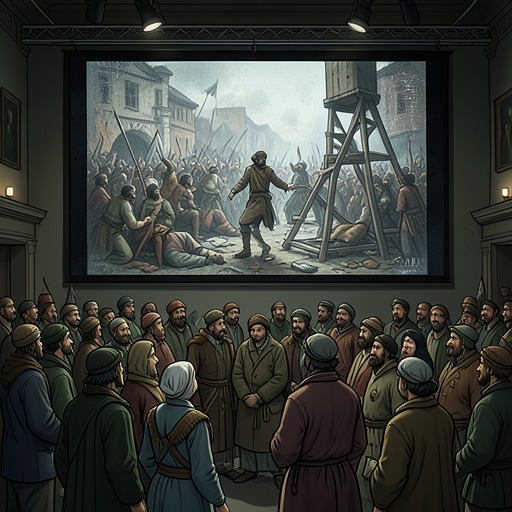
Near the end of the narrator’s stay in Romania, President Ion Iliescu and Prime Minister Petre Roman called on workers to defend democracy against an alleged neofascist plot. The appeal was framed by a climate of falsehood: the supposed genocide at Timișoara, blamed on the Securitate, was itself a fabrication. Yet the mobilization that followed was tangible. The National Salvation Front arranged special buses and trains to bring 20,000 miners to Bucharest on June 14, 1990, with the men galvanized by propaganda and carrying iron bars.
The miners terrorized the city for two days. At first they beat people suspected of belonging to the opposition; when those targets proved too few, they attacked people indiscriminately. The violence thus outgrew the political pretext used to summon them: a supposed defense of democracy became a public demonstration of force, directed at the city itself.
The Hotel Intercontinental and the aftermath
The narrator had been finishing his reporting in the Carpathian Mountains and reached Bucharest only as the spectacle was ending. Iliescu congratulated the departing miners, while journalists converged on the Hotel Intercontinental. The narrator postponed leaving and stayed for three days, watching for crowds that gathered and dissipated, listening to rumors accumulating in the hotel, and weighing the risk of leaving before something happened against the risk of remaining without a good reason to do so.
The hotel becomes a vantage point for an aftermath that offers no clear resolution. The miners have begun to leave, but the narrator encounters reports, expectations, and rumors rather than a settled account of what might happen next. Bucharest appears not simply as the scene of a completed attack but as a city in suspense, where journalists wait for events to resume and cannot tell whether the next sign will matter.
A city seen through paranoid fiction
During those three days, the narrator speaks at length with an American journalist whose face has been badly beaten. Their shared interest in paranoid science fiction leads them to Philip K. Dick, whose fiction about the collapse of reality and the minds that perceive it seems to them an unusually apt guide to Romania. The narrator singles out The Penultimate Truth: in that novel, people confined underground believe a war is still raging because powerful figures control television and conceal that the fighting has ended.
The analogy gives the Bucharest episode its distinctive interpretive frame. The miners have been sent to save democracy through a story about a neofascist threat, while the narrator and the injured journalist see hatred inflamed in the very people acting under that story. Their wish that this hatred might eventually turn against those who stirred it remains an impious hope, not a reported political outcome. The novel’s concealed-war scenario does not explain Bucharest literally; it makes legible the disorientation produced when official claims, rumor, and visible violence collide.