Winslow Hotel
LimonovThe Winslow Hotel is both shelter and measure of Eduard Limonov’s collapse: after Tanya leaves, he wakes there battered and barely conscious, and comes to believe that its cramped, filthy room is not another stop on the way to fame but the end of his road. In time, the hotel also becomes a vantage point on the Russian émigrés who share his displacement. Its rooms, welfare checks, and narrow balcony frame a life that continues without the work, friends, or future he once expected.
Setting and material conditions
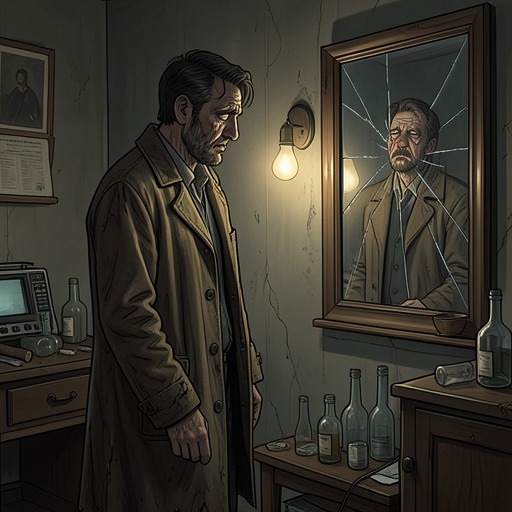
After an alcoholic blackout, Limonov wakes on February 28, 1976, in a room at the Winslow Hotel. Tanya had left six days earlier. For the first few days he does not leave the bed: he is weak and battered, and has nowhere else to go. The room is four paces long and three wide, with worn linoleum, sheets changed every fifteen days, and the competing smells of bleach, urine, and vomit. Its wretchedness is not incidental scenery. As Limonov lies there, he sees the room as the final set of his life, a place where the story of his anticipated rise has stopped.
The hotel also has an exact economic scale. Its cheapest room costs two hundred dollars a month. Limonov receives $278 in monthly welfare, leaving $78 after rent. The narrow margin makes the hotel a practical refuge, but not a route out of poverty: he has no job and does not want to look for one. Lenya Kosogor brings him chicken broth while he recovers. That small act of care takes place within a setting whose most immediate facts are dirt, exhaustion, and the difficulty of imagining a next destination.
An émigré refuge
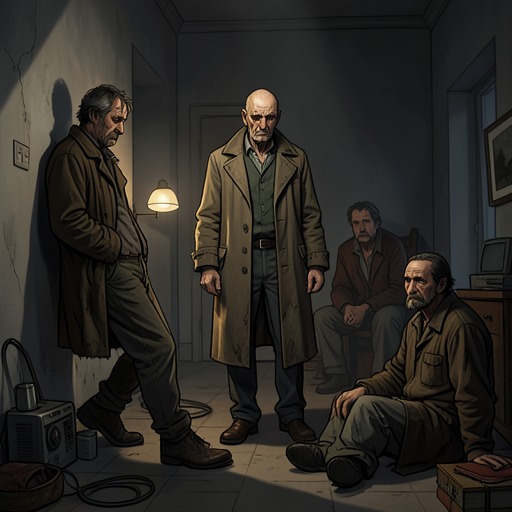
The Winslow houses Russians, mostly Jews, who belong to the third wave of emigration from the Soviet Union in the 1970s. Limonov recognizes people from this group on the street by what the narrative describes as an air of lassitude and misfortune. In Moscow or Leningrad, many had been poets, painters, or musicians associated with the underground; in New York, they work as dishwashers, house painters, or movers. They still tell themselves that their circumstances are temporary and that their talent will eventually be recognized, even as they know this hope is unlikely to come true.
Their shared life is organized around Russian speech and remembered separation. They gather, drink, complain, and talk about their country, imagining a return that will not be permitted. The account presents the hotel not as a community that resolves exile, but as a place where displaced people recognize one another and live with its consequences. The same émigrés who appear as a collective also occupy rooms marked by distinct forms of loneliness and fear.
One resident’s room smells so strongly of dogs, and contains chewed bones and dog excrement, that Limonov assumes the man keeps a dog. He does not: he is simply so lonely that he rereads the few letters his mother has sent. Another resident spends the day typing without publishing anything and fears that his neighbors are watching him. His suspicion is tied to memories of Soviet communal housing, where a small room could be valuable enough to provoke elaborate schemes among people crowded together. Explanation does not dislodge the fear; it is his remaining link to the grimy communal apartment he regrets leaving but cannot admit he misses.
Limonov’s place in the hotel
Lenya Kosogor becomes Limonov’s closest support there. He had found him on a sidewalk, nearly unconscious and half dead from cold, and stays by his side. Lenya had spent ten years in Kolyma and takes pride in being mentioned in Aleksandr Solzhenitsyn’s The Gulag Archipelago. Other émigrés call him the man Solzhenitsyn wrote about. Because Lenya spent longer in the camps than Solzhenitsyn, he imagines that he too could write about the Gulag and become rich and famous, though he never does.
Lenya’s help contains a possible complication: he may take some satisfaction in seeing Limonov, who had avoided him for fear of his bad luck, brought low. The narrative leaves this as a possibility rather than a settled motive. Whatever its mixture, Lenya’s assistance has a concrete result: he takes Limonov to the welfare office, where Limonov is allocated $278 a month. The hotel is thus connected not only to private care but to the public support that makes his continued residence possible.
Limonov spends the remaining money and his days in ways that keep him outside conventional recovery. He drinks cheap California wine, rummages through restaurant garbage, asks compatriots for cash, and sometimes steals purses. He wanders through poor and dangerous neighborhoods, breaks into abandoned buildings where he encounters other vagrants, and sometimes seeks shelter in churches. At the hotel, his refusal to look for work sits beside the routines of welfare and the limited help he gives Lenya with moving jobs. The building is a base for this unsettled existence, not evidence that he has found stability.
The sixteenth-floor balcony
By summer, Limonov tans on the hotel’s tiny balcony on the sixteenth floor, eating cabbage soup from a pot. A pot costs two dollars and lasts three days; the soup can be eaten hot or cold and does not spoil without refrigeration. Across from him stand office buildings with tinted windows. From them, suited businessmen and suburban secretaries might see a muscular, tanned man sitting in little red underpants, or naked, in the sun.
The scene makes the distance between Limonov and the respectable working world visible without moving him from the hotel. He lives on $278 a month, despises the American taxpayers whose support he receives, and goes every two weeks to the welfare office for his check. Every two months he meets a case officer and exaggerates his poor English, saying that he is looking very hard for work when in fact he is not looking at all. The welfare office also pays for English lessons. His classmates are Black, Asian, and Latino women who show him pictures of their children and sometimes bring sweet potatoes and plantains in thermal containers. They exchange accounts of their countries; when Limonov says education and health care are free in his, they ask why he left such a good country.
The balcony condenses the hotel’s larger significance. It offers a small patch of sun and a view across the city, but it does not undo the room’s poverty or Limonov’s estrangement. The Winslow remains refuge, shelter, and an enclosed endpoint in his imagination; its later summer routines show that life continues there even after the future he once expected has failed.