Kazakhstan
LimonovKazakhstan enters the narrative as a country caught between the breakup of the Soviet Union and the National Bolsheviks’ search for a new revolutionary frontier. For Eduard Limonov, it is first a projected site of political destabilization, then part of a two-month journey through Central Asia that changes the people he claims to champion. The country returns as the geographic basis for the criminal case that sends him from the Altai Mountains to prison and trial: an expansive political ambition is recast by the state as a security threat.
A post-Soviet frontier
After the Soviet Union disappeared, Limonov argued that Russians living outside Russia had been abandoned along with the state that had once sent them to administer its far-flung territories. He described them as people who had lost their former position, and who were now victimized, ostracized, or merely tolerated in countries that, in his account, owed their development to Russian sacrifice. His argument placed the Russian communities of the former Soviet republics alongside the Serbs of the former Yugoslavia, as populations he believed had been left without protection.
He made the scale of this claim concrete by naming approximately 900,000 Russians in Latvia, 11 million in Ukraine, and five million in Kazakhstan. The figures served his indictment of both Mikhail Gorbachev, whom he blamed for abandoning the republics, and Boris Yeltsin, whom he accused of refusing to help Russians beyond Russia’s borders. This was not simply a call to restore an old state: Limonov proposed fanning insurgency and fostering separatist republics in territories where he believed Russian communities had been displaced from power.
Kazakhstan was one of two broad targets in this program, along with the Baltic countries. The plan treated the post-Soviet map not as a settled division among sovereign states but as unfinished political terrain. For Limonov, the presence of Russians in Kazakhstan supplied a rationale for intervention; the proposed separatism also extended his party’s ambitions beyond Russia, where he told supporters that the political moment was not yet ripe for taking power.
The tour and a change of allegiance
Limonov announced that he would travel to Central Asia to canvass and assess possibilities, inviting a small group of volunteers. The response was far larger than he had requested: about a hundred hands went up. He framed the enthusiasm as the opening of a historic frontier, imagining the expedition in the heroic terms of Gabriele D’Annunzio’s campaign to retake Fiume. The resulting journey lasted two months and took eight National Bolsheviks, including Limonov, through Kazakhstan, Turkmenistan, Tajikistan, and Uzbekistan.
Photographs reproduced in Anatomy of a Hero show the group posing in front of tanks beside Russian troops stationed in the region. The images record the expedition’s paramilitary self-presentation, but the book does not establish that the party destabilized any of the countries it visited. Limonov had hoped to recruit Bob Denard, a professional organizer of coups whom he had met in Paris, because he thought Denard could help identify opportunities for destabilization. Denard did not join them, and the tour produced no demonstrated political upheaval.
The journey did, however, redirect Limonov’s rhetoric. He had set out with Russian communities as his stated concern, but returned more captivated by Uzbeks, Kazakhs, Tajiks, and Turkmens than by the Russians in Central Asia. He admired what he characterized as the local peoples’ pride, poverty, hospitality, susceptibility to insult, and traditions of violence and vendetta. The book presents these characterizations as Limonov’s sweeping generalizations, not as a neutral account of the region’s populations.
His imagined role consequently changed. Where he had left thinking of himself in the mold of D’Annunzio, he returned invoking Lawrence of Arabia and picturing himself as a liberator of Uzbek and Kazakh mountain dwellers. He also extended his admiration to the Chechens, praising their frugality, guerrilla tactics, and cruelty. The reversal exposes a persistent pattern in his politics: even as his chosen causes and ideological language shift, he repeatedly identifies with people he sees as weak, poor, or defeated. Kazakhstan is thus more than the object of a separatist scheme; it is one of the places through which his self-image as a champion of the underdog is revised.
The Altai expedition and the criminal case
The later journey to the Altai Mountains joined a proposed new field trip to explore destabilization in Kazakhstan with a survival course. The Altai region lies next to Kazakhstan, and Limonov’s group traveled there in the summer of 2000 looking for a remote site that might serve as a training camp. The party’s members and supporters treated the possibility of such camps as a potent legend, but the narrative explicitly says that no camps had yet been established. The site they found was a prospective retreat, not evidence of an existing network of armed bases.
After the raid, the authorities transported Limonov and his companions away from the camp. He rode in a sedan with Colonel Kuznetsov during the eight-hour drive to an Federal Security Service base at Gorno-Altaysk, while six other National Bolsheviks traveled in an army truck. Kuznetsov told Limonov that he had overseen earlier crackdowns on the party, including the arrest of members traveling to Riga. The conversation linked the arrest to a longer record of surveillance and confrontation between the authorities and the National Bolsheviks.
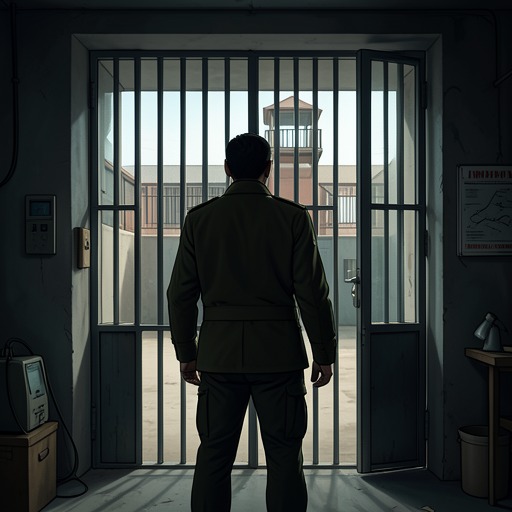
Limonov was held first at Lefortovo Prison and, after fifteen months, transferred by aircraft to Saratov for trial. The narrative explains that Saratov was selected because it was the Russian jurisdiction closest to Kazakhstan, where the alleged crimes were supposed to have taken place. The charges included terrorism, organizing or participating in an illegal armed group, firearms offenses, and incitement to extremist activity. The geographical connection was therefore central to the prosecution’s account, even though the raid in question had taken place in the Altai.
At the first hearing, Limonov faced the conflict between the grand scale of the accusations and the small force described in the book: six companions at a remote log cabin, about sixty miles from the Kazakh border, with only a couple of hunting rifles. He had to present himself as a bungling political adventurer to contest the claim that the group posed a serious threat, despite the attraction he felt toward being accused of high crimes. A television film broadcast as he arrived in Saratov enlarged the alleged camp into a secret base training hundreds of fighters. The book distinguishes that portrayal from the reality it has described, making Kazakhstan both the destination imagined by the National Bolsheviks and the border against which the state’s case measured their supposed reach.
Narrative significance
Kazakhstan’s role shifts from statistic to strategic objective, lived destination, and legal reference point. At first it is invoked to make a political claim about abandoned Russians; during the tour, its people become objects of Limonov’s fascination and his self-appointed liberating mission; after the Altai raid, its proximity helps define where the authorities say the conspiracy was directed. These successive uses reveal how geography acquires meaning through competing political stories rather than through a single, settled account.
The contrast between ambition and circumstance is especially sharp. Limonov’s speeches and the party’s paramilitary imagery cast Central Asia as a possible arena of insurgency, while the expedition’s actual outcome was a journey by eight men that did not destabilize the region. The subsequent criminal case magnified the supposed threat, transforming a remote camp and a handful of rifles into a narrative of organized danger. Kazakhstan remains at the edge of the described action, but that very distance allows it to function as a screen for Limonov’s revolutionary projections and for the state’s allegations about them.