Saltivka
LimonovSaltivka is the outlying Kharkov housing complex where Eduard Limonov’s adolescence took shape after his family was displaced from its former military neighborhood. In the book, it is more than a backdrop: a place experienced as social demotion, whose factory landscape and street life sharpen his rejection of the honest, ordinary future represented by his father. Years later, returning to the family apartment, he finds the same suburb marking the distance between the boy who left and the man who claims to have made it.
Relocation and the built landscape
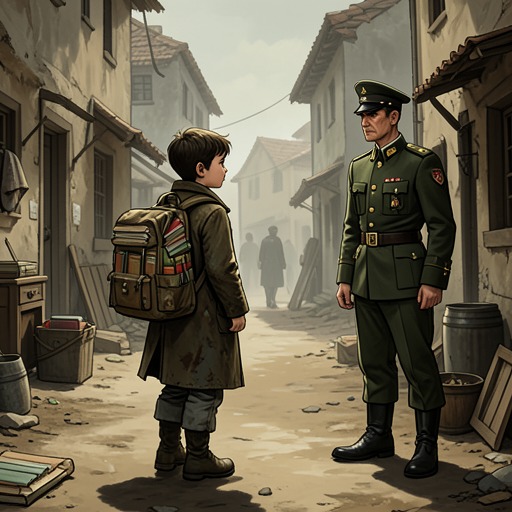
The Savenkos move to Saltivka after the building that housed NKVD officers is demolished and its residents scattered. The complex lies on the very outskirts of Kharkov. Its streets meet at right angles, but remain unpaved for lack of time and money; four-storey concrete blocks, built for workers at the Turbine, Piston, and Hammer and Sickle factories, are already run-down. The physical order of the suburb is stark and repetitive: planned intersections and factory housing without the resources to finish the roads or maintain the buildings.
The move also breaks the family’s connection to Red Army Street, the officers’ community Raya Zybin remembers as a world of shared status and cultivated leisure. There, officers exchanged books and danced with their wives to fox-trot and tango records confiscated in Germany. In Saltivka, the Savenkos have one room in a muddy suburb where Raya sees no one with whom a refined woman can talk and no one who reads or dances the fox-trot. She compares her husband, Venyamin Savenko, with more successful comrades who have been promoted faster and given proper apartments in the city center. The move therefore registers not simply as a change of address but as a fall in rank, comfort, and cultural company.
A working-class world and a changing allegiance
The narrator describes Saltivka’s adult men as mostly alcoholic and illiterate, and many of their children as leaving school at fifteen for factory work or drifting into drinking and street fights. Although Soviet ideology officially rejects class hierarchy, Limonov’s family experiences the suburb as a visible drop in status. The contrast between the classless ideal and the family’s sense of exile gives the neighborhood its particular pressure: its residents may be workers by social position, but the distinction between their world and the officers’ former community remains palpable.
Venyamin’s own place in this world complicates the idea of him as a simple instrument of repression. He has served as a low-ranking NKVD orderly during the war and later works as a junior lieutenant arranging cultural and leisure activities for soldiers, including dance parties on Red Army Day. He plays guitar and sings, likes the good things in life, and polishes his nails; his son later imagines that he might have led a more interesting life had he dared to escape his wife’s dominance. Yet young Eduard increasingly pities him as honest and somewhat foolish. The suburb helps turn that judgment into a choice of identity: Eduard’s new friends are workers’ sons who want to become thugs, not workers, and he finds in their code a dangerous alternative to his father’s respectable but, to him, dull existence.
That attraction becomes decisive after a school fight with Yura, a large boy from Siberia, who beats Eduard badly. His mother responds according to stoical military principles rather than comforting him, and Eduard takes the beating as a lesson about power. He concludes that people divide into those who can be hit and those who cannot, because the latter are prepared to kill. He decides to cross into the second camp. Saltivka is thus the setting for a formative reversal: the boy who had admired his father’s boots, uniform, and pistol begins to imagine manhood through the possibility of violence instead.
Ambition, the city, and a cultural foothold
Eduard’s contempt for the surrounding social order becomes shared ambition when he explains his new outlook to Kostya. The two boys dismiss the laborers, young punks, engineers, officers, and shopkeepers around them, and decide that they must become gangsters. Their first attempt to enter the city’s criminal world exposes how little they know: they take the tram downtown, feel out of place, and cannot decide where to go or whom to approach. Eduard gives Kostya a ritual tour of the landmarks of his earlier childhood, including Red Army Street and Sverdlov Avenue, but the excursion soon runs out of purpose. They return to Saltivka, a place the narrator describes as having little to do with real life, yet the place where they happen to live.
The suburb is not, however, sealed off from Kharkov’s cultural life. At fifteen, Eduard attends a poetry competition at the Pobeda cinema during a city celebration at Dzerzhinsky Square. The square fills with parades, dances, speeches, awards, and workers in their Sunday clothes; Eduard and Kadik respond with the sarcasm of young dandies. Eduard hopes that Sveta will come to hear him read, and carefully chooses love poems rather than his many poems about gangsters, armed robbery, and prison. She does not come: he learns that she is at the Park of Culture with Shurik, an older boy. Humiliated by his youth, virginity, and lack of any real claim on her, Eduard nevertheless reads his poem through tears. His Saltivka friends congratulate him with their ritual greeting, and he wins a certificate and a prize. The episode places his desire for danger alongside an early bid for recognition as a poet.
A later friendship with Kadik also offers an alternative to the neighborhood’s expected path. Kadik is interested in records, reading, guitar, and the city’s artistic circles; through an acquaintance he has been near the Blue Horse group, beatnik-like figures who have received attention in Komsomolskaya Pravda. He hopes to become an artist rather than a factory worker. For Eduard, this kind of cultural aspiration does not erase Saltivka’s limits, but it makes another kind of escape imaginable. His own poems begin circulating among poets and artists after he moves into the city center, where he reads them aloud and copies a collection by hand. The contrast between that new position and his former life in the Saltivka blocks gives his artistic recognition a social as well as literary dimension.
Return and the measure of a life
About fifteen years after leaving, Limonov arrives by train at seven in the morning and takes a taxi to the prefab concrete building where he spent his adolescence. He climbs the bare stairs and hesitates outside the door before announcing himself to his parents. Raya opens the locks one by one. She and Venyamin greet him with an embrace, but her attention quickly turns to his lack of a coat and the cold outside. She finds a good coat his father no longer wears, and the three of them examine it together. The domestic concern is immediate and practical, unlike the success he has come hoping to display.
Limonov explains that he is in Moscow for a prestigious reading tour and that his book has a print run of three hundred thousand copies. He wants his parents to understand that he has succeeded, but the scale of his literary career lies outside their world. They do not ask for a copy of the book; instead, they ask whether he has a wife and whether they can expect grandchildren. He says he has a wife but no children, without explaining further. His return does not restore the intimacy of the old household or reconcile their different measures of achievement. The apartment remains a place his parents regard as comfortable and quiet, while he makes clear that he will stay only a couple of days.
Near the end of the book, lying in a log cabin in the Altai and thinking back to his childhood in Saltivka, Limonov sees the distance he has travelled as a long journey full of obstacles. He believes that he wanted to live like a hero, did so, and did not shrink from the price. That retrospective claim gives Saltivka a final importance: it is the point of departure in his self-account, the concrete working-class suburb from which he measures a life built in opposition to the respectable existence his parents once represented.