Saratov
LimonovSaratov is the setting for the central trial and prison phase of Eduard Limonov’s 2001–2003 ordeal: transferred there from Lefortovo to face charges linked to an alleged plot against Kazakhstan, he enters an overcrowded jail where he must negotiate both a looming sentence and the unwritten rules of communal life. The city matters less as a portrait of urban space than as the place where political prosecution, prison society, and Limonov’s response to state violence converge.
Transfer and trial
After fifteen months in the strict isolation of Lefortovo, Limonov was flown under police escort to Saratov, on the Volga, for trial. The stated jurisdictional reason was its proximity to Kazakhstan, where the prosecution alleged that he and his companions had committed their crimes. Saratov thus became the site where a remote camp in the Altai was recast as a threat to national security.
On arrival, Limonov learned the formal charges and had to repeat their numbers and names: Article 205 for terrorism, Article 208 for organizing or participating in an illegal armed group, Article 222 paragraph 3 for firearms offenses, and Article 280 for incitement to extremist activity. The formula was so firmly drilled into him that the account says it could still spring to his lips when he was awakened with a start. In court, the severity of the accusations produced a divided calculation: he took a certain pride in being charged with such consequential crimes, yet had a vital need to clear himself.
The prosecution’s account, attributed to the Federal Security Service, portrayed Limonov and six companions as a serious danger to the country. His own description of the group’s circumstances was far less grand: several men in a log cabin in the Altai, about sixty miles from the Kazakh border, with only a couple of hunting rifles. He faced the problem of arguing that this group could not destabilize Kazakhstan without appearing to confirm the government’s inflated image of its importance. A television film shown as he arrived in Saratov magnified that image, presenting the National Bolshevik Party as an extension of Al-Qaeda and the camp as a training ground for hundreds of fanatics. Fellow prisoners called him bin Laden—a label that gratified him even as it underscored the danger of the public story being built around his case.
A prison of crowding and accommodation
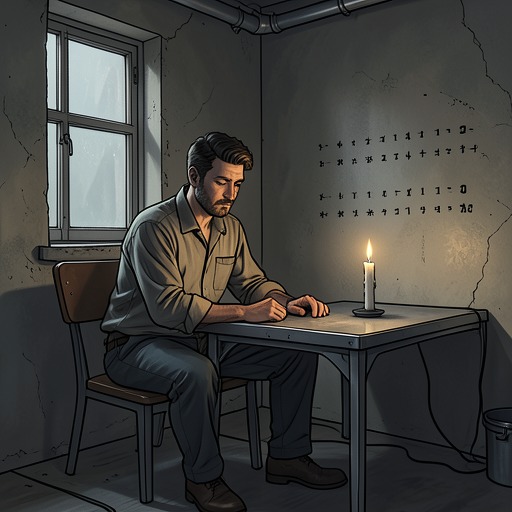
Saratov’s prison was the opposite of Lefortovo. Where Lefortovo imposed isolation in clean, private cells, Saratov imposed crowding: cells intended for four often held seven or eight. When Limonov entered his cell, every bed was occupied. He did not protest; he laid his mattress on the floor, accepting that the newest arrival should bear the greatest discomfort. The gesture unsettled expectations that a celebrated intellectual and political prisoner would behave as a difficult guest, and helped establish him instead as a straightforward, experienced inmate.
His conduct in the cell was practical and restrained. He avoided needless talk and gestures, did not evade chores, and shared what arrived in his packages. Rather than interrupting someone cooking or repairing something with an offer of help, he worked out what needed doing and did it. He declined cards and chess because he considered them a waste of time, but this did not amount to withdrawal from other people: he readily helped a cellmate write to his girlfriend or complete a crossword. Within a week, the other prisoners had formed a favorable judgment of him. His quiet manner carried authority without depending on his literary reputation, and he observed the prison’s informal rules without surrendering his own habits.
Friendship and meditation
One of the prisoners Limonov came to know best was Pasha Rybkin, a thirty-year-old who had already spent ten years in prison. Rybkin was described as peaceful and cheerful despite his long criminal history. Even in winter, when the cell temperature fell below freezing, he wore shorts and flip-flops; he ate no meat, drank hot water rather than tea, and practiced yoga. He recognized Limonov as a wise man and taught him to meditate.
The practice gave Limonov a way to structure attention inside confinement: sitting upright with his eyes closed, he concentrated on breathing and watched his thoughts rather than trying to force them away. The narrative connects this practice to the equanimity he displayed in prison. It also tentatively links his readiness for it to an earlier encounter with the Altai trapper Zolotarev and to an uncanny experience after learning of Zolotarev’s death. Saratov is therefore not only a setting of prosecution and crowding; it is where a friendship supplies Limonov with a discipline that changes how he inhabits enforced waiting.
Witness to the Dubrovka crisis
On the evening of October 23, 2002, Limonov’s cellmates were watching a crime film when news interrupted the program: Chechen terrorists had taken the actors and audience in a Moscow theater hostage. The other prisoners wanted to return to their film, but Limonov insisted on following the news. Over the next fifty-seven hours he watched the reports, including the gas attack launched at dawn on October 26 against the roughly eight hundred people in the theater, hostages and terrorists alike.
The crisis bore directly on his own predicament: terrorism was the charge hanging over him, and the atmosphere of public fear threatened to worsen his chances at trial. But it also sharpened a moral contrast he would return to thereafter. The ordinary crimes of his cellmates, often committed in passion or drunkenness, could bring them years of punishment; state crimes, by contrast, could be followed by decorations for their perpetrators. Following events from Saratov, Limonov feared a bloodbath and, when it came, suspected that officials were lying about the number of victims and the effort made to save them. His conclusions, formed from television reports in his cell, were strikingly close to those of journalist Anna Politkovskaya, who was following events at much closer hand. He also recalled rumors that the 1999 attacks had been carried out not by Chechens but by the Federal Security Service with the president’s approval, and described Vladimir Putin as a fascist—a notable change in the political language attributed to him.
Narrative significance
The account makes Saratov a counterpoint to the secrecy of Lefortovo: here Limonov learns the charges, encounters the crowded social world of prison, and watches a national crisis unfold through television. Its importance lies in these collisions. A prosecution that casts a handful of men with hunting rifles as a major security threat shares the same narrative space as a hostage crisis in which the state’s own violence becomes, for Limonov, the more disturbing object of scrutiny. The prison is at once a place where his freedom is constrained and a vantage point from which he judges the authorities seeking to define him.