Chechnya
LimonovChechnya enters the account as a territory whose independence, criminal economy, and strategic position became entangled with Russian domestic politics. The war launched against it was not simply a response to events on the ground: as the narrative presents it, Russian leaders also saw military intervention as a way to influence an election and conceal corruption. The result was a devastating assault on Grozny and a conflict that shattered the promise of a quick victory for tens of thousands of young conscripts.
Independence and the case for intervention
Chechnya had been independent since 1991 and was governed by a former Soviet apparatchik who had hastily converted to Islam. Before turning to the siege of Grozny, the book introduces an explanation offered by Paul Klebnikov, the narrator’s cousin, for why Russian hawks wanted a major conflict. Klebnikov did not, the narrator stresses, subscribe to conspiracy theories. His account nevertheless treats the war as more than a response to Chechnya’s internal conditions. Klebnikov described Chechnya as a permissive zone for organized crime, drug trafficking, and counterfeiting. But this did not, in his view, mean that Moscow urgently needed to intervene: Russia itself continued to benefit from the arrangement, and its share of the illicit profits was shrinking without disappearing. The more pressing danger for the military leadership was the possibility that its own dealings would be exposed. According to Klebnikov’s theory, senior officers had sold large quantities of weapons and ammunition on the black market, including tanks. A major war could make those stocks appear to have been destroyed in combat. The account does not present this as a proven explanation for the intervention; it identifies it as one proposed motive, while leaving open how decisive it was. That uncertainty matters: the war’s rationale is shown as a convergence of public political calculation and private institutional interest, not as a single settled cause.
The 1996 election and the turn to war
The conflict also took shape against the approaching 1996 presidential election. The effects of economic shock therapy and the first privatizations had plunged Russia into chaos, while Boris Yeltsin, once the focus of democratic hopes, appeared to have lost control. His declining popularity gave the hawks on the general staff an opportunity. With his security chief close at hand, they persuaded him that a limited, successful war against Chechnya could weaken nationalist opposition and revive support for his presidency. The proposed quick victory did not materialize. Instead, a political wager became a prolonged and costly conflict. This electoral context complicates the image of intervention as a response demanded solely by Chechnya’s criminal economy or by a straightforward question of Russian security. In the narrative, the approaching vote helps explain why Yeltsin’s advisers would regard military action as useful, even as the evidence of what followed made the promise of an easy campaign untenable.
Grozny under siege
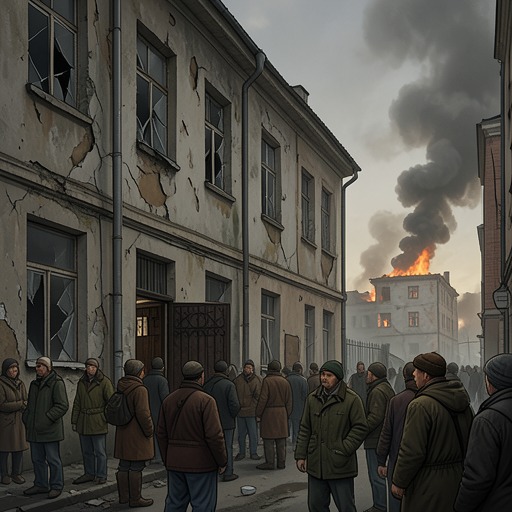
The book conveys the scale of the assault on Grozny through an abrupt comparison with the Siege of Sarajevo. At the height of that siege, there were 3,500 detonations a day; when the siege of Grozny began in December 1994, there were 4,000 an hour. The change in scale turns a statistical comparison into an image of bombardment accelerating beyond the measure of ordinary daily life. Grozny was laid waste as completely as Vukovar had been. The Russian army’s heavy bombardment met a determined Chechen guerrilla response. Chechen fighters attacked Russian soldiers in their tanks and carried out bloody terrorist actions on Russian territory. The account places these responses within a war defined by brutality on both sides, without suggesting that the city’s destruction or the campaign’s political aims can be reduced to a contest of tactics. Grozny’s devastation is the starkest consequence in the evidence: the promised rapid operation had become a conflict on the scale of other recent urban wars.
Conscripts and the political aftermath
Forty thousand young conscripts were sent into the conflict, among them Zakhar Prilepin. They had been promised a swift victory and a triumphant return; instead, they became trapped in a war the narrator compares to the Soviet experience in Afghanistan. The comparison is sharpened by chronology: Soviet troops withdrew from Afghanistan in 1988, leaving only six years of peace before the beginning of another dirty war. Young Russians who returned from these conflicts came back crippled, humiliated, and suffering from hallucinations; some did not return at all. The war also helped shape the political atmosphere in which Yeltsin sought reelection. By the time the narrative returns to the campaign, he is described as hated even more than his predecessor, and his apparent loss of popularity is so severe that he considers canceling the election. The account does not claim that Chechnya alone produced that collapse. It does show how the intervention intended to shore up his position instead became part of a wider record of disorder, violence, and failed promises. Chechnya thus remains more than a setting for military action: it exposes the human cost of treating war as an instrument of election strategy, while the account of the generals’ arms sales points to the corruption that may have made the conflict useful to the very institutions conducting it.