Kharkov
LimonovKharkov, called Kharkiv in present-day Ukraine, is a rail and industrial center whose destruction and postwar reconstruction shape Eduard’s childhood and later returns. The city is not a stable backdrop: its ruins make danger part of children’s everyday life, the move to the outskirts marks a painful change in the Savenko family’s standing, and downtown becomes the setting for Eduard’s first encounters with literary life beyond the factory suburb.
War ruins and postwar settlement
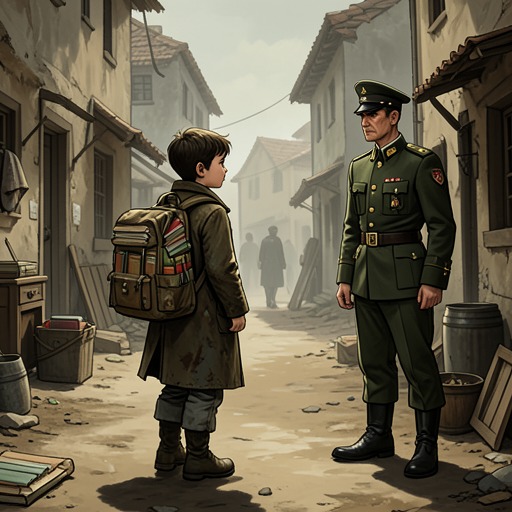
After the war, the young Savenko family moves with Venyamin’s military postings, living in barracks and army camps along the Volga before settling in Kharkov in February 1947. The city they enter has been repeatedly taken and retaken by German and Russian forces. The fighting and massacres leave the main railway station in ruins: from the concrete constructivist building on Red Army Street, where NKVD officers and their families live, the family can see a field of broken stone, brick, and metal enclosed by fences. The rubble is not simply a remnant of battle. Mines and grenades remain among the debris, and one boy has already lost a hand there.
The children Eduard joins nevertheless treat the ruins as a territory for adventure. They search for cartridges, empty out the powder, and set it on tramway tracks to make crackling bursts; once, their exploits cause a derailment that becomes legendary. At night, older boys turn the landscape into a source of frightening stories about dead German soldiers haunting the rubble and cannibalism. The contrast between real hazards and the children’s games gives the ruined station a double character: it is both a dangerous remnant of war and a playground in a city where ordinary childhood has been badly damaged.
Kharkov’s postwar poverty extends beyond the wrecked station. Food is scarce, with bread, potatoes, and buckwheat porridge forming the ordinary diet; sausage is rare enough that Eduard dreams of becoming a butcher. Pets are absent because they would be eaten, while rats are plentiful. The narrative places the city within a wider national catastrophe: millions have died in the war, many more people are homeless, and streets are crowded with survivors missing limbs and children left without parents or driven to fend for themselves. In this setting, the city’s ruins are not an isolated spectacle but part of a society struggling to live amid the war’s continuing consequences.
From Red Army Street to Saltivka
The Savenkos’ first home belongs to a community of military officers and their families. When the building is demolished, its residents scatter and the family moves to Saltivka, at the far edge of Kharkov. The new district consists of straight, intersecting streets that have not been paved and four-storey concrete blocks built for workers at the Turbine, Piston, and Hammer and Sickle factories. The housing is already run-down. Although Soviet ideology assigns no formal disgrace to working-class origins, the narrative emphasizes how sharply this move feels like a fall in status to the family.
Raya misses the world of Red Army Street: officers who share a sense of caste, books passed among them, and evenings when uniformed husbands dance with their wives to fox-trot and tango records confiscated in Germany. In Saltivka she finds neither those books and dances nor people with whom she feels she can speak as an educated woman. Rain turns the unpaved streets to blackish mud. She reproaches Venyamin for advancing slowly while more clever comrades rise faster, receive apartments in the city center, and escape the cramped single room in which the three Savenkos now live.
The move also changes Eduard’s image of his father. As a boy he had admired Venyamin’s boots, uniform, and pistol; after the family’s decline in status, he begins to pity him as honest but somewhat foolish. The neighborhood’s working-class streets bring Eduard into contact with boys whose ambitions are not to follow their parents into factory work but to become thugs. He finds their dangerous code attractive. The suburb thus marks more than a change of address: it separates him from the military identity he once hoped to inherit and redirects his imagination toward a life outside respectable work.
Downtown and the literary underground
Eduard and his friend Kostya eventually take the tram from Saltivka into the center, convinced that the city must contain the gangsters they want to join. Their confidence falters when they arrive: downtown makes them feel like country boys out of place in a more sophisticated district. Eduard leads Kostya past landmarks from the period when he lived there, including Red Army Street and Sverdlov Avenue, but the tour gives them no route into a gang. Unsure where to go or even how to order a beer, they return to their apartment complex. The city center is at once familiar through memory and inaccessible as a place in which to make a new life.
A different route into downtown opens through work. After a psychiatrist tells Eduard not to return to the factory, he is sent to a bookstore seeking an itinerant salesperson. The poorly paid job requires him to display used books on a folding table, sometimes in a movie-theater lobby or at the zoo entrance. Its importance lies less in the sales than in the bookshop at 41, where Eduard collects and returns his boxes each day. The shop is a meeting place for Kharkov’s artists and poets, known as the decadents, and becomes a threshold between his factory-suburb existence and a clandestine literary circle.
Eduard begins lingering after closing time, even though missing the last streetcar can mean walking two hours through the night and snow to reach Saltivka. Once the metal shutters come down, the group drinks, talks, and exchanges samizdat: banned texts copied and recopied so they can circulate outside official channels. A faint fifth- or sixth-generation carbon copy of Joseph Brodsky’s poem Procession arrives from Leningrad. Years later, Eduard judges the poem’s artistic merit skeptically but remembers how precisely it fitted the cultural development of Kharkov and the bookshop’s regulars. In this episode, Kharkov is not only the site of postwar scarcity and social exclusion; it is also a provincial center where literary life survives through personal meetings and fragile copies.
Return to the family home
Kharkov remains a place to which Eduard can return in person, rather than only through the childhood landmarks he once showed Kostya. After deciding to abandon his tour and take the first train for Kharkov, he travels third class and arrives at 7:00 in the morning. A taxi leaves him in Saltivka, in front of the prefabricated concrete building where he spent his adolescence. With a duffel bag over his shoulder, he climbs the bare concrete stairs and hesitates at his parents’ door, wondering whether they will be shocked and whether someone should prepare them for his arrival. He rings and identifies himself as their son; his mother answers cautiously, asking who is there, and he repeats that it is her Edichka.
The arrival gathers the location’s successive meanings into one scene. Saltivka had embodied the family’s displacement from the officer community and Eduard’s departure from his father’s model of life; now its familiar building is the destination of a deliberate return. The hesitation at the threshold makes home neither an uncomplicated refuge nor merely a remembered place. Kharkov’s importance lies in this layering: ruined wartime city, stigmatized suburb, provincial literary meeting ground, and the address to which Eduard comes back to face his parents.