Balkans
LimonovThe Balkans are a turning point in the book’s geography and moral portrait of Eduard Limonov. His journeys there, and his involvement on the Serbian side during the wars, transform the image of the provocative friend admired in Paris into that of a man taking part in a conflict the narrator finds indefensible.
A region mapped through wartime chapters
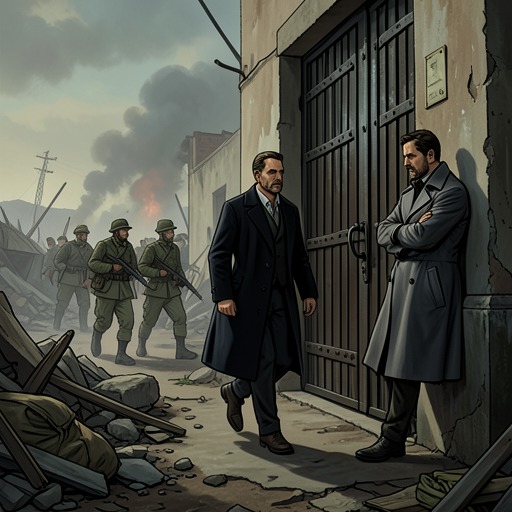
The Balkans enter the book not as a single, sustained description of place but as a cluster of named settings and journeys. One chapter heading joins Vukovar and Sarajevo in 1991–1992; another places Moscow and Paris alongside the Serbian Krajina in 1990–1993. These headings frame the Balkan material as part of a wider movement between Russia, France, and the places where Yugoslavia’s wars were being fought.
That structure matters: the region is encountered through Limonov’s departures and returns, through the cities named at chapter thresholds, and through the political choices that make those journeys consequential. The book supplies no comprehensive portrait of Balkan geography or everyday life. Instead, it makes the region a recurring point of contact between a personal biography and a conflict that changes how others understand its subject.
Limonov’s wartime involvement
Before the collapse of communism, the narrator remembers Limonov as an adventurous, provocative figure whose unconventional behavior fascinated the bourgeois youths around him. After that collapse, Limonov began disappearing to the Balkans for long periods. The narrator and his circle eventually learned, to their horror, that he was fighting on the Serbian side. What had looked like a colorful life at the margins of respectable society now had a direct political and military consequence.
The book gives a particularly concrete image of that involvement through a BBC documentary: Limonov is shown bombarding besieged Sarajevo under the eye of Radovan Karadžić, identified by the narrator as the Bosnian Serb leader and a known war criminal. The scene makes Sarajevo more than a name in a chapter heading. It is the place through which the narrator’s changing judgment becomes visible: Limonov is no longer merely an entertaining barbarian but a participant in violence against a besieged city.
From friendship to estrangement
The narrator measures the Balkan episode against the earlier intimacy of Parisian social life. Limonov’s return from his exploits in the Balkans, followed by his creation of the National Bolshevik Party in Russia, sharpens the contrast between the friend they had adored and the political figure they now saw. The narrator likens the shock to discovering that an old school friend had entered organized crime or carried out a terrorist attack; the comparison conveys the distance that has opened, rather than supplying a literal account of Limonov’s actions.
The region thus marks a rupture in the narrator’s relationship with Limonov as well as a change in the book’s tone. The remembered jacket, club life, arguments, and charm give way to the image of a man at war. The Balkan chapters and references do not resolve the chain of motives that brought him there; they make that transformation the question the narrator must confront.
Narrative significance
The Balkans function as a threshold between the life Limonov’s Parisian acquaintances could treat as theatrical and a political existence whose consequences could not be dismissed as provocation. The contrast is central to the retrospective structure: the narrator returns to memories of friendship precisely because the later scenes have made those memories difficult to accept at face value.
By connecting Limonov’s long absences, his fighting on the Serbian side, and the documentary image of Sarajevo under bombardment, the book turns geography into evidence of change. The Balkans are not simply a distant backdrop to his Russian political career. They are where the gap between the admired friend and the man whose actions the narrator condemns becomes impossible to ignore.