Grozny
LimonovGrozny is presented as the site where a promised lightning strike in Chechnya became a ruinous war. At the siege’s outset in December 1994, the Russian bombardment reached 4,000 detonations per hour; the city was laid waste on a scale compared to Vukovar. The contrast between the speed promised to the soldiers and the destruction they encountered defines Grozny’s place in the narrative.
The siege and the scale of destruction
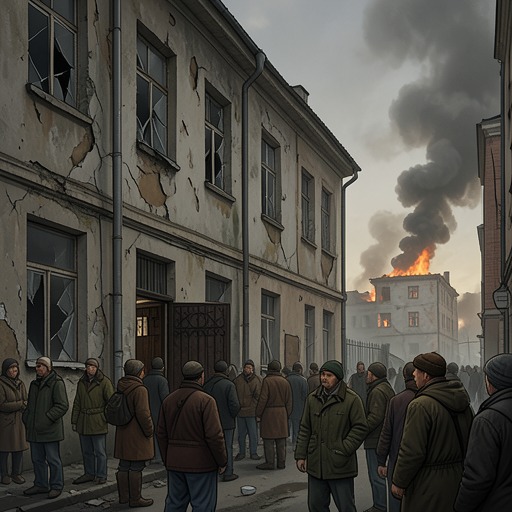
The account measures Grozny’s bombardment against the siege of Sarajevo: at the height of that siege there had been 3,500 detonations a day, whereas at the beginning of the siege of Grozny the figure was 4,000 an hour. The change of unit makes the comparison stark. Grozny is not described through a sequence of individual buildings or streets, but through the pace of the explosions and the completeness of the city’s devastation.
Resistance and the prolonged war
The Chechens answered the Russian assault with what the account calls a merciless guerrilla war. Russian soldiers were burned in their tanks, and bloody terrorist actions were staged on Russian territory. The city therefore stands not only for bombardment but for a conflict in which overwhelming force did not produce the promised swift victory. Forty thousand young conscripts, including Zakhar Prilepin, had been told to expect a lightning strike and a triumphant return; instead, they became bogged down in a war compared to Afghanistan’s, which had marked their fathers and older brothers.
Political setting and human cost
The narrative places the assault within a political calculation: Russian hawks persuaded Boris Yeltsin that a successful war could weaken nationalists and revive his declining popularity. It also presents, with explicit uncertainty, Paul Klebnikov’s theory that the generals needed a major conflict to conceal the scale of military corruption, including the sale of weapons and tanks on the black market. These explanations frame Grozny as more than a battlefield: the city’s destruction is entangled with the ambitions and interests of those directing the war.
The cost extends beyond the city. The account describes the two dirty wars in Afghanistan and Chechnya as conflicts from which young Russians returned, if they returned at all, crippled, humiliated, and suffering hallucinations. Grozny’s devastation thus marks both the intensity of the campaign and the collapse of its promise of an easy, triumphant return.