Manhattan
LimonovFor Eduard Limonov and Tanya, Manhattan is at first a city made startlingly real: familiar from American films they had never been allowed to see in the Soviet Union, yet newly immediate in its steam-filled streets, fire escapes, neon, sirens, and crowds. The city’s promise is not simply spectacle. Its open bookstores, reliable maps, and permissive public life expose how different ordinary access to information and movement can be from the world they have left. Later, as their marriage and fortunes unravel, Manhattan supplies neither a secure refuge nor a stable home; it becomes the landscape in which Limonov’s fall and his work as a writer take shape.
Arrival and First Impressions
In their first days, the couple walk across Manhattan hand in hand, laughing and kissing as they greedily take in the city. A bookstore astonishes them because its books are within reach: customers can pick them up, leaf through them, and read without first buying them. The map they purchase seems just as extraordinary. Its streets correspond to the places it names, unlike Soviet maps, which may be outdated, speculative, or designed to mislead visitors. The contrast turns commonplace urban objects into evidence of two different systems: in Manhattan, a map can guide a stranger; in the Soviet Union, even finding one may be difficult.
Their explorations carry the same mixture of freedom and performance. They visit expensive boutiques, diners, fast-food restaurants, and small cinemas showing double features, including pornographic films. At one screening, Tanya becomes aroused beside Limonov and tells him; he brings her to orgasm, and the couple notice that other men in the audience seem more affected by her moans than by the film. Limonov takes pride in being with a beautiful wife and in approaching the experience as a libertine’s adventure rather than as a response to sexual deprivation. In this early Manhattan, intimacy becomes part of their public passage through a city whose permissions and audiences differ sharply from those of the life they knew before.
Contacts, Ambition, and the Social Summit
In Manhattan, the couple’s first points of connection are Tatiana Liberman, a friend and former rival of Lilya Brik, and Joseph Brodsky, whose address is routinely passed to new arrivals from the Russian underground. Three years after his expulsion, Brodsky has become a celebrated figure among Western intellectuals, from Octavio Paz to Susan Sontag. He has helped some of his largely Communist-sympathizing friends recognize the reality of Soviet rule, while his gift for poetic conversation and for befriending literary celebrities has made meeting him almost a genre in itself. The Russian émigrés call him nachal’nik, or boss; the name places him within a New York literary hierarchy that Limonov encounters as both a newcomer and a rival in the making.
Brodsky no longer remembers precisely who Limonov is when he telephones, but agrees to meet him and Tanya in an East Village tearoom. The dim, cozy room, arranged to suggest Mitteleuropa, invites the literary debates Brodsky enjoys, though its familiar intellectual rituals and lack of alcohol immediately put Limonov off. Tanya’s ease with Brodsky helps the meeting relax; Limonov watches the poet from the sidelines. The encounter makes Manhattan a place where access to a celebrated émigré can be obtained through a chain of introductions, but where proximity is not the same as belonging.
At a party in the Libermans’ penthouse on the Upper East Side, that distinction becomes more spectacular. The guests combine wealth, power, beauty, fame, and talent, and the setting seems to Tanya like a world in which she might make a place for herself. Limonov, by contrast, imagines destroying it—though he first savors having reached it from Saltov. His pride rests on a double vision unavailable to the guests: he knows both the polished interior before him and the life in Saltov that they have never seen. Manhattan briefly seems to reward the distance he has traveled, while confirming that his strongest claim to distinction is his knowledge of two incompatible worlds.
That sense of mastery falters when Limonov sees Rudolf Nureyev at the center of the gathering. He had imagined himself as an exotic conqueror whose presence would expose the blandness of the refined company; Nureyev, whose origins lie even farther from this social summit, embodies the same ascent with greater force and radiance. Tanya appears drawn to approaching him, while Limonov leaves the room in a disgruntled fit and retreats to the bathroom. The party thus reverses the triumph he had been staging in his mind: Manhattan offers him a view into a world he can claim to understand, but it also places before him another outsider whose arrival makes his own performance seem less singular.
The Park, the Hotels, and the Making of a Book
The Manhattan of Limonov’s decline is measured each morning against the lawns of Central Park and the terraces of Fifth Avenue. He lies on the grass for hours, using a plastic bag containing his notebook as a cushion, and looks from the sky to the buildings where the Libermans live. Their world, once newly accessible to him as a promising writer and the husband of a prospective model, now seems to belong to another life. The view preserves the vertical distance between the park and the superrich apartments, but the sharper fall is personal: he has gone from being welcomed into that interior to occupying the park as a man with nowhere secure to go.
From the grass, he studies other people as possible futures. The homeless appear trapped; office workers and secretaries may advance but seem unlikely to travel far; two young intellectuals writing what he takes to be a screenplay might reach Hollywood. A Puerto Rican family camping on the lawn seems destined to remain where it is, yet he imagines that the baby among the blankets and thermoses might one day win a Nobel Prize or become secretary-general of the United Nations. These projections expose both the energy and the limits of his gaze: he turns strangers into stories of ascent or confinement while trying to decide whether his own life in the park is a romantic episode or its final chapter.
The answer begins to take material form in the notebooks. Smoking a joint bought from a small-time dealer he knows, Limonov writes on the grass about the welfare office, the Winslow Hotel, the lost Russian émigrés, Tanya, and the sequence that has brought him there. He does not pause to polish the prose; he fills one notebook, then another, then a third. The book becomes, in his understanding, his only chance. Manhattan is therefore not merely the setting of his destitution: the park gives him a place from which to survey the lives around him, and the notebook turns that exposed, uncertain present into material he can shape.
The Winslow Hotel, meanwhile, has become the headquarters of the Russian émigrés from whom he wants distance. Tired of communities and of the émigré circle in particular, he takes his suitcase across to the still shabbier Embassy Hotel, whose residents include Black people, drug addicts, and sex workers. He is its only white resident, but does not feel out of place. With the few dollars he earns helping to move people, including a rabbi, he buys conspicuous secondhand clothes: pink-and-white suits, shirts with lace collars, mauve crushed-velvet jackets, and two-tone ankle boots. The outfits win him the respect of his new neighbors and mark a deliberate change of social setting—from the Russian literary world that had once offered him access to a penthouse party to a hotel whose inhabitants stand at a very different edge of the city.
The change does not free him from the stories others tell about him. Among the émigrés, rumors that he is a queer, a Chekist, or dead give way to a new tale that he lives with two Black sex workers and acts as their pimp. Limonov lets the rumors circulate and enjoys the disturbance they cause. In Manhattan, where he has passed from literary guest to park-bound writer and then to the Embassy Hotel, his public identity is partly something imposed by others and partly a role he knowingly allows them to enlarge. The city’s successive settings register that instability: the park makes him visible in his fall, the hotel offers a place among people outside his former circle, and the notebooks preserve the fall as the beginning of a book.
Loneliness, Performance, and the City’s Margins
The city’s pleasures return to Limonov as memories whose charge has reversed. At night he sometimes spends money on a pornographic film, not chiefly to become aroused but to cry over the earlier visits when Tanya sat beside him and he could take pride in making her come. The remembered theater audience once served as an imagined audience for his libertine prowess; now the same kind of place sharpens his sense that he has become the loser. Elsewhere, he drives a knife into the back of a church pew and twangs it while worshippers watch warily from the corners of their eyes, unwilling to approach. Manhattan’s public spaces allow him to remain in view, but visibility does not amount to fellowship.
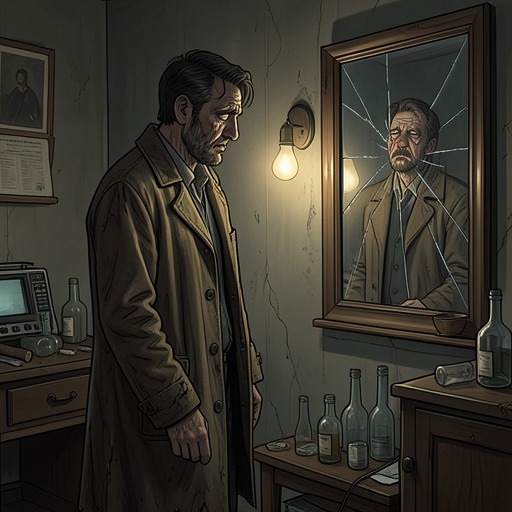
Tanya’s absence has become its own private theater. Limonov does not know where she is and has stopped trying to find out; after the drinking binge that followed her departure, he avoids the loft where she might be living. Back at the hotel, he masturbates not by imagining sex with her but by imagining her with other partners, including the man and woman she had described to make him jealous. He stages the scene on his own body, using a candle and repeating the words he imagines she might say, then lies amid the mess and drinks cheap red wine. The episode turns abandonment into a deliberately painful performance: he tries to inhabit the humiliation he attributes to Tanya’s infidelity, rather than simply recover the intimacy he has lost.
His fantasies also unsettle the masculine code he had carried from Saltov. At thirty-three, he still looks like a teenager and knows that men have been attracted to him, though he had previously rejected their advances. After Tanya’s betrayal, he imagines that being pursued and cared for might be preferable to pursuing and protecting; he wants, in his own formulation, to become Tanya in order to replace her. The wish remains conflicted: he longs for protection while doubting that he could respect the person who gave it. In this private reversal, Manhattan’s loneliness presses beyond sexual jealousy into a question of identity and dependence.
The fear behind these episodes is not only that he has lost Tanya or his former place among émigrés, but that nobody will remember him. He imagines himself as a Russian boy stranded in Manhattan, alongside Lenya Kosogor, Edik Brutt, Alyosha Shneerson, and others who may die as obscurely as they have lived. His bodily self-image offers a counterweight: he sees a young, vigorous body that many women or men might want to touch, even as he feels that nobody needs it. The gap between desirability and being cared for, between a body that attracts and a life that seems to have no witness, gives the city’s spectacle a harsher underside. Manhattan had first made the world vivid to him; in these later scenes, it provides no guarantee that a vivid life will leave a trace.