Arlington National Cemetery
1919Arlington National Cemetery appears in the book as the destination of an unidentified American serviceman’s remains and the stage for their national commemoration. The burial’s solemn spectacle gives the unknown dead man a place in the country’s public memory, while the narrative’s attention to the unmarked, indistinguishable body unsettles the ceremony’s promise of honor.
The Cemetery and the Burial
A congressional resolution authorized the Secretary of War to bring home the body of an American member of the American Expeditionary Forces who had died in Europe during the war and whose identity had not been established. The designated place of burial was the Memorial Amphitheater at Arlington National Cemetery, in Virginia. The cemetery is thus presented not through a general account of its grounds but through a specific national act: the interment of a serviceman who could not be named.
The selected coffin comes from a tarpaper morgue at Châlons-sur-Marne, where pine boxes hold the remains of the dead. The narrative places the chosen box among many others, including remains that might equally stand for Richard Roe—the conventional name for an unidentified person. That setting makes the selection both ceremonially decisive and materially arbitrary: one body is brought to Arlington, but the surrounding boxes insist on the number of dead who remain outside the ritual’s focus.
The Ceremony at the Memorial Amphitheater
The burial is rendered as a public observance rather than a private farewell. Its emotional register is solemn: silence, tears, songs, prayer, muffled drums, and soft music replace applause. The president’s address describes the tribute as impersonal, a description that accords with the dead man’s unknown identity even as it formalizes the nation’s claim upon his memory.
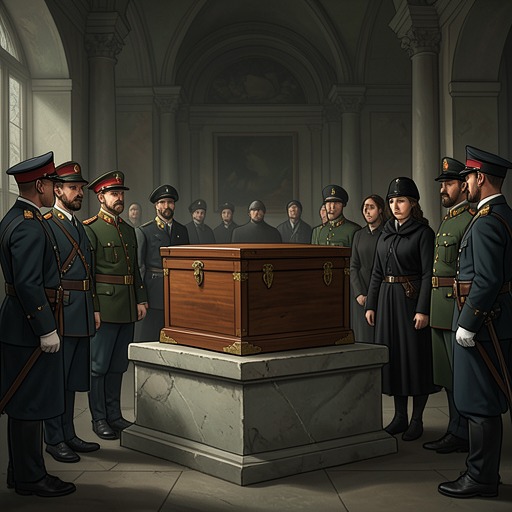
The coffin is placed in a sarcophagus in the Memorial Amphitheater, covered with the American flag, and honored with a bugler’s taps and three volleys. Decorations are pinned where the dead man’s chest ought to have been: American, French, Belgian, Italian, Romanian, Czechoslovak, and Polish honors, alongside a wreath and a gift of wampum from an Indigenous delegation. The profusion of honors makes the body a focus for many forms of national and international recognition, although none can restore a name or distinguish its life from the lives represented by the other boxes.
A National Symbol and an Unknown Person
The ceremony’s grandeur depends on a paradox. The dead man is honored as an American, yet the defining fact about him is that his identity has not been established. Arlington gives the remains a monumental resting place and a public meaning, while the narrative repeatedly returns attention to what that meaning cannot supply: a recoverable individual history. The state can name the body as a representative of the war dead, decorate it, and bury it with full ceremony; it cannot make the unknown man personally known.
The passage also complicates the consoling language of patriotic mourning through its concrete inventory of bodily remains, coffins, and insignia. The medals are attached to an absent chest, and the flag covers a body whose features and name do not emerge. Arlington therefore functions both as a site of commemoration and as the setting where commemoration’s limits become visible: collective remembrance can honor the dead, but it can also turn distinct lives into a single public emblem.