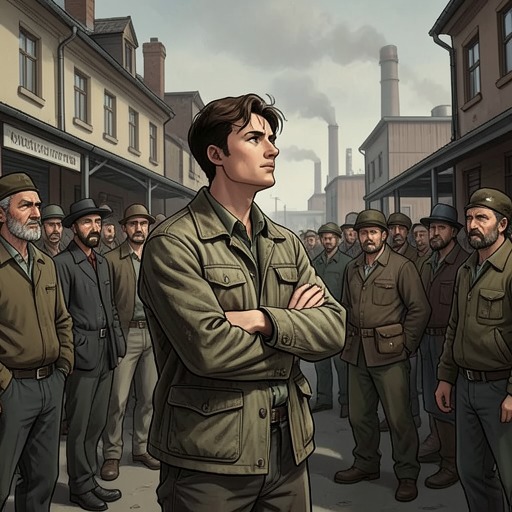
New York City
1919New York City is not a single backdrop but a network of neighborhoods, workplaces, stations, rented rooms, and meeting halls through which the novel’s characters move between possibility and constraint. Brooklyn gives Joe Williams a temporary foothold after maritime work fails him; Manhattan offers Richard Ellsworth Savage anonymity and a route home; and the city’s radical organizations give Ben Compton a public voice, then expose him to surveillance and prosecution. Across these stories, the city’s spaces determine who can find work, speak, hide, or leave.
Brooklyn: Work, Illness, and Departure
After leaving a barge job in East New York, Joe walks through Red Hook looking for a boarding house with forty-five dollars in his pocket. Brooklyn first appears as a place where a job’s end quickly becomes a practical crisis: he must find lodging and income, and, after falling ill, pay for repeated medical treatment. Unable to face returning directly to his boarding house after an appointment, he wanders through the streets and reaches a bridge he takes to be Brooklyn Bridge. Sitting at a pier, he reckons with the cost of treatment, his board, and the work he still needs. The harbor is within sight, but for the moment it marks the distance between his former life at sea and the unsettled one on shore.
During a later winter in Brooklyn, Joe divides his time between a navigation course from the Alexander Hamilton Institute, afternoon treatment appointments, and evenings spent seeking information about ships. The doctor’s office is a place of waiting and social embarrassment: people sit without speaking, and acquaintances sometimes pass one another outside as if they had never met. The Seamen’s Institute and the Seaman’s Union offer more useful prospects, linking city life to the possibility of another berth. Mrs. Olsen’s boarding house provides a contrasting kind of support; Joe grows deeply fond of her, even as her attentiveness begins to feel like an attempt to direct his life. When the doctor asks for more money, Joe leaves the treatment unfinished and ships as an able seaman on a Standard Oil tanker. Brooklyn has sheltered him, but it has also become a place he needs to escape.
Stations, Returns, and Urban Anonymity
After the voyage, Joe returns to Mrs. Olsen, repays his debt, and gives her an account of the crew before heading to Penn Station. On the overnight train to Washington, D.C., he thinks of Georgetown and of people and places from his childhood. His return to the capital is shaped by hesitation: he avoids going first to see his family and decides to wait for Janey near her workplace. Walking past the enlistment booth where he had joined the navy brings back an unwelcome association with his past. In the city, public places let him delay the personal encounters he is not ready to face, but waiting does not guarantee the reunion he hopes for.
New York City gives Richard Ellsworth Savage a different form of shelter. When he receives news that his father has died, he dreads facing classmates and delays the journey to Trenton. At Grand Central Station, the surrounding streets offer relief because nobody knows him there. He crosses on the ferry, misses the first train deliberately, and spends time in the Pennsylvania Station dining room, eating and reading before eventually continuing. His father’s death and the family’s uncertainty remain unresolved, but the city lets him postpone them for a few hours. Its crowds and transport links turn anonymity into a temporary freedom: he can feel like a traveler on his own before duty carries him onward.
A City of Organizing and Political Speech
For Ben Compton, New York City is a base for radical work. After returning home, he studies law in Morris Stein’s office on lower Broadway and speaks at meetings protesting the Everett massacre. The audiences come from different parts of the city and its industrial surroundings: East Side garment workers, Brooklyn waterfront workers, and workers from chemical and metal-products plants in Newark. At Madison Square Garden, the scale of the crowd initially overwhelms him. Once he begins speaking, however, his voice steadies, and ideas about protest, collective action, and revolution register across the hall. The scene makes political speech a material encounter: a speaker on a platform, an audience assembled from many trades, and a message carried through a crowded room.
The Russian Revolution intensifies this activity. Ben and the Steins follow reports closely, while meetings are organized to send greetings to the new workers’ and peasants’ government. After Ben and Helen Mauer move to a room on East 8th Street, news of the Bolsheviks’ seizure of power reaches them over morning coffee in a pastry shop on Second Avenue. They go to the Ferbers’ house on 17th Street, where Al and Molly Ferber offer money for a meeting but want their names kept out of it for fear of the consequences. The work of organizing proceeds cautiously: Ben and his companions visit people whose addresses they know and avoid using the telephone because they fear the lines may be monitored.
Surveillance, Confinement, and Public Display
The planned gathering takes place at the Empire Casino in the Bronx. Federal agents sit in the front row with a stenographer, police shut the doors after the hall fills, and uniformed soldiers and sailors enter the gallery. The meeting’s stated purpose is to send greetings to Russian workers, but the presence of officials and the police response make the hall a contested political space. Ben speaks against a war he sees as serving bankers and munitions makers. Police converge on the speakers, and he is arrested before he can speak to Helen. New York’s meeting halls can bring a dispersed movement together, yet the same visibility makes its participants easy to identify and detain.
Ben is held in a federal building on Park Row, questioned repeatedly, and eventually allowed to see Morris Stein. The case proceeds to trial; a jury finds him guilty, and the judge imposes a twenty-year sentence, later reduced on appeal to ten. While out on bail, Ben lives in the Steins’ apartment and withdraws from ordinary activity. His political commitments have carried him from public meetings into legal jeopardy, while the city’s offices and apartments become successive spaces of interrogation, waiting, and refuge.
When Ben must report to custody, lower Broadway is transformed by flags, crowds, motorcycle police, and a military band. The cheerful public celebration contrasts with his understanding of what the same society has done to political dissenters. He walks toward Morris Stein’s office with his suitcase, reminding himself of the people he believes have been jailed, killed, or attacked for their convictions. The route through the city brings the two New Yorks of his experience into one frame: a public display of national unity and the private knowledge of repression. In Joe’s and Richard’s stories, the city’s stations and streets permit movement or delay; in Ben’s, its halls, offices, and avenues expose the struggle over who may speak and what the cost of speaking will be.