Liverpool
1919Liverpool is the destination that transforms Joe Williams’s uneasy passage on the Argyle into a forced encounter with wartime authority. The city first appears as a river crowded with ships and veiled by smoke; then its wharf, police rooms, and American consulate carry Joe from shipboard suspicion toward a hurried departure. In Liverpool, the promise of reaching England gives way to detention, exposure, and the uncertain prospect of going home.
The Port at the End of the Passage
The approach to Liverpool is shaped by fear before the city itself comes into view. The Argyle’s crew has heard that German submarines are cruising off the Lizard, and the ship is eventually told that a convoy and destroyer will escort it through the Irish Sea to safety in the Mersey. When the destroyer first looms through the twilight fog, the crew mistakes it for an enemy vessel; once it identifies itself, the sailors cheer. The escort makes the harbor feel less like a peaceful arrival than the last guarded stretch of a dangerous passage.
Joe reaches the Mersey after spending the night in irons. Crossing the deck with his ankles still stiff, he sees a sunlit morning over the water: ships lie at anchor, while patrol boats cut across its pale, ruffled surface. Brown smoke spreads above the river, broken by white steam catching the light. The scene offers a striking visual contrast to his confinement, but it does not mark his release. The Argyle is still moving upriver, and Joe remains in the ship’s custody.
From Ship to Police Custody
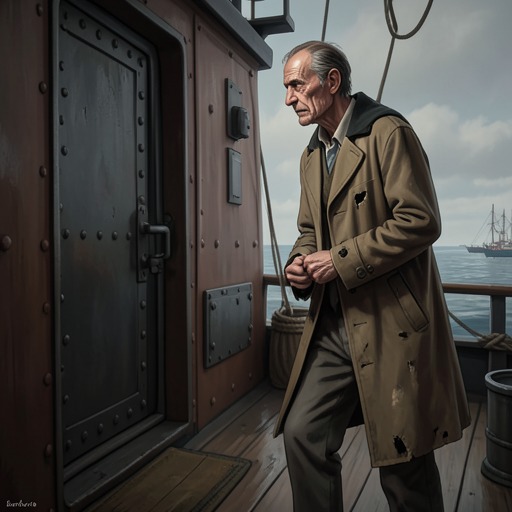
Liverpool’s wharf becomes the setting for Joe’s abrupt removal from the voyage. After the ship docks, a policeman wakes him and takes him away before he can wash or say goodbye. Joe brings his cigarbox; he is not paid off, and his shipmates do not accompany him. The policeman grips his arm as they cross the flagstoned wharf and pass through large iron gates toward a waiting Black Maria.
A small crowd watches the transfer. Men in grimy clothes jeer, a woman hisses, and others boo and call out as the vehicle closes around Joe. His shabby appearance—paint-spotted clothes and dirty felt slippers—leaves him exposed to the crowd’s contempt. Inside the dark car, he is glad to be alone and tries to compose himself, cold and struggling not to shiver. Liverpool’s arrival has delivered neither the welcome nor the freedom he had hoped for; it has made his suspected foreignness a public spectacle.
At the police office, the interrogation begins with another confusion: an inspector approaches Joe as though to strike him and addresses him in what Joe takes to be German. Joe shakes his head and grins. The episode continues the suspicion that followed him aboard ship, where his American identity and opposition to America’s involvement in the war had made him a target. The city’s authorities now treat his identity as a question to be checked rather than a fact to be accepted.
Detention and Recognition
Joe spends several days in custody. A turnkey brings his meals, and on the third day delivers a brown-paper package containing a suit, shirt, flannel underwear, socks, and a necktie. The clothing changes his appearance but fits badly: the collar is too tight and the trousers too large at the waist. Wearing them, he is led through corridors and across a court full of soldiers to an office with a sentry at the door.
There, a young man has reviewed the records and tells Joe that the case suggests he is what he claimed to be. Asked for his father’s name, Joe gives the same name as his own and asks whether the visitor is the American consul. This encounter brings official recognition, but only after detention and investigation. The consul’s intervention releases Joe from the immediate threat of being held as a suspected spy; it does not restore his position aboard the Argyle or provide money for the journey ahead.
A Consulate, a Ticket, and a Departure
After leaving custody, Joe waits in an empty office at the consulate while papers are prepared. Hunger occupies his attention: he keeps thinking of beefsteak and french fries. At last he is handed a document and told that a berth is ready for him on the American steamer Tampa, out of Pensacola. He is warned to go directly to the agents and board, and that returning to Liverpool would bring further trouble.
The consulate’s practical help is limited. Joe explains that the Argyle never paid him off and that he is nearly starving after jail. The consul gives him a shilling, while insisting that no more assistance is available. Joe examines the coin and thanks him, then walks along the street with the agent’s address in one hand and the shilling in the other, feeling faint and sick. Across the street he spots Mr. Zentner and runs toward him with his hand outstretched; the scene ends before the encounter’s result is shown.
Liverpool therefore functions as both a point of arrival and a place of expulsion. Its harbor brings Joe within reach of England, but the sequence of custody, official recognition, and consular paperwork redirects him toward a ship bound from Pensacola. The change is measured in concrete things: irons, a cigarbox, ill-fitting clothes, a travel paper, and a single shilling. The city’s brief promise of passage resolves not in a settled life there but in another departure, imposed under threat and undertaken while Joe is still hungry and unwell.