Hôtel de Crillon
1919The Hôtel de Crillon, on the place de la Concorde, serves as more than a hotel during the Peace Conference: it is a busy Parisian hub where J.W. Moorehouse’s visitors encounter the people, rituals, and backstage traffic of diplomacy. Its salons promise tea, conversation, and personal closeness, but their crowded corridors and interrupted meetings keep exposing the work and power relations beneath that social surface.
Setting and Function
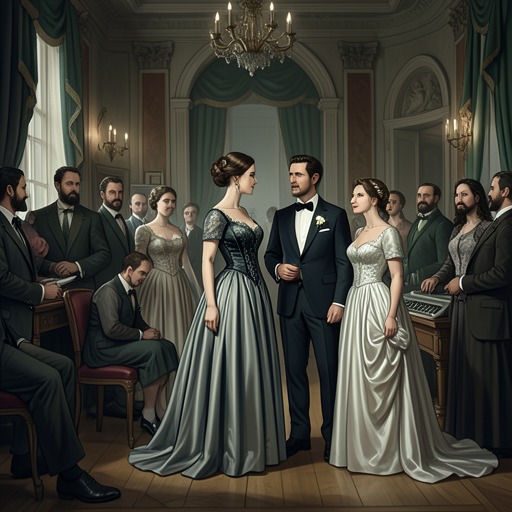
For the Peace Conference, J.W. Moorehouse keeps a suite at the Crillon. His blonde secretary, Miss Williams, works at a desk in a small anteroom, while his English valet, Morton, serves tea in the late afternoon. Americans stream through the hotel’s old-fashioned corridors; in the large salon, people in uniform and formal evening dress exchange fragments of stories in an atmosphere smoky with cigarette smoke. The arrangement makes the suite a meeting place, but not an open or leisurely one: telephone calls, telegrams, notes from the secretary, and requests to see Colonel House repeatedly draw Moorehouse away from the company.
The hotel also anchors the official geography of this Paris. Its position on the place de la Concorde and its proximity to the rue Royale place it among the routes and rooms through which visiting dignitaries pass. Richard Ellsworth Savage sees President Wilson, David Lloyd George, and the King and Queen of the Belgians parading along the rue Royale under escort by the garde republicaine. The Crillon is thus both a particular workplace and a vantage point on the spectacle of international diplomacy.
Eveline Hutchins and Moorehouse’s Salon
Eveline Hutchins visits the suite after walking from her office along the arcades of the rue de Rivoli. She sees Moorehouse in grey Scotch tweeds, his trousers sharply creased, having abandoned his Red Cross major’s uniform. His manner is agreeable but aloof; he is habitually preoccupied, slipping away to answer a telephone, read a telegram or note, or speak privately with someone beside a window overlooking the place de la Concorde. Yet he also offers Eveline tea or a champagne cocktail, and his direct, boyish glance makes her feel briefly singled out. Her attraction develops in the very room where his attention is constantly claimed by other people and business. She tells herself she has no right to jealousy because nothing definite exists between them, while feeling that Eleanor watches their exchanges closely.
The suite’s social life continues when Moorehouse is occupied. Eveline sometimes goes out with Edgar Robbins, who works with him and condemns the coming peace as potentially worse than the war. His favorite refuge is Freddy’s near Montmartre, a contrast to the Crillon’s diplomatic rooms: there, music, drinking, and argument replace the measured circulation of officials and visitors. The Crillon nevertheless remains the point to which Eveline returns, a setting where professional access and private longing are difficult to separate.
An evening at the opera reveals the same overlap. Moorehouse, Eleanor, Eveline, and Robbins assemble before going to see Castor and Pollux; Miss Williams is already in the box. Eveline envies the secretary’s proximity to Moorehouse, even noticing her peroxide hair and brisk manner. At an intermission, Moorehouse speaks with tears in his eyes about the music, then turns to Eveline with concern about her having no proper evening wrap. The tenderness is real but brief, held within a crowded evening and a social circle in which Eleanor’s presence continually complicates Eveline’s hopes.
Corridors, Access, and Professional Power
The Crillon’s rooms make rank visible through who works, who hosts, and who gets admitted. When Eveline returns from leave, Miss Williams meets her with cold hostility and says Moorehouse has a fever and is seeing no one. Eveline offers to write or call later, but the secretary’s manner leads her to suspect that something has changed. On a later visit, the anteroom and salon appear almost exactly as before: Miss Williams at her desk, Morton distributing tea and petits fours, Moorehouse talking privately with a visitor near the window, and Eleanor chatting with young staff officers. The familiar arrangement does not give Eveline an assured place in it. She takes tea, speaks briefly with Eleanor, and leaves for another engagement, passing Miss Williams, who remarks that staying busy keeps a person out of mischief.
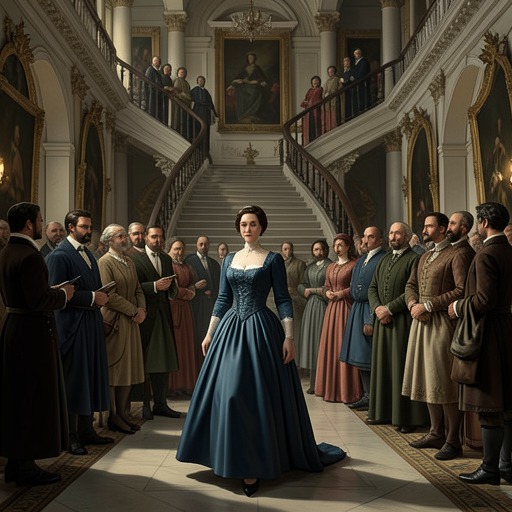
For Richard Ellsworth Savage, the Crillon is also a site of professional introduction and access. Before the first plenary session, he rushes there to see Moorehouse, who had promised to obtain cards for Savage and Colonel Edgecombe. The effort has failed; after Savage reports this to Edgecombe, he and Ripley go for a drink at the Ritz bar. On another visit, Savage arrives with Eleanor after tea. The corridors are crowded with khaki-clad personnel, marine yeomen, messenger boys, civilians, and civilian experts speaking quietly, exchanging glances, and making notes. Eleanor grasps Savage’s arm and compares the place to a dynamo. He answers that it does not look like peace.
Inside the suite, people stand in blue light from the long windows while a waiter carries glasses and a valet-like attendant moves with a bottle of port. Some visitors hold teacups, others drinks, but attention is fixed elsewhere. Savage notices that Eleanor moves as if accustomed to running the room and that Moorehouse comes forward to meet her. Moorehouse remembers Savage’s name, but a message summoning him to a telephone call from Colonel House ends the opportunity for further conversation. Courtesy opens the door; the demands of the conference decide who can stay and speak.
Narrative Significance
The Crillon gathers private desire and public power without reconciling them. Eveline reads its tea service, glances, and invitations for signs of personal feeling, while its phone calls, telegrams, staff, and interrupted conversations continually remind her that Moorehouse belongs to a larger professional world. Savage, by contrast, studies the same salon as a place to observe character and seek access. The hotel’s repeated appearances make this difference of perspective tangible: the polished rooms can feel intimate to one visitor and impersonal to another, while the corridors outside them keep moving with the work of a conference whose promised peace remains uncertain.