St. Thomas
1919St. Thomas becomes a place of enforced pause in Joe Williams’s life at sea: put ashore delirious with dengue fever, he spends two months there recovering, dependent on hospital care and then a cook’s help for shelter. The island’s hot streets, closed harbor, and quiet coal wharf give his convalescence a physical setting, while his eventual passage north ends the interval of isolation and returns him to the unsettled choices he had left behind.
Illness and Hospitalization
A couple of days after drinking with an old man ashore, Joe Williams develops a fever and terrible joint pains. By the time he is put ashore at St. Thomas, he is out of his head. An orderly later tells him that he had been delirious for five days and that the staff had given him up for dead. The doctors were angry at the prospect of losing him in their post hospital; as the orderly explains it, Joe was a white man, unconscious, and not someone they could simply feed to the sharks. The remark exposes the racial terms through which his treatment is described, even as his survival depends on the care he receives there.
His illness keeps him from ordinary movement for two months. By July he is well enough to walk, but he must leave the hospital without having regained his strength. A cook at the marina barracks looks out for him and finds him a place to sleep in an unused section of the building. That makes the barracks a makeshift refuge after the hospital, and the cook’s practical help a condition of his continued recovery.
The Wharf and Convalescence
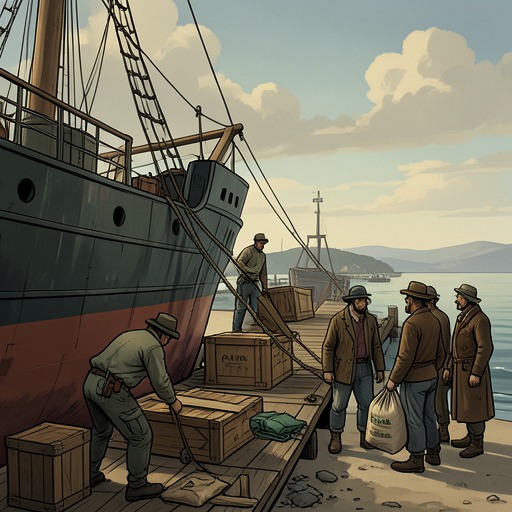
Joe’s walks take him along the steep streets dusted with coral. In the heat, under a sky with no clouds, he grows tired of the bare hills and the blue, shut-in harbor. Much of his time passes on the old coal wharf, where a piece of corrugated iron roofing provides shade. Through gaps in the planking, he watches shoals of snappers feed around the piles in the clear, deep blue-green water.
The wharf gives his days a repetitive rhythm: he sits, watches the fish, and thinks about Del, the French girl in Bordeaux, the war, and the United Fruit Company, which he regards as a monopoly that cheats the people who work for it. His thoughts circle and circle like the small fish around the weeds on the piles, until he falls asleep. The scene ties his physical weakness to a restless return of unresolved concerns; recovery does not settle what he wants to do with his life.
Departure North
When a northbound fruit steamer enters the harbor, Joe tells one of its officers his story from the wharf. The ship’s people give him passage to New York City. St. Thomas thus ends not with a decisive cure or resolution, but with a means of leaving: once well enough to travel, Joe moves north again, carrying his doubts about Del, the war, and a steady life ashore with him.