Châlons-sur-Marne
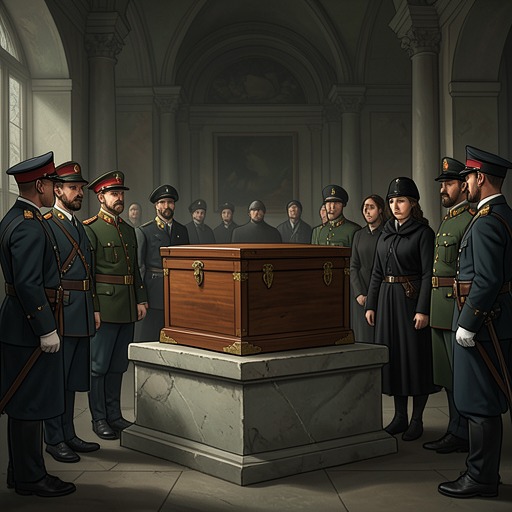
1919Châlons-sur-Marne is presented as the wartime collection point for the remains of an unidentified American soldier, and as the setting of a selection that turns many dead into one national symbol. Its tarpaper morgue, stacked pine boxes, and the difficulty of identifying a body from bones and scraps stand in sharp contrast to the formal burial planned for the chosen dead at Arlington National Cemetery.
The Morgue and Its Contents
The scene takes place in a tarpaper morgue at Châlons-sur-Marne, where the air is marked by chloride of lime and the smell of the dead. Pine boxes are stacked there, holding what remains of Richard Roe and other unidentified people. The passage does not make the morgue a neutral storehouse: its crude construction and the bodies’ material condition are present as part of the meaning of the selection conducted inside it.
The evidence of identity is fragmentary. The text invokes a sack of bones, bronze buttons stamped with an eagle, and a pair of roll puttees: remnants that can suggest military service but cannot establish who the dead man was. The remains are further described as an incorruptible skeleton, scraps of dried viscera, and skin bundled in khaki. At Châlons-sur-Marne, the distinction between a soldier and an unknown person is therefore both institutionally important and physically difficult to verify.
Choosing One Unknown Soldier
The selection is framed against the abundance of boxes: many contain the remains of people whose identities are unknown, but only one can be taken home. The passage asks how John Doe was chosen from among them, emphasizing the gap between the procedure’s national importance and the limited evidence available to identify an individual body. The selection produces a representative American dead without recovering the person’s name.
That gap is sharpened by the text’s attention to racial and ethnic tests of Americanness. It exposes the contradiction in trying to certify a man as fully American when the available evidence is a bundle of bones and military clothing. The morgue thus becomes a setting not only for identifying remains but for confronting the assumptions built into the category of the American body the state proposes to honor.
From Châlons-sur-Marne to Burial
The passage places the morgue within an official process. A congressional resolution authorized the Secretary of War to bring to the United States the body of an American member of the American Expeditionary Forces in Europe whose identity had not been established, for burial in the Memorial Amphitheater at Arlington National Cemetery. Châlons-sur-Marne is where the remains are gathered and the pine coffin is prepared before the transatlantic journey.
The chosen remains are laid out neatly in a pine coffin and taken home aboard a battleship. Their journey ends in a sarcophagus in the Memorial Amphitheater at Arlington National Cemetery. The movement from a stack of unmarked boxes to a single formal burial gives the location a precise narrative role: it is the point where dispersed, anonymous wartime death is made into an official object of national mourning.
Narrative Significance
The passage sets the morgue’s sensory bluntness against the ceremony that follows. At Châlons-sur-Marne, chloride of lime, dirt, bones, and scraps resist the polished language of public commemoration; elsewhere in the account, the day of national recognition is marked by silence, tears, songs, prayer, muffled drums, and soft music rather than applause. The contrast makes the burial’s solemnity inseparable from the bodily remains and uncertainty that precede it.
The site’s significance rests on that unresolved uncertainty. The chosen dead receives a coffin, a voyage, and a monumental resting place, while the evidence cannot restore his identity or distinguish him securely from the other dead left behind. Châlons-sur-Marne therefore anchors the passage’s central tension: the nation can honor an unknown soldier, but its ceremony cannot undo the anonymity that made him representative.