Tivoli
1919Tivoli is the destination of a New Year’s Day outing that becomes a decisive episode in Anne Elizabeth’s relationship with Richard Ellsworth Savage. Its waterfall, ruined temple, rain-washed hills, and small cyclamens frame a day that moves from group sightseeing and private jealousy into mutual desire, then abrupt refusal. The place persists afterward as a sensory memory: Anne Elizabeth keeps cyclamens on her desk in Paris and recalls the excursion while imagining a life of travel with Richard Ellsworth Savage.
Setting and excursion
On the first of January, a holiday, Anne Elizabeth, Richard Ellsworth Savage, Ed Schuyler, and G. H. Barrow hired a car to visit Hadrian’s Villa and continue to Tivoli for lunch. Showers had left the roads muddy. The winter Campagna, colored yellow and brown, reminded Anne Elizabeth of the countryside around Middlebuster, while the town’s dark cypresses stood out against its roofs. At a restaurant above the waterfall, the party ate fritto misto and drank Frascati wine. Ed Schuyler and G. H. Barrow discussed the Roman Empire and the ancients’ knowledge of how to live; Anne Elizabeth appeared to Richard Ellsworth Savage to be flirting with G. H. Barrow as he drew his chair close to hers. Richard drank his coffee in silence, stung by the scene.
The excursion’s shared itinerary then broke apart. After coffee, Anne Elizabeth wanted to climb to a small round temple on the opposite hillside. Ed Schuyler objected that the path was steep after lunch, while G. H. Barrow offered to go without much enthusiasm. Anne Elizabeth ran across the bridge and down toward the waterfall, with Richard Ellsworth Savage slipping after her on loose gravel and in puddles. Above them, the falls filled the air with noise; when Richard looked back, G. H. Barrow was no longer following. Anne Elizabeth treated his absence as evidence of a dislike of going anywhere, and the two continued uphill together. From the temple they could see Ed Schuyler and G. H. Barrow still on the restaurant terrace. Anne Elizabeth thumbed her nose at them, then waved, making her preference for movement and discovery into a playful rebuke to the party left behind.
From ruins to the hills
Anne Elizabeth wanted to see more of the countryside. She and Richard considered whether they could reach Nemi, associated with Caligula’s galleys, but without the car the outing became a walk instead. The prospect of rain did not deter her. They followed a path above the town through wet pastures and oak woods, with the light-brown Campagna below and Tivoli’s roofs punctuated by black cypresses. Showers crossed the landscape in dark and pale blurs. Small red-purple cyclamens grew underfoot; Anne Elizabeth picked them and held them toward Richard to smell. She ran and skipped along the way, her cheeks flushed and her hair untidy, while a light sprinkle dampened them before a patch of chilly sunlight appeared.
The walk’s sensory details gather around a pause beneath a large beech tree. Sitting on its root, they looked at the long, pointed red-brown buds overhead and smelled the cyclamens. Richard Ellsworth Savage felt the combined effects of the climb, wet undergrowth, wine, and flowers. The natural setting does not simply decorate their encounter: it marks the shift from the group’s talk about Roman history to the couple’s private physical attraction. Tivoli’s landscape—its rain, flowers, and uneven paths—gives the intimacy a bodily immediacy that the formal excursion had not allowed.
Intimacy and interruption
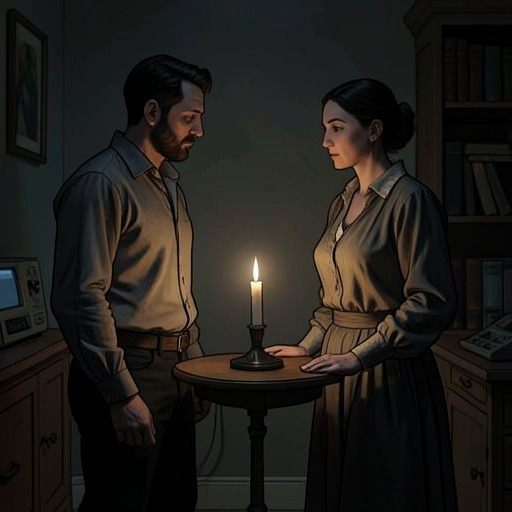
Beneath the beech tree, Anne Elizabeth kissed Richard repeatedly and asked him to say that he loved her. He drew her to her feet and kissed her; they left the path for a neighboring field and made their way to a small brush hut filled with dry corn fodder. There, as Richard tried to undo her clothes, something tore under his hand. Anne Elizabeth pushed him away, saying that they could not continue there and had to return. She ran out of the hut. Richard remained seated among the fodder, brushing its dry shreds from his uniform and hating her in the immediate aftermath of her refusal. The abrupt reversal complicates the day’s earlier exuberance: shared attraction does not mean that Anne Elizabeth has agreed to go further, and Richard’s hurt turns the intimate scene into a rupture rather than a romantic resolution.
Tivoli remembered
The excursion acquires a second life in Anne Elizabeth’s later account. In Paris, working at a desk among colleagues she found tiresome, she wrote to Richard Ellsworth Savage that she wanted to travel through Europe rather than remain at office work. A bunch of little cyclamens on her desk brought back the flowers from the hills above Tivoli. She remembered having been too prissy to continue their encounter in the hut and expressed regret, while also describing herself as lonely, ill with a cold, and homesick for Richard’s return to Rome. The flowers thus carry the excursion into a very different setting: the remembered freedom of the walk contrasts with the confinement and dreariness she associated with her Paris work.
Anne Elizabeth’s later recollection also reveals that the encounter had not meant the same thing to both of them in every moment. She remembered wanting Richard, being frightened and cold when their intimacy first continued, and feeling happy the next day when he was gentle and strong. Later, when she discovered that she was pregnant, she expected that he would marry her; the available account also records that they considered postponing marriage and the baby until he had left the service. Tivoli therefore remains more than a picturesque stop near Hadrian’s Villa. It is the place where desire, hesitation, memory, and expectations of a shared future first become tightly joined, while the cyclamens make that brief landscape recur in the unsettled life that follows.