Seine River
1919The Seine River gives the Paris episodes of the novel a continuous physical axis: it is at once a view from a room, a route through a city under attack, a gathering place for strangers, and the setting for a private disclosure that changes Eveline Hutchins’s future. Its appearances do not make the river a single, stable refuge. Instead, the changing scenes along and across it place intimate routines beside war, political tension, and the uncertainty of life after the fighting.
A river framed by everyday Paris
In one of the Camera Eye passages, the river belongs to a close, particular view of Paris: two cats, their faces black against pale fur and their eyes aquamarine, occupy the window of a laundry opposite the small creamery where the group eats breakfast. Around them, narrow streets, tiny bars and restaurants, old prints, and the smell of frying butter make up a dense neighborhood world. The river is not mentioned in that detail, but it belongs to the sequence’s intimate geography of Paris, which repeatedly shifts between small daily observations and events on a citywide scale.
That wider scale becomes startlingly literal when the Bertha drops into the Seine River. While the river carries the shock of a bombardment, fishermen in small green skiffs are holding a fishing contest. The concussion has stunned minnows, which they scoop up in their nets. The scene turns an instrument of destruction into an accidental source of a catch, without making the danger disappear: the ordinary activity continues in the same water that has just received a shell. The Seine River is therefore neither merely scenic nor a passive backdrop; war interrupts its use, but does not wholly suspend the city’s daily life.
Domestic life on the Quai de la Tournelle
For Eveline Hutchins, the river becomes part of a home shared with Eleanor Stoddard. Eleanor has obtained a fine apartment on the Quai de la Tournelle, in the mansard of an old, peeling grey house. Eveline watches the current through the delicate lines of the wrought-iron balcony. Toy steamboats struggle upstream, towing polished barges whose deckhouses have lace curtains, geraniums, and painted green-and-red windows. Across the water, the rising curves of the flying buttresses of Notre-Dame de Paris appear above the trees of a small park.
The view is joined to a routine of work and rest. After days spent preparing scrapbooks of ruined French farms and orphaned and starving children for American Red Cross drives, Eveline and Eleanor take tea by the window at a small Buhl table. Afterwards, Eveline watches Yvonne cook. Food is secured through the American Red Cross commissary and Yvonne’s barter system, which Eveline initially tries to stop. The apartment’s quiet, river-facing domesticity thus coexists with the practical economy of wartime relief and with the images of suffering the women assemble for audiences back home.
The river view also provides the setting for a more precarious kind of closeness. During a later visit, Dick Savage walks along the left bank toward Eleanor’s apartment on the Quai de la Tournelle. The trees are budding pink and pale green; the booksellers are closing their stalls in the lavender twilight. Inside, Eleanor serves tea in an ivory-colored dress and tells him gossip about the Crillon and the Peace Conference. Her apartment offers Dick a welcome pause from military duties and the chill of Paris. When Eleanor says that she is leaving for Rome to work at the American Red Cross office, both express regret that they will not be there at the same time. The riverbank walk makes their attachment legible through the ease of this familiar visit, while her departure makes that comfort temporary.
The river as a crossing and a threshold
In June, the Seine River becomes the setting for a revelation in Eveline’s relationship with Paul Johnson. After a month in which the couple spend their pay quickly and eat at inexpensive table d’hôte restaurants, they take a Sunday walk through the forest at St. Germain. Eveline is weakened by spells of nausea and has to lie on the grass several times; Paul grows worried. At a settlement beside the river, they cross on a small ferry rowed by an old man whom Eveline calls Father Time. Halfway across, she tells Paul that she is going to have a baby.
The crossing is not just a picturesque pause in their walk. It gives the news a precise place and a change of direction: Eveline’s pregnancy alters the plans they had made the previous day, when they spoke of returning to New York, finding work, and marrying. Paul says he will find out how they can marry in the American Expeditionary Forces. His response acknowledges both a commitment and the disruption the pregnancy brings to his plans. The river crossing binds a movement through the landscape to a new obligation in the couple’s life.
Public space and the unsettled peace
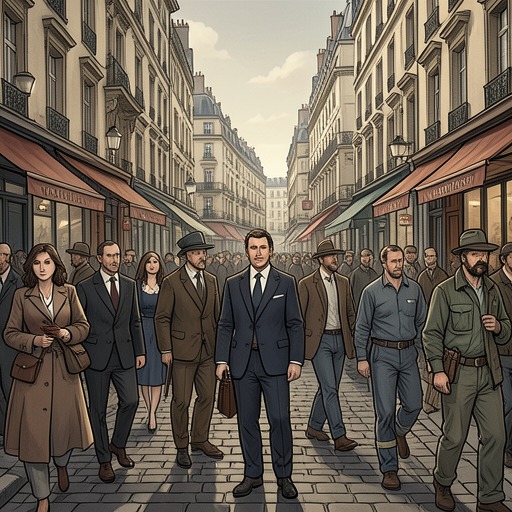
The Seine River also divides and connects the public spaces of political Paris. On the far side, Eveline and Paul encounter more people and small groups of gendarmes. At a street crossing, older working men carry a red flag and a sign declaring that the workers’ union will bring peace to the world. Republican guards ride at them with drawn sabres; the demonstrators run or flatten themselves in doorways. Nearby, crowds cheer soldiers standing beside stacked rifles. The river’s presence helps orient the scene, but the streets reveal its central contrast: a claim to peace is met with armed force even as the surrounding crowd appears good-natured.
Later, Dick Savage and Edgar Robbins walk along a foggy quay past the dark mass of Notre-Dame de Paris after their taxi refuses to take them farther. They complain about the cold, find a café, and drink whisky while talking about Paris as a center of world affairs. When Moscow enters their conversation, a Frenchman at the next table looks up from his checkers. The moment is brief, but the riverside walk leads from ordinary discomfort into the political suspicion that shadows the postwar city.
Narrative significance
Across these episodes, the Seine River links distinct forms of passage: fish stunned by a falling shell, boats and barges moving against the current, a ferry carrying Eveline and Paul toward a consequential conversation, and pedestrians moving between work, home, cafés, and street demonstrations. The river’s banks can shelter a domestic routine or expose people to the tension of public life; its crossings can carry both everyday travelers and a change in personal circumstance. Its recurring presence gives Paris a coherent geography without making that city feel settled. Even after the fighting, conversations about revolution, soldiers in the streets, and the guards’ attack on workers insist that peace remains contested. The river consequently functions as more than a view: it is the material thread joining private lives to the unsettled history unfolding around them.