Snohomish County
1919Snohomish County appears in the novel as the setting of the coercive aftermath of an Industrial Workers of the World free-speech campaign at Everett, Washington. The decisive scene unfolds in the woods beside a county road and a railroad crossing, where local authority turns a demand for constitutional rights into a forced retreat; reaching the county line offers the marchers a measure of safety, but not an end to the harm they have suffered.
Setting and Labor Conflict
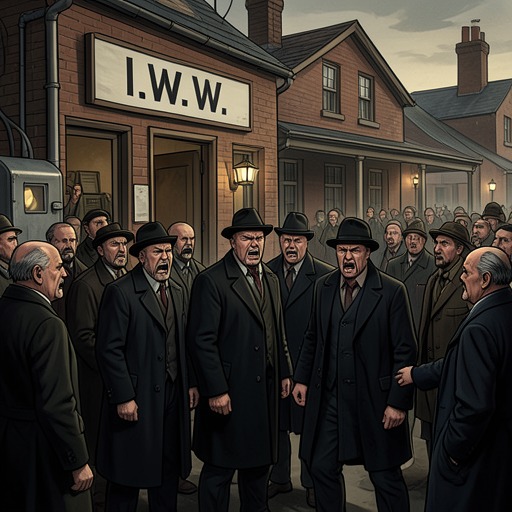
The county enters the narrative after Ben Compton, Bram Hicks, and other members of the Industrial Workers of the World travel from Seattle to Everett to hold a meeting. Their arrival meets organized opposition: deputies arrest the demonstrators at the dock and transport them away from town. The narrative then shifts from the waterfront to an isolated stretch of woods where a county road crosses the railroad track. This change of setting carries the conflict beyond the attempted meeting and into a place where armed deputies can control the group with little public scrutiny.
The County Road and the Deputies
At the crossing, deputies hold the workers at gunpoint while the sheriff and two well-dressed men discuss what to do with them. A worker states that the group seeks only its constitutional right to free speech. The sheriff responds by invoking the county as the source of his authority and warning that workers who return may die. The threat makes the location more than a backdrop: county power is asserted through the sheriff’s words and the armed men gathered around the detainees.
The deputies form two lines leading toward the railroad track and force the workers through them. Ben is beaten when he refuses to deny his membership in the Industrial Workers of the World. The episode presents the confrontation as a clash between the workers’ stated purpose—holding a meeting—and a local apparatus prepared to punish that effort physically. The county’s role in the episode is represented through this specific encounter, not through a broader account of its residents or institutions.
Crossing the Boundary
Ben tries to keep walking rather than run, falls at the rail, and struggles onward as other workers help him away from the crossing. Bram tells the group that they have crossed the county line. The boundary gives the episode its stark turning point: the marchers are moving out of the jurisdiction whose sheriff has threatened them, though shots and shouts remain behind them, where other workers are still being driven through the deputies’ line. Bram’s insistence that they must remember the night frames the escape as both a narrow survival and an experience to be carried forward.
Aftermath and Narrative Significance
At an interurban trolley station, the exhausted group collects money for tickets for those most seriously hurt; Bram and others set out on foot for the thirty-mile return to Seattle. Ben is hospitalized for three weeks and leaves barely able to walk. These consequences connect Snohomish County to a wider labor conflict in which the effort to exercise free speech meets organized repression. The county line marks where the immediate assault ends for Ben’s group, while the injuries, arrests, and remembered threat show that crossing it does not undo what happened.