Genoa
1919Genoa is both a destination on a wartime sea route and the setting for a night visit shaped by the blaze of an abandoned tanker. Its marble streets, steep stairs, arcades, and harbor lights form a city of striking beauty, but the fire outside its breakwater brings the risks and uncertainty of wartime shipping directly into that urban scene.
City and Setting
Genoa is presented as an ancient ducal city rising from the waterfront into the hills. Its stone houses and marble palaces stand among campaniles, towers, and porticoes; some streets climb in steep steps, while broad arcades open onto clean pavement patterned in mosaic. In the night scenes, the city’s stone surfaces become part of the spectacle: the moon catches the marble, and later the glow of the harbor fire colors the seaward façades and windows red.
The city is also encountered through movement rather than a single fixed view. A streetcar carries its passengers toward Genoa, rounding houses before emerging at the waterfront; on foot, the narrow streets and breakneck stairs lead upward toward broad avenues. From the harbor, the town seems to pile up behind the breakwater, with old towers and porticoes set against the hills. The recurring views make Genoa at once a navigational destination, a walkable city, and a mass of illuminated stone seen across the water.
Arrival by Sea
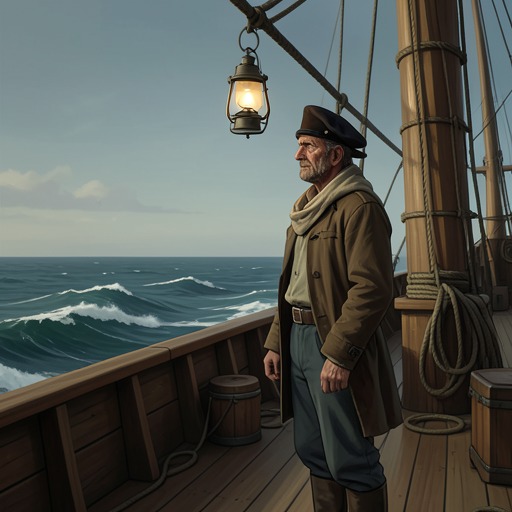
Joe Williams reaches Genoa aboard the Appalachian, a freighter bound for Bordeaux and Genoa after he has been turned out of his lodging in New York and spent nights at a mission. His passage gives the city a place in a long, crowded wartime route. The convoy moves along the coast in single file: camouflaged freighters travel outward with lifepreservers on deck and boats swung out on davits, while transports, colliers, hospital ships, and other vessels pass on the return journey. French and British battleships remain offshore, and destroyers come alongside to inspect the ship’s papers.
The approach contrasts this visible machinery of war with the landscapes along the way. After the Strait, the weather turns sunny; the Spanish coast appears green against bare pink and yellow mountains, and the French Riviera is seen in wind and rain, with bright towns beneath rocky hills and snow-covered peaks beyond. Genoa enters this route not as an isolated destination but as the end point of a passage through busy waters, patrols, and changing weather. At Bordeaux, Joe had hoped to look up Marceline, but the crew was not allowed ashore; the account thus also establishes how little freedom the voyage affords him before Genoa.
The Harbor Fire
On the approach to Genoa, a red glare ahead is mistaken for evidence that enemy forces have captured and set fire to the town. The rumor spreads aboard the Appalachian; the second mate urges the skipper to turn back and put into Marseille, but the skipper dismisses his intervention. As the vessel draws nearer, the source of the light becomes clear: a large, new Standard Oil tanker is burning outside the breakwater. The harbor, crowded with ships, and the town’s windows and waterfront buildings shine in the reflected flare. The threatened city and the actual fire are visually fused before the cause of the glow is known.
After anchoring, the bosun takes Joe and several younger sailors out in a dinghy to see whether they can help. The tanker’s stern rides high, and they can see no one aboard. A motorboat approaches with people speaking to them, while a fireboat stands by without being able to do anything. Joe spots a rope ladder hanging into the water and climbs aboard before his companions can stop him. The deck and surrounding sea are bright with burning oil. He finds clothes and seabags left near the davits, takes a new sweater, and goes down to the cabin, where a box of Havana cigars and a package of seven pairs of silk stockings remain.
Joe’s brief search is practical and personal at once. He lights a cigar beside the burning tanks, aware that the ship may explode; the stockings first suggest a gift for Del, but he remembers that their relationship is over and keeps them anyway. He also takes a wallet, which proves empty. On his way back down the ladder he tells the others that the fire is crude oil, not gasoline, and may burn for a week. The sailors return to the Appalachian and report that the tanker has been abandoned, leaving its disposal to the port authorities.
A City Under the Flare
The fire continues into the following day. Near nightfall another tank explodes, sending the blaze farther across the water, and the Appalachian raises anchor and moves to the wharf. Joe and the bosun then go into Genoa. They walk through narrow streets with steps leading uphill to wider avenues, past cafés and small tables beneath colonnades, on pavements of polished patterned marble; in the cold, they enter a bar and drink hot pink drinks with rum.
The waterfront episode gives Genoa’s beauty a concrete, unstable source of light. From the streetcar and the harbor, the city can look like a theatrical scene of marble and flame; aboard the tanker, that same brightness means an abandoned ship, an active fire, and the possibility of an explosion. Genoa therefore gathers two scales of wartime experience in one setting: the movement of convoys and military patrols beyond the breakwater, and the small decisions of sailors who, after returning from a burning vessel, walk the city’s streets and seek warmth in a bar.