Siddhartha's Awakening
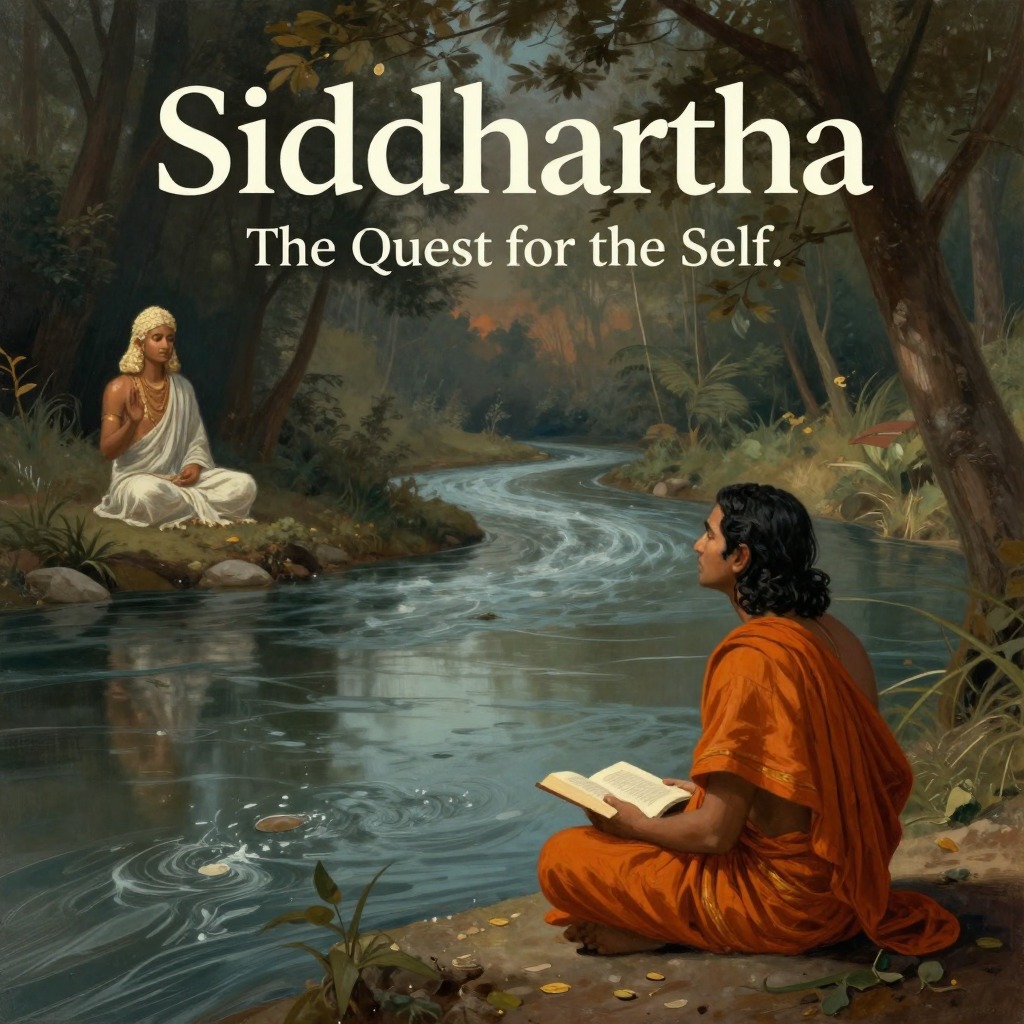
Siddhartha's Awakening marks the decisive turning point in his spiritual journey, the moment when he sheds the last vestiges of his dependence on teachers and doctrines and resolves to learn from himself and the world directly. Leaving the grove Jetavana, where the Buddha Gotama and his friend Govinda remained behind, Siddhartha felt that his past life had also stayed behind and parted from him. He pondered this sensation deeply, letting himself sink down to the ground of the sensation, down to the place where the causes lie, because to identify the causes, so it seemed to him, is the very essence of thinking, and by this alone sensations turn into realizations and are not lost, but become entities and start to emit like rays of light what is inside of them.
The Realization of the Self
Slowly walking along, Siddhartha realized that he was no youth any more, but had turned into a man. He realized that one thing had left him, as a snake is left by its old skin: the wish to have teachers and to listen to teachings. He had also left the last teacher who had appeared on his path, even him, the highest and wisest teacher, the most holy one, Buddha, he had left him, had to part with him, was not able to accept his teachings. He asked himself what he had sought to learn from teachings and from teachers, and what they were still unable to teach him. He found: "It was the self, the purpose and essence of which I sought to learn. It was the self, I wanted to free myself from, which I sought to overcome. But I was not able to overcome it, could only deceive it, could only flee from it, only hide from it. Truly, no thing in this world has kept my thoughts thus busy, as this my very own self, this mystery of me being alive, of me being one and being separated and isolated from all others, of me being Siddhartha! And there is no thing in this world I know less about than about me, about Siddhartha!" He realized that his ignorance of himself stemmed from a single cause: he was afraid of himself, fleeing from himself. He had searched Atman, searched Brahman, willing to dissect his self and peel off all of its layers to find the core, but he had lost himself in the process.
A New Way of Seeing the World
Siddhartha opened his eyes and looked around, a smile filled his face and a feeling of awakening from long dreams flowed through him from his head down to his toes. He walked quickly like a man who knows what he has got to do. He thought: "Now I would not let Siddhartha escape from me again! No longer, I want to begin my thoughts and my life with Atman and with the suffering of the world. I do not want to kill and dissect myself any longer, to find a secret behind the ruins. Neither Yoga-Veda shall teach me any more, nor Atharva-Veda, nor the ascetics, nor any kind of teachings. I want to learn from myself, want to be my student, want to get to know myself, the secret of Siddhartha." He looked around as if seeing the world for the first time. Beautiful was the world, colourful was the world, strange and mysterious was the world! Here was blue, here was yellow, here was green, the sky and the river flowed, the forest and the mountains were rigid, all of it was beautiful, all of it was mysterious and magical, and in its midst was he, Siddhartha, the awakening one, on the path to himself. All of this entered Siddhartha for the first time through the eyes, was no longer a spell of Mara, was no longer the veil of Maya, was no longer a pointless and coincidental diversity of mere appearances, despicable to the deeply thinking Brahman who scorns diversity and seeks unity. Blue was blue, river was river, and if also in the blue and the river, in Siddhartha, the singular and divine lived hidden, so it was still that very divinity's way and purpose, to be here yellow, here blue, there sky, there forest, and here Siddhartha. The purpose and the essential properties were not somewhere behind the things, they were in them, in everything.
The Break with the Past
Siddhartha realized that he had been deaf and stupid, scorning the symbols and letters of the world for the sake of a meaning he had anticipated before he read. He had called the visible world a deception, called his eyes and his tongue coincidental and worthless forms without substance. But now he declared: "No, this is over, I have awakened, I have indeed awakened and have not been born before this very day." In thinking these thoughts, he stopped once again, suddenly, as if there was a snake lying in front of him on the path. He became aware that he, who was like someone who had just woken up or like a new-born baby, had to start his life anew and start again at the very beginning. When he had left in this very morning from the grove Jetavana, already awakening, already on the path towards himself, he had every intention of returning to his home and his father. But now he awoke to the realization: "But I am no longer the one I was, I am no ascetic any more, I am not a priest any more, I am no Brahman any more. Whatever should I do at home and at my father's place? Study? Make offerings? Practise meditation? But all this is over, all of this is no longer alongside my path." Motionless, he remained standing there, and for the time of one moment and breath, his heart felt cold, he felt a cold in his chest, as a small animal, a bird or a rabbit, would when seeing how alone he was. For many years, he had been without home and had felt nothing. Now, he felt it. Still, even in the deepest meditation, he had been his father's son, had been a Brahman, of a high caste, a cleric. Now, he was nothing but Siddhartha, the awoken one, nothing else was left. Deeply, he inhaled, and for a moment, he felt cold and shivered. Nobody was thus alone as he was. There was no nobleman who did not belong to the noblemen, no worker that did not belong to the workers, and found refuge with them, shared their life, spoke their language. No Brahman, who would not be regarded as Brahmans and lived with them, no ascetic who would not find his refuge in the caste of the Samanas, and even the most forlorn hermit in the forest was not just one and alone, he was also surrounded by a place he belonged to, he also belonged to a caste, in which he was at home. Govinda had become a monk, and a thousand monks were his brothers, wore the same robe as he, believed in his faith, spoke his language. But he, Siddhartha, where did he belong to? With whom would he share his life? Whose language would he speak?
Emergence and New Beginning
Out of this moment, when the world melted away all around him, when he stood alone like a star in the sky, out of this moment of a cold and despair, Siddhartha emerged, more a self than before, more firmly concentrated. He felt: This had been the last tremor of the awakening, the last struggle of this birth. And it was not long until he walked again in long strides, started to proceed swiftly and impatiently, heading no longer for home, no longer to his father, no longer back. This awakening fundamentally reorients his entire life, setting him on a path of direct experience, love for the world, and learning from the river, which will eventually lead him to Vasudeva and to his final realization of oneness.