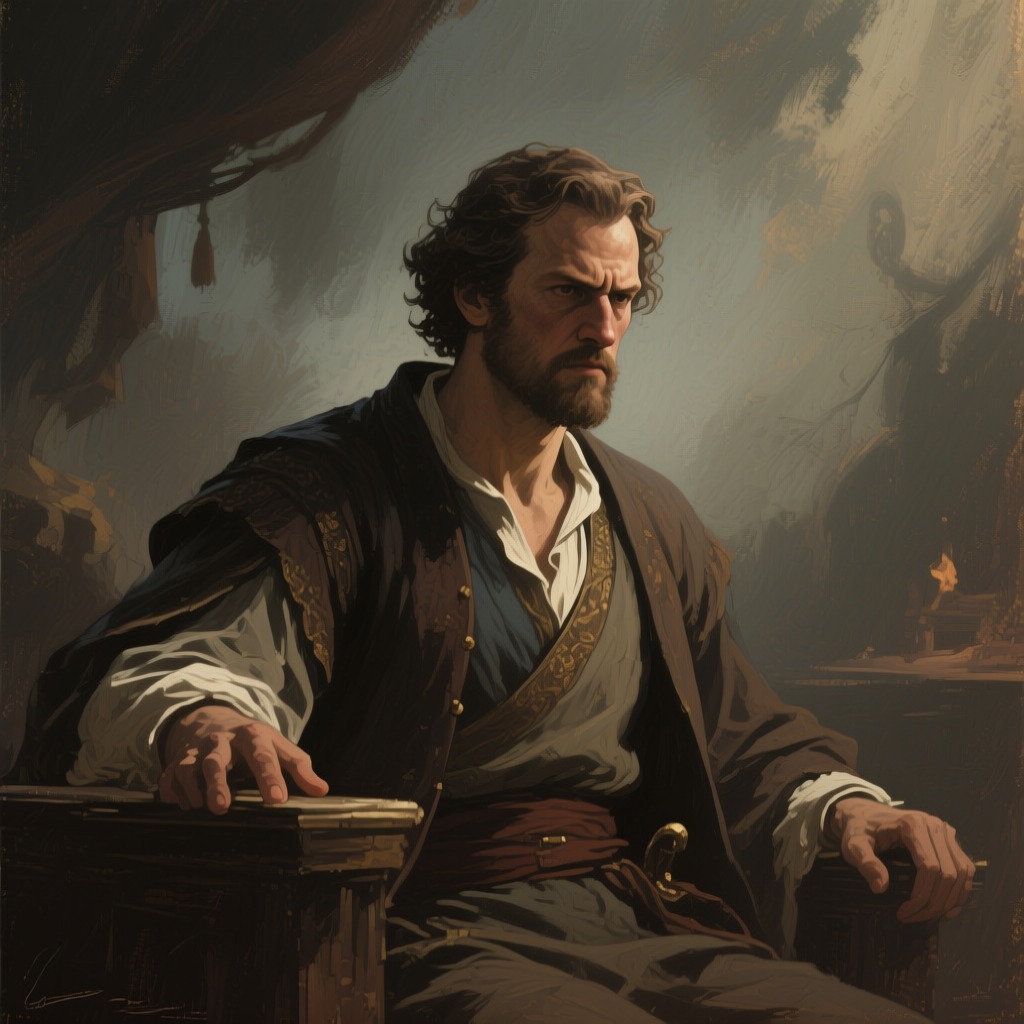
Irji
Irji is the eldest son of Fiyero, the Arjiki prince, and Sarima, the Dowager Princess of Kiamo Ko. As the firstborn, he is the nominal heir to the chieftainship of the Arjiki tribe, a position of considerable authority in the Vinkus. Yet from his first appearance, Irji is defined by a temperament that stands in stark contrast to the martial expectations of his birthright. He is described as "soft" and prone to crying, a boy whose natural disposition is one of sensitivity rather than aggression. This fundamental softness sets him apart from his younger brother, Manek, who is characterized as "a little bantam" and who dominates the sibling dynamic with his cruelty and ambition.
Life at Kiamo Ko and Sibling Dynamics
Irji grows up within the isolated, decaying mountain stronghold of Kiamo Ko, surrounded by his mother, his five aunts (known only by numbers Two through Six), his sister Nor, and the foundling boy Liir. The household is a "nest of venomous doves," and Irji's place within it is largely passive. He is a witness to Manek's relentless bullying of Liir, participating in games of hide-and-seek that turn into cruel ordeals. When Manek suggests pushing Liir off a tower to force him to reveal secrets, Irji laughs along, but he lacks the initiative to lead the cruelty himself. He is a follower, not a perpetrator. His primary bond is with his brother, but it is an unequal one; Irji is the older brother who looks on while Manek acts. The arrival of the Witch Elphaba at Kiamo Ko, and later the presence of Commander Cherrystone's soldiers, further destabilizes the household, but Irji remains a peripheral figure, observing rather than engaging.
Retreat into Religion
As the pressures of his life mount—the death of Manek, the growing tension with the occupying soldiers, and his mother's withdrawal—Irji retreats into a world of private devotion. He begins to "moon about in the old unionist chapel, teaching himself to read better by scrutinizing moldy hymnals and breviaries." This turn to religion is a form of escape from the harsh realities of his situation. Nanny, the family's old nursemaid, observes this change with disapproval, declaring that Irji is "going weird" and that he "ought to be taking some lessons from these men in manliness." Irji's piety is not a source of strength or action but a withdrawal from the world, a quiet refusal to engage with the violent, masculine role that his lineage demands. He composes "long devotional libretti in honor of Lurlina," finding solace in a solitary, intellectualized faith that sets him apart from the practical concerns of the castle.
The Kidnapping and Fate
When Commander Cherrystone's soldiers move to take the entire Arjiki family into custody, Irji is among those seized. The Witch, upon her return, learns from the Wizard himself that Irji did not survive. The Wizard reports, with a chilling casualness, that Irji "had to die" because he was "the next in line to be Prince." The method of his execution was a public affair known as "the Paraffin Necklace," a brutal spectacle designed to make a political statement. Irji, the soft, religious boy who sought refuge in prayer, was killed not for any action he had taken but for the title he was born to inherit. His death is a stark illustration of the merciless logic of political power in Oz, where even a passive heir is a threat that must be eliminated. His fate is a tragic counterpoint to the more active, defiant ends of other characters; he is a victim of a system he never sought to challenge.