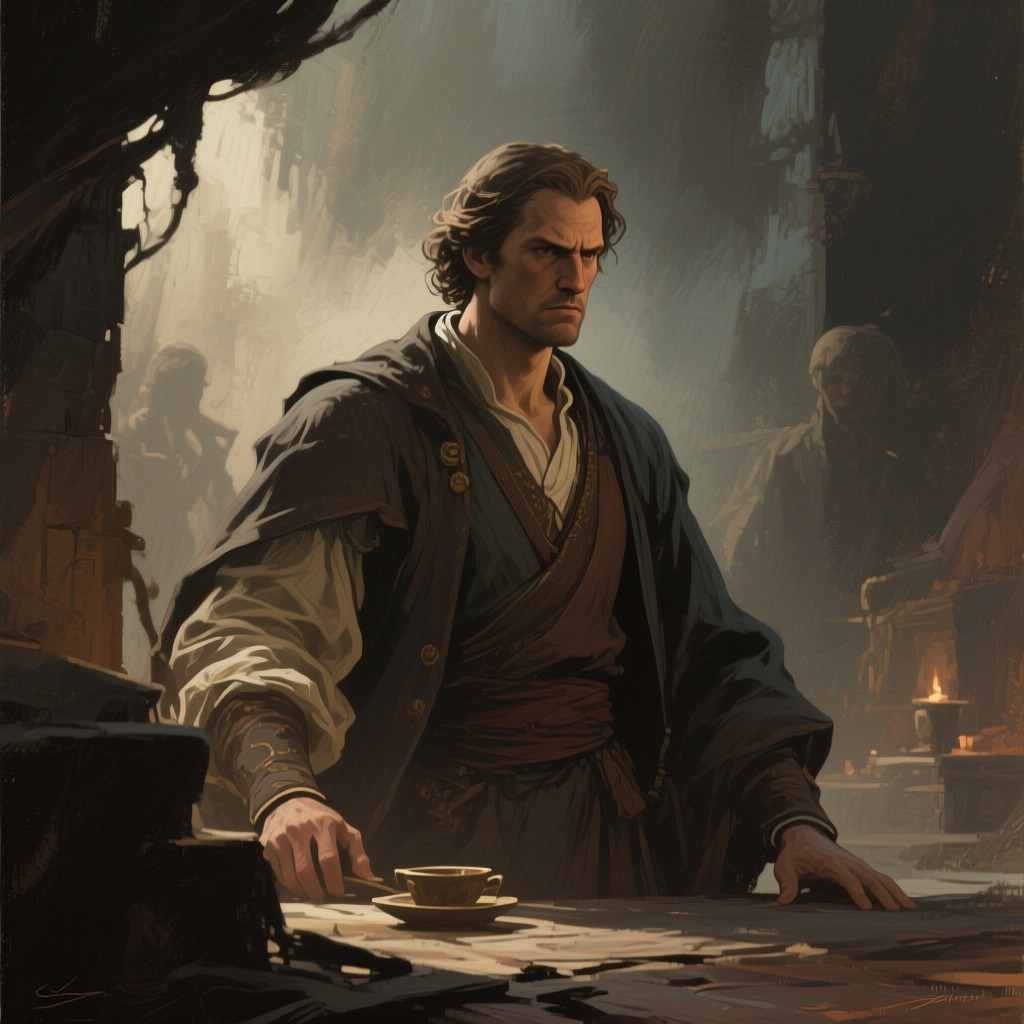
Sarima
Sarima, the Dowager Princess of the Arjikis, is the wife of Fiyero and the mistress of Kiamo Ko, whose refusal to forgive Elphaba for her husband's death becomes a central, unresolved tension in the latter half of the novel. She is a complex figure: a woman of authority and hospitality within her isolated mountain stronghold, yet also a prisoner of her own grief, her family's expectations, and the rigid social codes of her tribe. Her story is one of loss, stubbornness, and the painful limits of mercy, as she chooses to withhold the absolution Elphaba desperately seeks, thereby shaping the Witch's final years.
Identity and Background
Sarima was married to Fiyero at the age of seven, a child bride selected for a prince of the Arjiki tribe. She grew up within the curtain walls of Kiamo Ko, a castle originally built as a waterworks headquarters that was later taken by siege and converted into the seat of the Arjiki princes. Her education in polite behavior came largely from what Fiyero taught her upon his return from Shiz University, and she admits to having mastered reading only later in life. She is the mother of three children: Irji, Manek, and Nor. After Fiyero's death, she became the Dowager Princess, a nominal ruler whose authority is constantly tested by her five younger sisters—known only as Two, Three, Four, Five, and Six—who live with her in the castle and resent her position. Sarima describes her life as one of deprivation and denial, ruling over nothing but irritating children and backbiting sisters, her authority a thin pretense that barely masks her fear of the present, the future, and even the past.
Life at Kiamo Ko and the Arrival of Elphaba
When Elphaba arrives at Kiamo Ko with the Grasstrail Train, Sarima initially welcomes her with the traditional mountain hospitality, insisting that a traveler is always welcome. She is intrigued by the green-skinned stranger, whom she recognizes from Fiyero's stories as the girl who did not believe in the soul. Sarima immediately asserts her authority, refusing to let Elphaba confess her role in Fiyero's death. "I don't care to discuss my husband or the affairs of his death with you," she declares, establishing a boundary that will define their relationship for years. She offers Elphaba and the boy Liir the southeast tower to live in, a gesture of kindness that also keeps the guest at a distance. Sarima's life is one of routine and confinement; she takes her meals alone in the Solar, and her days are filled with managing the castle, dealing with her sisters' petty grievances, and raising her children in an atmosphere of stifled ambition and grief.
Relationships and Conflict
Sarima's relationship with Elphaba is the novel's most fraught dynamic. She is drawn to the green woman as a contemporary and a confidante, yet she steadfastly refuses to hear the truth about Fiyero's death. She believes, based on her own suspicions and the gossip of her sisters, that Fiyero was having an affair with Glinda, and that Sir Chuffrey, Glinda's husband, had him killed out of jealousy. This theory, though wrong, gives Sarima a framework for her grief that does not require her to forgive. She tells Elphaba, "I don't care to know who it was exactly, but I have heard enough about that vile Sir Chuffrey to have my strong opinion." This willful ignorance becomes a form of power, a way to control the narrative of her husband's death and to punish Elphaba by denying her the forgiveness she craves. Sarima's relationship with her children is also marked by tension. She is protective of her sons, Irji and Manek, keeping them close to Kiamo Ko for fear they will be killed by rival tribesmen, but she is also indulgent, allowing Manek's cruelty to go unchecked. Her daughter, Nor, is largely ignored, left to wander the mountains alone. Sarima's sisters, who despise her for marrying Fiyero and then being widowed, constantly undermine her authority, and she in turn treats them with a mixture of condescension and weary tolerance.
Change and Ending
Sarima's life is shattered when Commander Cherrystone and his soldiers arrive at Kiamo Ko, ostensibly to conduct a survey. Despite Elphaba's warnings, Sarima insists on honoring the mountain code of hospitality, allowing the soldiers to stay. When Elphaba leaves for Colwen Grounds to attend Nessarose's memorial service, the soldiers return and kidnap Sarima, her sisters, and her children, taking them to an unknown location. Elphaba spends years trying to find them, but learns from the Wizard that Sarima and her sisters are all dead, and that Irji was executed by a method called the Paraffin Necklace. Sarima's final fate is one of unresolved tragedy: she dies without ever granting Elphaba the forgiveness that might have redeemed them both. Her refusal to listen, her stubborn adherence to her own version of the past, and her inability to move beyond her grief ultimately lead to her destruction and leave Elphaba permanently burdened by guilt.
Thematic Significance
Sarima embodies the novel's exploration of forgiveness, grief, and the corrosive power of withheld absolution. Her character demonstrates how the refusal to forgive can become a form of imprisonment, trapping both the one who withholds and the one who seeks it. She is a figure of cold anger, as she herself describes it: the "ceaseless grudge, the talent to avoid forgiveness, the sidestepping of compromise" that she believes is a necessary compensation for women's limited scope in the world. Sarima's story also highlights the isolation and vulnerability of women in a patriarchal society, where a widow's authority is always provisional and her safety dependent on the whims of men. Her fate—kidnapped and killed by the Wizard's forces—is a brutal reminder that even the most remote strongholds are not safe from the reach of political power. In the end, Sarima is a tragic figure, a woman who chose to live in the shadow of her own pain rather than step into the light of reconciliation, and whose death leaves a wound that never heals.