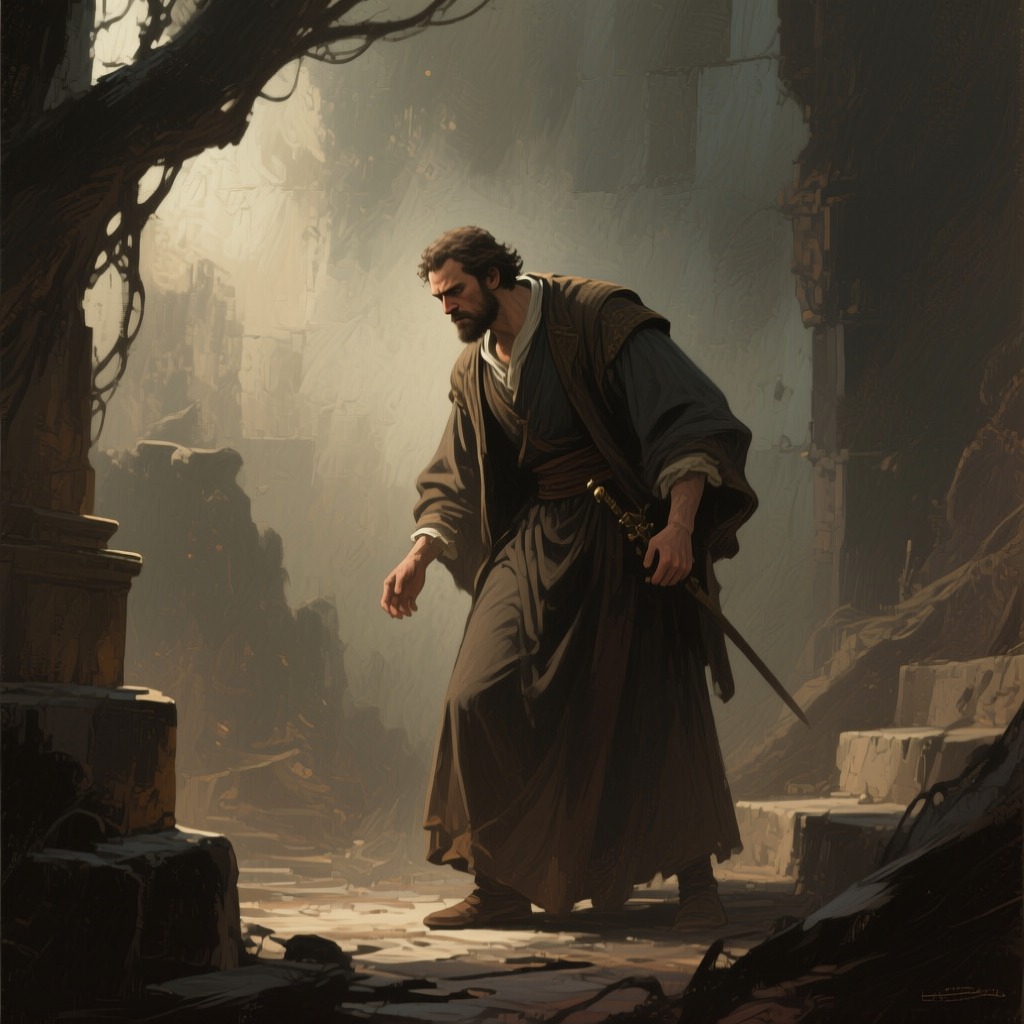
The Scarecrow
The Scarecrow is one of the companions Dorothy Gale gathers on her journey along the Yellow Brick Road. He is a figure constructed from a wooden stake, a crossbar, and a sack of straw, animated by an unknown magic. Though he famously lacks a brain, he repeatedly proves himself the most resourceful and strategically minded member of the group, a paradox that becomes central to his encounters with the Wicked Witch of the West.
Identity and Appearance
The Scarecrow is first mentioned by a peddler who describes him to the Witch as a "straw man" traveling with Dorothy, a Tin Woodman, and a large cat. The Witch, upon hearing this, immediately recognizes him as a figure of myth, one that Dorothy has somehow "awakened" and "charmed to life." The Scarecrow's body is a simple construction: a painted cornmeal sack for a face, stuffed with straw. When the Witch's bees attack the party, the Scarecrow demonstrates his physical nature by pulling straw from his own chest and leggings to cover Dorothy and the Cowardly Lion, protecting them from the stings. He himself is reduced to a pile of straw and empty clothes on the ground, revealing that there is nothing inside him but air and fiber.
Role in the Journey
The Scarecrow's primary function within Dorothy's group is that of a strategist and protector. When the Witch sends her crows to peck out the eyes of the travelers, the Scarecrow knows exactly how to repel them, using his own nature to scare the birds away. When the bees attack, he devises the plan to use his straw as a shield. The Witch, observing these actions from her tower, is forced to acknowledge his ingenuity, muttering, "You've got to give our guests credit for ingenuity." His actions consistently thwart her magical assaults, not through brute force or magic, but through clever, practical thinking.
The Witch's Hope and Disillusionment
The Scarecrow holds a unique and devastating significance for Elphaba. As she watches him from afar, she begins to harbor a desperate, irrational hope: that behind that painted cornmeal sack of a face, there is a face she would know, a face she has been waiting for. She whispers to herself, "Fiyero didn't die. He was imprisoned, and he has escaped. He is coming home to Kiamo Ko, he is coming home to me, and he is disguised as a scarecrow because he doesn't yet know what he will find." She believes that the Scarecrow's cleverness is proof that he is her lost lover, Fiyero, in disguise. This hope is brutally shattered when she witnesses the bee attack through her telescope. She sees the Scarecrow pull out his straw, and she realizes with a shock that there is nothing inside his clothes but straw and air. "No hidden lover returning, no last hope of salvation," the narrative states. The Scarecrow's hollow interior is not a disguise but a literal emptiness, a final, cruel confirmation that Fiyero is truly gone.
Thematic Significance
The Scarecrow embodies the novel's central paradoxes about identity, consciousness, and worth. He is a character who explicitly lacks the organ most associated with intelligence, yet he is the most consistently clever member of the group. This inverts the traditional hierarchy of value, suggesting that wisdom is not a function of biology but of action and experience. For Elphaba, he becomes a symbol of her own shattered hopes. Her belief that he might be Fiyero reflects her desperate need for forgiveness and reunion, a need that the world refuses to satisfy. The Scarecrow's ultimate revelation—that he is nothing but straw—mirrors Elphaba's own fear that she is hollow, that she has "no soul." He is a walking, talking embodiment of the question that haunts her: can a being without a soul still be good, still be worthy of love?