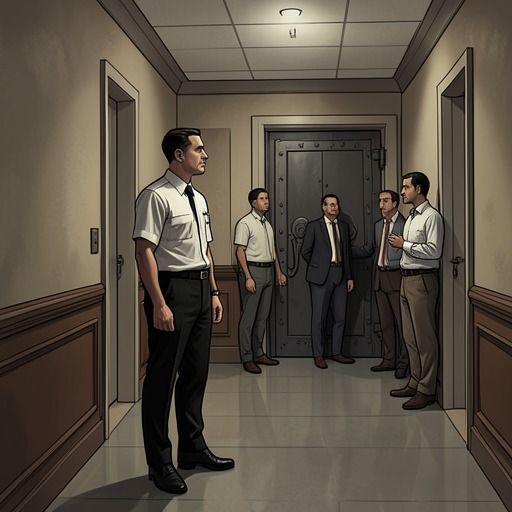
Agarwalla
ChowringheeAgarwalla is a businessman whose influence at the Shahjahan Hotel reaches well beyond that of an ordinary guest: his company permanently leases Suite Number Two, which functions as a private guesthouse, and Karabi Guha works there as its housekeeper and business intermediary. He can present himself as a generous host and public benefactor, yet repeatedly turns the hotel’s hospitality and its workers into instruments of commercial advantage. The contrast between his philanthropic image and his private calculations makes him a vivid embodiment of the novel’s scrutiny of respectability, patronage, and the bargains hidden behind public appearances.
Identity and Suite Number Two
Agarwalla is a regular client of the hotel, but his relationship with it is unusually entrenched. Suite Number Two is reserved for him and is not assigned to other guests. Sata Bose explains that the suite is not merely another room: the prospects of several hotel employees depend on the mood prevailing there. The permanent arrangement gives Agarwalla a private base within the hotel and makes his business a matter of concern to the staff.
The company’s lease turns the suite into a guesthouse, and Karabi is placed in charge of it. Bose describes her as something like a colleague to the hotel staff, while also warning that she is not free to use the hotel’s public spaces as other guests might. She rarely appears, often takes the back stairs, and is not allowed to sit in the lobby lounge because Agarwalla dislikes it. At the same time, she receives a substantial cheque in addition to her salary. Her position thus combines employment, financial dependence, and a measure of authority within the suite: she is the person Agarwalla summons when his arrangements require her services.
Philanthropy as public performance
At a banquet organized by the Sociedad Filantrópica, Agarwalla stands at the entrance with Langford and Khan Bahadur Huq to welcome guests. Their clothing advertises distinct cultural affiliations: Agarwalla wears a bandhgala and churidar, Langford formal Western dress, and Huq attire associated with Mughal tradition. The scene initially seems to offer a picture of people from different communities united by service to humanity. The narrator, however, watches Agarwalla whisper to Langford and make him laugh; the amusement passes along to Huq, and the three men appear to form a convivial whole. The episode complicates the narrator’s earlier ideas about political and religious divisions without making their charitable work free of self-interest.
The banquet’s elaborate scale sharpens that irony. Bose has prepared the hall, where three hundred and fifty boar heads made by Nityahari await the guests. Bose also points out that Agarwalla’s company pays for Suite Number Two as a permanent guesthouse and that Karabi’s work there supports the arrangement. Public generosity and private patronage occupy the same hotel, but their costs and benefits are not evenly distributed.
Bose further warns the narrator not to mistake the banquet’s polished public account for the whole event. Calcutta’s social gatherings, he says, draw repeatedly on the same guest lists, while newspapers print speeches and summaries prepared before the banquet itself. The charitable occasion is therefore both a social performance and a managed story. Agarwalla’s visible role at its entrance belongs to that performance; the private arrangements surrounding his suite reveal another side of the same world.
Hospitality, access, and commercial calculation
Agarwalla’s control of the permanent suite also lets him intervene when business associates need accommodation. When Madhab Pakrashi complains that he cannot secure two suites because hotels are fully booked, Agarwalla appears and insists that a suite is available through his special arrangement with the Shahjahan. He offers to send for Karabi, and Bose immediately directs the narrator to Suite Number Two. The incident presents Agarwalla as someone able to turn a private privilege into public assistance. His help is real, but it also reinforces his standing as a broker of access.
His manner of doing business depends on reading what people want and arranging benefits around it. Karabi describes a southern Indian visitor, Ranganathan, who wants a drink but fears becoming drunk, and who is also curious about cabaret entertainment. Agarwalla offers him access to the cabaret at another hotel and gives him the impression that his religious observance is admirable. Karabi recounts that Ranganathan removes his shoes to pray while drinking, and then explains that he does so because he fears his wife will withhold dinner if he misses his evening prayers. Behind the show of piety lies a nervous customer, and behind the hospitality lies a commercial negotiation.
Agarwalla has sent Ranganathan to Karabi because he is difficult to persuade. Ranganathan controls a potential order for roughly one hundred thousand hinges and is trying to press Agarwalla for favorable terms; Karabi says Agarwalla has reminded her to keep the hinges in view. She recognizes that the cabaret visit and the business discussion are linked, and that Agarwalla uses her skill in dealing with a customer he cannot readily win over himself. In her wry account, the world’s salesmanship consists of finding a way to secure a good deal without paying for it.
The German delegation and the rivalry with the Pakrashis
Agarwalla’s generosity becomes more openly strategic when the German businessmen Reiter and Kurt arrive at the Shahjahan in a Chrysler belonging to Madhab Industries. The hotel is handling their accommodation while the Pakrashi family seeks a partnership with the Germans to build a factory. Karabi discovers that Agarwalla has obtained the detailed plan for the Pakrashi project and wants to approach the Germans separately, without the Pakrashis present. The Germans, she observes, are not committed to working with one Indian business partner rather than another; Agarwalla sees an opportunity to enter the deal on his own terms.
He tries to shape the circumstances around that private approach. Agarwalla repeatedly asks Karabi how long Anindo Pakrashi will remain at the hotel and checks the day’s schedule. She gives him misleading information, saying that Anindo will be there until late, while warning that Phokla Chatterjee is supplying Agarwalla with information. Phokla has promised to keep Anindo away from the hotel that evening, with Agarwalla agreeing to pay whatever is necessary, including expenses for an outing or drinks. The hotel’s guest services and social network become part of a contest over who will control the German project.
Agarwalla’s conduct in the lobby sustains the appearance of ordinary hospitality. He tells Anindo that he has come to see a friend who is supposedly waiting in the bar, then goes to the lobby telephone and fails to reach the person he wants. When Phokla arrives looking for him, Agarwalla has already instructed the staff to say that he has gone to Mrs. Chakladar’s home. This small evasion sits beside his public assurance that he has come as a friend and that he wants the German guests to be comfortable. The episode does not erase his generosity toward the Pakrashis, but shows how readily courtesy and concealment can coexist in his business dealings.
Narrative significance
Agarwalla is defined less by a single confrontation than by his ability to move between public and private roles. At a philanthropic banquet he appears as a civic-minded host; in the hotel he is the powerful client whose permanently leased suite affects employees’ prospects; in commercial dealings he arranges access, entertainment, information, and introductions to improve his position. The staff’s labor makes each role possible, while Karabi’s situation shows how a person can be at once an employee, an intermediary, and an instrument of a patron’s plans.
The hotel is consequently more than a setting for Agarwalla’s transactions. Its rooms, lobby, telephone, and banquet hall connect civic display to private negotiation. The carefully staged charity gathering and the discreet manoeuvring around the German partnership are different versions of the same social order: both depend on lists, access, performance, and relationships that can be converted into advantage. Through Agarwalla, the novel makes visible the commercial calculations beneath Calcutta’s polished hospitality without reducing every act of assistance to mere deception.