Sir Hariram Goenka
ChowringheeSir Hariram Goenka survives in the novel less as an active participant in events than as a bronze presence before whom the narrator measures ambition, honesty, and historical remembrance. His statue stands in Calcutta as evidence that a few citizens escape the city’s oblivion, while the narrator’s repeated addresses to it turn a public monument into a private witness.
Identity and Public Memorial
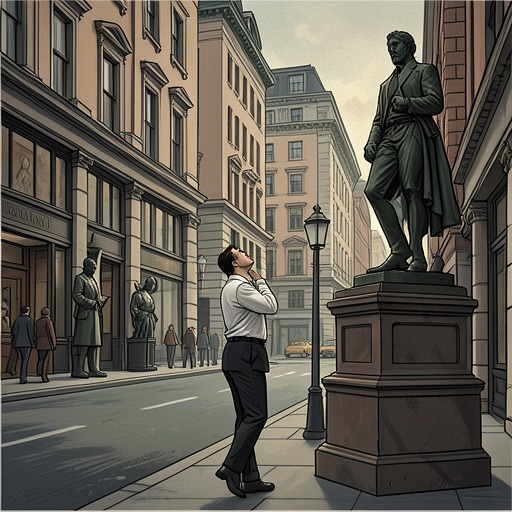
An inscription records Sir Hariram Goenka’s dates: he was born on June 3, 1862, and died on February 28, 1935. The novel presents him as one of Calcutta’s most distinguished deceased citizens, and as a man who once presided over the city’s commercial world. The statue stands before the governor’s residence; at one point, a pair of crows perch on its shoulder. That small, ordinary detail places the monument amid the lived city rather than apart from it, even as its permanence distinguishes Sir Hariram Goenka from the crowds who pass through Calcutta.
The narrator first invokes the statue while recalling a difficult period after the death of his British employer. A doorman at the Clive Building offers him tea, puts a hand on his shoulder, and urges him not to lose heart. He points to Sir Hariram Goenka as someone who, too, had struggled to survive, and tells the narrator that he sees the same fire in the young man’s eyes. The doorman’s prediction that the narrator might one day become as great as Sir Hariram Goenka gives the name an intimate force: it is not merely an emblem of wealth, but a measure of what someone rising from poverty might become.
The Statue as Witness and Judge
The doorman’s encouragement is complicated by the narrator’s own conduct. He has asked for four annas per basket and recognizes that he has betrayed the doorman’s trust. After leaving Dalhousie Square, he goes to Curzon Park, where people without offices or secure shelter rest beneath the trees. There, seated at the statue’s feet, he silently thanks those whose donations made the park possible, including Lord Curzon, and then appeals to Sir Hariram Goenka for forgiveness. The statue seems to turn its face away. The narrator explains that the doorman has seen traces of Sir Hariram Goenka in him, but insists that he means no insult.
The scene makes the monument a focus for a private moral reckoning. Sir Hariram Goenka does not speak or act; the narrator supplies the judgment he fears, reading the statue’s posture as disapproval. The contrast is pointed: the doorman sees promise in the narrator, while the narrator, conscious of a small betrayal, doubts that he deserves the comparison. His address to the statue brings public greatness down to the scale of everyday conduct, where trust can be broken over the price of a basket.
Calcutta, Commerce, and Historical Memory
Sir Hariram Goenka also belongs to the novel’s account of a city that makes fortunes and then forgets most of the people who made them. At the western end of Curzon Park, the statue continues to gaze toward Raj Bhavan. The narrator imagines it asking whether a merchant’s scales are weaker than a ruler’s sceptre. The image sets commercial power beside political authority, while the surrounding reflection stresses how people of different origins, languages, customs, and fortunes have arrived in Calcutta and been swept, with time, into oblivion. Only a few survive that erasure in the form of statues.
This survival is significant but incomplete. A statue preserves a name and a public identity; it cannot hold the full texture of a life or the stories of the many people who remain uncommemorated. The narrator’s address to Sir Hariram Goenka therefore carries both reverence and unease. The monument marks exceptional remembrance against a background of near-universal forgetting, while the narrator’s own presence at its feet suggests how much history is lived beyond the reach of official memorials.
The Shahjahan and the Reach of the Past
Later, after finding work at the Hotel Shahjahan, the narrator returns to Sir Hariram Goenka in thought and speech. He imagines that the hotel’s nights must have been as brilliant as its days when Sir Hariram Goenka governed the city’s commercial empire, and supposes that the magnate must have visited often. The passage frames this as the narrator’s conjecture, not as a confirmed account of Sir Hariram Goenka’s visits. By speaking to the statue about his new employment, the narrator connects his modest place in the hotel to an earlier Calcutta of commerce and splendour.
That connection resonates with the novel’s other surviving fragments of the past: old drawings in the hotel lobby welcome visitors with the assurance that the establishment has a long history behind it, while later recollections attach dramatic events to a hotel receptionist otherwise forgotten. In this landscape of statues, sketches, and memories, Sir Hariram Goenka represents one of the few lives made publicly legible. Yet the narrator’s encounters with his image keep that legacy from becoming merely ceremonial. The statue is at once a civic monument, a promise offered by a compassionate doorman, and a silent presence before which the narrator confronts the distance between aspiration and deserving it.