Shankar
ChowringheeShankar is the first-person narrator and a developing hotel worker whose education at the Shahjahan Hotel is both practical and emotional. He learns the reception desk’s demands, discovers that he can perform beyond his experience, and gradually becomes someone Satyasundar Bose trusts with private counsel. His narrative also makes him the recipient of other people’s late disclosures: Sutherland’s confession about his origins and Bose’s letters about a love and loss that leave him bereft.
Identity and Narrative Position
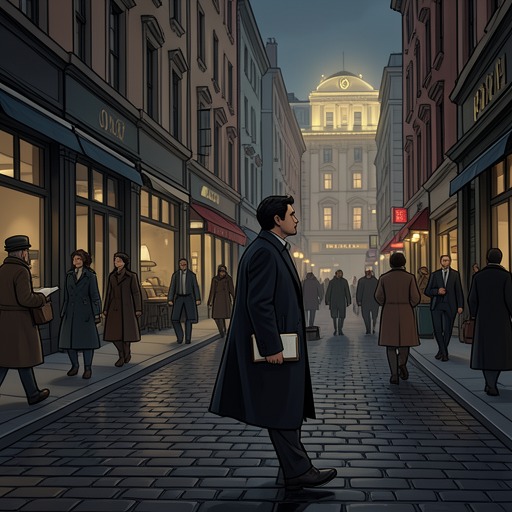
Shankar recounts events from within the hotel’s working life, observing its staff and guests while also recording his own changes. The surviving episodes show him at different degrees of maturity: initially inexperienced in the conventions of the hotel, then increasingly able to take responsibility and understand the emotional costs carried by those around him. His account is not simply a record of hotel procedure. It gives private weight to gestures that might otherwise disappear into routine: a meal left in a drawer, an apology sent after departure, or a letter written because its sender has nobody else.
The hotel’s reception desk becomes a vantage point as well as a workplace. From there, Satyasundar Bose can notice Shankar’s condition and encourage his growth; later, Shankar is also the person to whom Bose turns when he needs advice. That movement—from being taught to being trusted—gives the narrator’s development a clear shape without suggesting that he ever stands outside the precarious lives he describes.
Work, Confidence, and the Threshold of Adulthood
On the day Satyasundar Bose begins teaching him the principles of reception work, Shankar’s experience is marked by a reversal: Rosie has just shut a door in his face, yet the new instruction opens, in his perception, a window onto the world. The contrast joins personal rejection to professional opportunity. He is not presented as having mastered the hotel at once; rather, the beginning of training gives him access to a broader world of people, rules, and encounters. Satyasundar Bose also tells him that Calcutta is known for its banquets, where people spend themselves into ruin arranging parties, hinting at the social spectacle he may learn to manage from behind the desk.
A later night walk through deserted Calcutta becomes an inward threshold. Shankar feels that he has at last reached adulthood, leaving behind the inexperienced way in which he had previously seen the world. The narrative identifies this as a change in perception, not as a sudden acquisition of worldly mastery. When he returns to the hotel, Satyasundar Bose reads his reddened eyes and asks after him. He has noticed that Shankar missed dinner, asked Juneau whether he had seen him eat, and saved sandwiches supplied by the older man. With the hotel otherwise quiet, he permits Shankar to eat them at the desk despite the rules.
Satyasundar Bose’s practical kindness is joined to a strikingly expansive estimate of Shankar’s abilities. He praises Shankar’s work as an emcee and reports that Connie was impressed that he had never introduced a cabaret performer before. He imagines him becoming indispensable across reception, the bar, and the cabaret. Shankar begins to cry, unable to explain his reluctance to let the tears fall; Satyasundar Bose responds with an affectionate embrace. The scene links professional recognition to emotional release: the young worker is being told not only that he performed well, but that his place in the hotel may matter.
Curiosity, Discretion, and Learning
Shankar’s growth does not mean that he already possesses polished manners. After learning that people pay to see Connie and do not care about Lambreta’s performance, he walks toward the elevator, then follows an impulse and takes the stairs. On a melancholy dry day, he enters Connie’s room without warning, hoping to discover what the manager had said to her. In retrospect, he recognizes the breach as audacious and says that his later knowledge of good manners would have kept him from doing it. At the time, however, he was inexperienced and driven by a need to know.
He does not regret the intrusion. He considers what he learned that day beneficial and himself fortunate to have learned it. The account does not specify the lesson in this passage, so the importance lies partly in the narrated contrast between the impulsive young employee and the more considerate observer looking back. Shankar’s recollection preserves both facts: his conduct crossed a boundary, and the experience nonetheless enlarged his understanding. His maturity is presented as something acquired through encounters, including mistakes, rather than as a quality he possessed from the beginning.
Sutherland’s Letter and a Hidden Past
Sutherland leaves for London early the morning after the events that had strained his relations with Shankar. Shankar does not see him before he goes and expects that the discourtesy might have remained unforgiven. A few days later, however, a letter arrives. Sutherland apologizes for his behaviour on that night and for withholding the truth from both Shankar and Hobbs. He says that his connection with India has ended and that the World Health Organization is sending him to Tahiti, where he expects to spend the few days remaining to him.
The letter discloses the history that makes Sutherland’s departure more than a personal parting. He was born in Williams Lane; his parents were Robert Adam and Jane Grey. The child whose life was saved through the generosity of the boys of Williams Lane was taken back to England by Father Sutherland and legally acquired the clergyman’s surname. Sutherland explains that this history was the reason he wanted to spend his last night in Calcutta at the Shahjahan Hotel, and he thanks Shankar for making that wish possible. The apology and the revelation arrive together: Shankar receives both the correction of a painful misunderstanding and the concealed account of the man’s identity.
Sutherland’s letter also conveys relief that the hotel bar no longer employs hostesses. He credits Mrs. Brockway of Union Chapel with sparing many girls a life of misery as barmaids, regrets that she has died before he could visit her, and says he has written to her son. By carrying this reflection to Shankar, the letter extends beyond private reconciliation into a judgment about the conditions faced by women in the bar trade. Shankar’s narrative gives that judgment a place alongside Sutherland’s personal history, without confusing the two.
Bose’s Trust, Departure, and Grief
Shankar’s relationship with Satyasundar Bose changes from instruction to mutual confidence. At a cafeteria in Howrah Station, Bose tells him that he had thought himself made of steel but now understands he was mistaken. He describes Shankar as a brother and his only friend at the Shahjahan, and asks for his advice. Shankar is pleased that Bose has turned to him in a time of need. The exchange reverses their earlier positions: the mentor who had read Shankar’s distress and offered food and encouragement now admits his own vulnerability and seeks help.
After leaving for Santa Cruz, Bose writes that he has settled in an airline hotel. He recalls the story of a washerman’s son transformed into a prince who cannot enjoy his new life and finally invites his companions to play while washing clothes. Bose sees himself in that figure, sitting in a lobby, thinking of his friends and wishing to keep playing while he washes. The tale gives form to his dislocation: a changed station has not erased his attachment to the life and people left behind. He also tells Shankar that Sujata Mitra had been there for work and that the prospect of a home and family, which he had never allowed himself to consider seriously, is becoming increasingly attractive.
Bose’s later letter turns that emerging possibility into bereavement. After Sujata dies in a car accident on the way to Delhi airport, he writes that he has returned from scattering her ashes in the Arabian Sea and has nobody else to whom he can write. The airline had listed him as her closest contact, and, in accordance with her last wish, arranged for her body to be sent to him by air. Bose understands that she had chosen him as the person nearest to her among all people. He also confesses that he postponed marriage while thinking about himself and his career, whereas Sujata never hesitated to acknowledge him as her man. Shankar receives the account of a relationship whose emotional truth outlasted its uncompleted plans. As the letters’ addressee, he becomes the witness to Bose’s grief; as narrator, he preserves the difference between a life’s outward arrangements and the intimacy a person has already recognized.