Gurberiya
ChowringheeGurberiya is a Hotel Shahjahan attendant whose small acts of service and uneasy night watch reveal how sharply a hotel’s hierarchy can shape a worker’s prospects. Once employed on a guest-facing floor, he is sent to the roof after breaking a dozen cups; with that demotion, he loses access to tips and the marriage that had been arranged for him. He remains attentive to Satyasundar Bose, whom he believes can influence his future, and tells the narrator that even the hotel’s dead founder continues to police its night shift.
Identity and Introduction
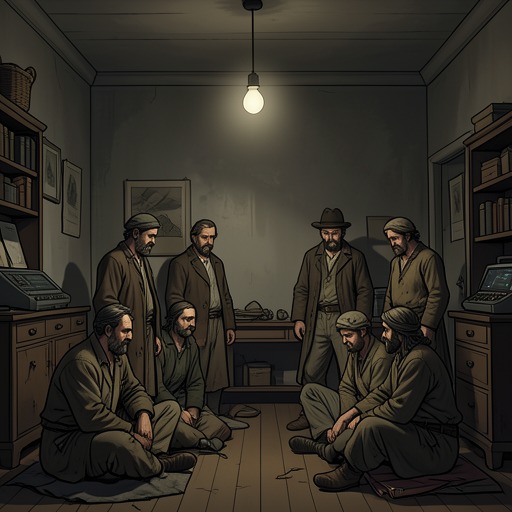
Gurberiya first appears as an attendant who comes promptly when Satyasundar Bose stops outside his dark room. Once the room is lit, Bose introduces him as his watchman and presents him to the newly arrived narrator as a fellow Bengali. He even describes the newcomer as the hotel’s second governor, though that grand title does not alter the practical difference between Gurberiya’s lowly position and Bose’s authority.
Gurberiya responds with a bow, his turbaned head lowered. The gesture establishes his deferential manner, but he is not merely a figure in the background: Bose gives him responsibility for guiding the narrator to room 362 and fetching its key. Earlier, an attendant had carefully taken off Bose’s shoes and socks, placed them beneath the bed, and set out sandals. The sequence presents service as precise, physical labor, performed with a familiarity and submission that Bose commands among the staff.
Demotion and Lost Prospects
Bose explains that Gurberiya once worked on the second floor, directly serving hotel guests. After he broke half a dozen cups, the management transferred him from guest service to service for the hotel staff and banished him to the roof. Bose compares the change to leaving a job with Shell to keep the books in a corner grocery: Gurberiya has not been killed, but he has been removed from the source of the hotel’s tips. His punishment is therefore economic as well as occupational, marking the difference between serving paying guests and serving workers who cannot provide the same rewards.
The demotion also upends a personal prospect. Parabashia, the chief doorman, had arranged for Gurberiya to marry his daughter. After Gurberiya’s sudden loss of status, Parabashia withdrew from the arrangement. The account gives no further details about the daughter or the intended marriage; its consequence for Gurberiya is clear nonetheless. A workplace reversal reaches beyond the hotel, narrowing his prospects outside it as well.
Dependence on Satyasundar Bose
Bose says Gurberiya is trying to recover from the setback by giving him his full attention. Gurberiya appears to believe that Bose has enormous influence over both Parabashia and Marco Polo, and that neither could refuse a request from him. That belief helps explain his attentiveness: his service is not only a duty but also, in Bose’s account, a bid to regain what the demotion has cost him.
The relationship is unequal but mutually revealing. Gurberiya relies on Bose’s perceived connections, while Bose can describe the demotion, lost tips, and broken marriage as an example of the hotel’s internal hierarchy. When Gurberiya arrives with the key, Bose ends his explanation and Gurberiya leads the narrator away. His practical usefulness is immediate; the power to change his own circumstances, as far as the account shows, remains elsewhere.
Night Watch and the Ghost of Simpson
On another night, Gurberiya knocks insistently at the narrator’s door after the narrator has fallen asleep with the lights on. It is very late, and the narrator, woken abruptly, is angry at the interruption. Gurberiya’s visit places the narrator’s irritation against the attendant’s continuing night duty: what seems to the sleeping guest an unwelcome disturbance belongs to Gurberiya’s work of watching over the hotel.
Gurberiya explains that the cause of his sleepless nights is Simpson, identified as the hotel’s first proprietor and known by a slight limp in his right foot. He recounts that, around two in the morning, after finishing his work, he nodded off on his stool. The guests were asleep, the doors secured, the corridors quiet and dark. As soon as he closed his eyes, he felt someone removing his belt. When he seized it, he saw Simpson; Gurberiya tried to prostrate himself, but says such a gesture cannot be made before a ghost.
In his telling, Simpson ignored Gurberiya’s tearful promise not to do it again, took the belt, and left it in a dark corner on the second floor. Gurberiya presents the encounter as proof that a ghostly manager has no mercy and allows no rest on the night shift. His account turns the hotel’s labor discipline into something that survives its human management: even after death, its founder appears to enforce the expectation that workers remain alert. The narrator is half asleep and nearly laughs at the story, leaving Gurberiya’s testimony suspended between comic absurdity and the unease of a worker who cannot escape the demands of his post.