Sreelekha Devi
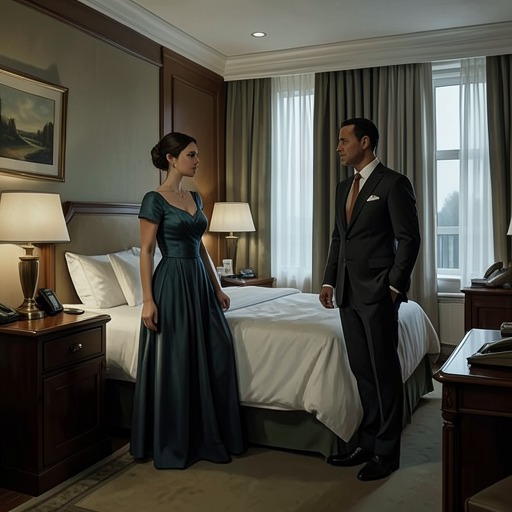
ChowringheeSreelekha Devi is the most famous film star in the world of the novel, but her appearance at the Hotel Shahjahan reveals how little celebrity makes visible about a person’s private life. Seen first through the narrator’s awareness of her screen image and a remembered scandal, she becomes, over the course of one night, a woman asking for a sari and then quietly rejoining a husband who has waited for her outside. Her brief visit ends in departure rather than explanation, leaving the hotel staff with an unpaid bill and the narrator with only an imperfect view of what passed between them.
Identity and Public Image
The narrator has seen Sreelekha Devi’s photographs in film magazines, where they have made a striking impression, but he has never expected to encounter her anywhere other than on the big screen. Her fame is described in extravagant terms: crowds would have filled the hotel to see her. The contrast between that public image and her actual presence at the reception desk gives her entrance its force. She is recognizable as a star, yet the scene does not make her glamour an explanation for her actions.
Before meeting her, the narrator knows her chiefly through a story involving Phokla Chatterjee. At a party at the Shahjahan, Phokla vomited on her after trying a cocktail named Film Star. Sreelekha Devi refused his apology, loudly declared that she would never again attend a party where he was present, and left. The consequence reached beyond that evening: people in the film world stopped inviting Phokla to their parties. His later account of the incident casts her as unforgiving; he says she thinks he acted deliberately and threatens to throw a bucket of water in her face so that her real appearance will be exposed. But the narrator has no personal acquaintance with her before this night, and Phokla’s grievance is not independent proof of what she is like.
A Night at the Hotel Shahjahan
When Sreelekha Devi arrives, Satyasundar Bose greets her and gives her a room key after checking the register. The narrator is startled because Satyasundar Bose has just told a caller that the hotel is full, although the narrator knows rooms are available. The discrepancy places her arrival within the hotel’s practical world of access and decisions, but the evidence does not explain why the caller was turned away or what connection, if any, that refusal has to Sreelekha Devi.
Her first surprising request is for a sari. She asks for one at an hour when the shops are closed, and Satyasundar Bose points out that nothing can be bought at that time. The small, immediate need cuts across the grand image the narrator associates with a screen star: in the hotel, her fame does not make an ordinary closed shop open. The scene records the request and the obstacle without explaining why she needs the garment.
Later, while the narrator is on duty, the telephone rings and Sreelekha Devi identifies herself from her room. The narrator wonders whether she is still awake because she feels uncomfortable away from home, but that is his conjecture, not an explanation she gives. Her call leads into a meeting with her husband outside. The narrative gives no account of what she says to the narrator on the telephone, preserving the limits of what he can know.
Marriage, Departure, and Narrative Significance
At around four in the morning, Sreelekha Devi’s husband waits outside rather than entering the hotel. The narrator is struck by the cheap brand of cigarette he smokes. The man explains that when he brought Durga to Calcutta, they used to eat at Little Shahjahan because it offered the cheapest meal. He still smokes the same cigarettes, he says, although Durga has become the celebrated Sreelekha Devi and moved from the modest Little Shahjahan to the grander Hotel Shahjahan. His account preserves the name Durga and a shared history of inexpensive meals, setting the couple’s earlier circumstances beside her present celebrity. He refuses to come inside, adding that after waiting until four he can wait a little longer.
When Sreelekha Devi comes down, she walks directly toward the door, asks the narrator not to follow farther, and approaches her husband in the street. From a distance, the narrator cannot make out their words. He sees what appears to be her sobbing and her husband trying to comfort her. They then get into a car; the husband drives away without speaking to the hotel staff. The encounter supplies an image of distress and concern, but not its cause, and the narrator’s restricted view prevents the scene from resolving the couple’s difficulties for the reader.
Her departure has an immediate, prosaic consequence for the narrator. He realizes that Sreelekha Devi has left without settling the room charge, and fears that the cost will be deducted from his wages because ensuring payment is his responsibility. He had not thought to ask her for money amid the events of the night. The ending thus places the star’s unexplained private crisis beside the employee’s concrete financial exposure. Sreelekha Devi remains at once a public figure, a wife with a history reaching back to Little Shahjahan, and a person whose private reasons the hotel’s watchful but powerless narrator cannot recover.