Sutherland
ChowringheeSutherland is a physician and epidemiologist for the World Health Organization whose return to the Hotel Shahjahan ends in a letter that recasts him from a passing international visitor as a child of Williams Lane. His professional identity is public and mobile; his Calcutta origins are private, withheld until after he has left. The contrast gives his last night in the city its force: what first looks like a difficult guest’s unexplained anger becomes the response of a man confronting a past he had not told the hotel staff.
Identity and Background
When Shankar first sees Sutherland, he has only recently begun his career at the Hotel Shahjahan. He hears that Sutherland has come to India as a representative of the World Health Organization and is involved in research on an important vaccine. Later, the hotel staff hear that he has left India carrying dangerous disease germs preserved in a refrigerator. These fragments establish a scientific career directed toward epidemics, but they reach Shankar as hotel talk, not as a personal history. Sutherland is one among the many guests who pass through the building, and Shankar does not ask after him once he disappears from view.
Sutherland’s later letter supplies the identity that his professional travels have obscured. He states that he was born in Williams Lane and names his parents as Robert Adam and Jane Grey. As an infant, he was saved through the generosity of the neighborhood boys. Father Sutherland took him back to England, and the child received the legal right to use the priest’s surname. The disclosure links a celebrated scientific visitor to the local community whose history Shankar had not known was also his own.
The Return to the Hotel
Sutherland’s next appearance follows a delayed flight from London that lands at Dum Dum Airport after its scheduled time. He returns to the Hotel Shahjahan the previous night, while Shankar is asleep, and the two meet the next morning on the rooftop. Sutherland sits in a folding chair in a T-shirt and trousers, looking east toward the horizon as if absorbed in it. The morning roar of buses and trucks rises from the distant street; he seems to be listening closely. Shankar, surprised and dressed only in a lungi, slips back into his room. The quiet, unusual encounter gives no immediate explanation of why Sutherland has returned or what the city means to him.
The return ends with Sutherland leaving for London early the following morning. Shankar does not see him before his departure, and believes he will never see him again. In the taxi ride before that departure, Shankar has remained silent, and Sutherland has also said nothing. Shankar leaves the car without waiting for thanks and goes back to the reception counter. The parting therefore appears abrupt and unresolved; the letter that arrives a few days later changes its meaning.
Apology and Disclosure
In the letter, Sutherland tells Shankar that he cannot make peace with himself without writing. He regrets his conduct before leaving the hotel and acknowledges that he had withheld the truth from both Shankar and Hobbs. He had intended to apologize in person on another visit, but says that his connections with India have ended. His next World Health Organization assignment is in Tahiti, where he expects to spend the few days he has left. The letter is thus not simply a correction of manners: it is his only remaining means of explaining himself to the people he has wronged.
Sutherland connects his outburst to what he has read and heard about Calcutta, which, he says, proved different when experienced with the hotel staff. He explains that he wanted to spend his last night in the city at the Hotel Shahjahan and thanks Shankar for making that possible. His account recasts the hotel stay as a return to the place of his birth, though he had not told Shankar this while they were together. The emotional explanation arrives only after the encounter has ended, giving the letter the shape of a delayed confession and apology.
Memory and Narrative Significance
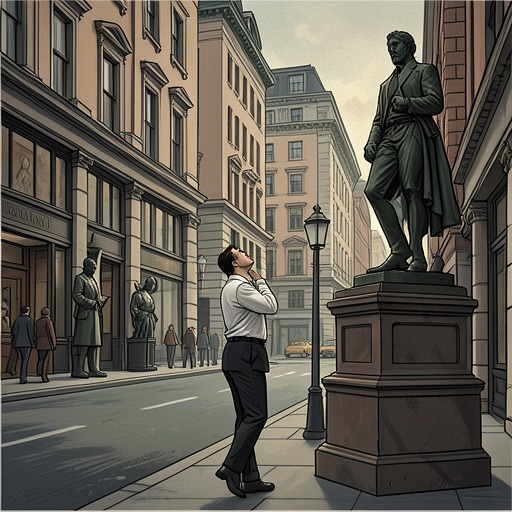
Sutherland’s appearance had already made an impression on Shankar before the disclosure of his origins. Satyasundar Bose compares him to a Greek sculpture, and Shankar later visits an old house on Chitpore Road to look at a damaged nude statue. Its broken arm and missing part of the face do not prevent the statue from bringing back Sutherland’s face and the agony Shankar associates with him at Lower Circular Road Cemetery. This remembered image makes Sutherland’s physical presence vivid even as it becomes indistinct in Shankar’s memory; the later letter supplies the history that the image alone could not explain.
The characterization is built around a sharp difference between what Sutherland does and what he tells. His work takes him across countries in pursuit of the causes of epidemics, while his own connection to Calcutta remains unspoken until he is already gone. He is not reduced to the distant doctor or the angry guest: the letter joins his professional mission, his remorse toward Shankar and Hobbs, and the recovered story of his birth. His departure to Tahiti closes the immediate relationship, but his confession turns the hotel’s ordinary traffic of arrivals and departures into a moment of recognition, revealing how much of a guest’s history can remain invisible to those who serve him.