Miss Munro
ChowringheeMiss Munro is a singer whose pursuit of music begins amid poverty and social constraint, and whose marriage to Marco Polo briefly promises escape from the limits of her life in Calcutta. Her story joins the precarious labor of an aspiring performer to a marriage shaped by public reputation: in Calcutta, a woman’s past as a Park Street singer can seem to bar her from the social heights of Chowringhee, while marriage itself can also serve as protection.
Identity and Background
Miss Munro lost both parents and was brought up by a charitable organization that tried to prepare her to support herself. As an adult, she sought independence through work rather than relying on a family household. She first sold cakes at a Swiss pastry shop near New Market, but music remained her passion and fame her ambition. She was even willing to sing in restaurants without pay, a choice that expresses the strength of her desire to perform but also the precariousness of her means.
Her route to a restaurant stage was arduous. She spent the day standing in the pastry shop, then went directly to sing, changing clothes at the restaurant because there was no time to return home. The venue offered no women’s bathroom: she asked a waiter to stand guard at the door while she changed in the shared bathroom, whose stench nearly made her vomit. These conditions place her musical aspiration within the unglamorous physical work required to pursue it. Performance did not remove hardship; it added another shift to her working day.
Work, Voice, and Meeting Marco Polo
Miss Munro was singing at a small Park Street restaurant when Marco Polo entered one evening seeking respite from the bustle of his hotel. The narrator’s account, relayed by Byron, presents their first encounter through Marco’s attention: he stopped concentrating on his dinner, listened to her sing, and later invited her to his table. Byron’s assessment distinguishes her appearance from the effect she had on Marco. He did not consider her particularly beautiful, yet Marco was convinced that the performer before him was like a nymph. The contrast suggests that his fascination arose not from conventional beauty alone but from the force of her performance as he perceived it.
Her voice had not been cultivated at a music school. When Marco expressed surprise that she had never studied singing formally, she explained that music lessons cost money. Her talent and her lack of access to training therefore belong to the same account: she possessed a voice Marco found remarkable, while poverty had kept formal instruction beyond reach.
At the restaurant, however, her place onstage was temporary. Another singer, Lisa, had broken a leg and was recovering; Miss Munro was allowed to sing while Lisa was absent. Once the doctor removed Lisa’s cast, Miss Munro expected her days as a singer there to end. The opportunity that brought her and Marco together was thus contingent on another woman’s injury, and Miss Munro knew from the outset how quickly it could disappear.
Marriage, Mobility, and Reputation
Marco felt sympathy for Miss Munro, and her orphanhood drew him closer because he, too, had lost his parents. He took her to the hotel as his wife. Their shared bereavement forms part of the account of their attachment, but marriage also changes the practical circumstances of her life: Marco leaves Calcutta with her because her history there is widely known. He believes that a woman who has sold her music on Park Street cannot rise to the social heights of Chowringhee, and that remaining in the city would prevent her from succeeding.
Marco accepts a hotel-manager position in Rangoon, where the couple can live among people who do not know Miss Munro’s past. The move is presented as an attempt to begin again beyond the reach of Calcutta’s recognition and judgment. It is also a sharp measure of how limited her prospects seem: rather than staying and challenging the status attached to her earlier work, the couple seeks a place where that history is unknown. The arrangement offers distance, but it does not erase the importance of reputation in their marriage.
Separation and the Meaning of Respectability
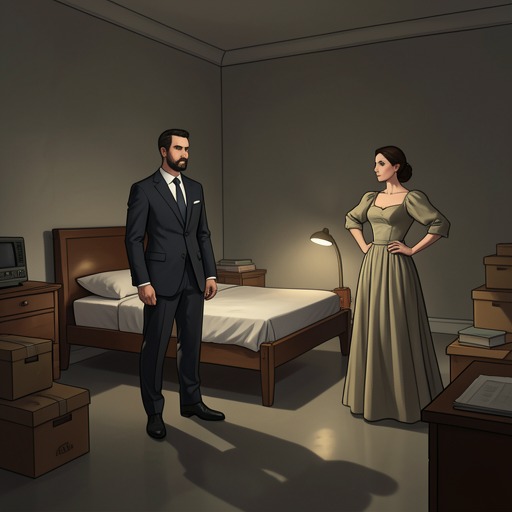
Later, after Marco raises his voice to God on the terrace on Theatre Road, he tells Miss Munro over breakfast that it is time for them to separate. She does not agree at first. Her response shows that the marriage has provided more than companionship: because she is married, she says, undesirable men do not dare to trouble her, and the American military police keep officers from coming to her home. She fears Marco will destroy the respectable profession she has through marriage.
That exchange complicates the apparent promise of escape. Marriage had taken Miss Munro away from the restaurant and the reputation that, in Marco’s view, blocked her advancement; now its public status is also a shield against harassment. Her objection is not merely resistance to a personal break. It registers what separation may cost her in security and social standing. The account records Marco’s announcement and her initial opposition, but does not establish the final outcome of the separation.
Miss Munro’s story is conveyed through Byron’s recollection to the narrator, who is shown an old newspaper image that Byron obtained from the offices of The Statesman after buying the relevant issue. The aged photograph cannot recover her beauty, while the narrative instead reconstructs her through work, voice, and the judgments placed upon her. Her trajectory moves from cake shop to restaurant stage, from a precarious singing engagement to marriage, and from Calcutta to Rangoon. At each turn, the possibility of independence is shaped by money, opportunity, and reputation; the marriage that seems to offer protection also becomes something Marco can announce an end to.