B. Byron
ChowringheeB. Byron is a would-be private detective whose optimism is matched by a knack for turning uncertain circumstances into opportunities. He investigates a client’s husband, uncovers an affair involving Rosie, and uses the resulting vacancy to propose a place for the narrator. His part in the story joins detective work to friendship: he presents himself as someone who may be useful when needed, then notices when the narrator is in trouble and asks for help in return.
Identity and Ambition
Byron introduces himself through a business card that identifies him as a friend to call on in need. Its telephone line is blank: he has no number yet, but says he expects to have one in the future. The empty space makes his professional identity visibly provisional, while his explanation refuses to treat that incompleteness as failure. He imagines not only a telephone but also a car, a house, and a spacious office, and believes a focused private detective can eventually earn more than a chief inspector of the High Court.
The narrator has encountered detectives mainly through books and stories, and the prospect of meeting one in person seems almost fantastical. That reaction gives Byron’s chosen occupation an unusual air in the narrator’s eyes, even as Byron himself speaks of it as practical work. His confidence is expansive, but it is attached to a concrete ambition: to establish a successful business and acquire the tools and status he does not yet possess.
Investigation and Opportunity
Byron’s work produces an immediate result for a client, Mrs. Banerjee. At one point he explains that he had found Rosie in room 72 of another hotel in Chowringhee, in the company of Mrs. Banerjee’s husband. Mrs. Banerjee had hired him for a modest fee, and he had sent her a report that there was no hope for the marriage. That night, her assistant and Mr. Banerjee left by train.
The investigation therefore changes the circumstances at the hotel as well as exposing the husband’s conduct. Byron presents the departure as leaving an empty place into which the narrator might be installed, and brings this news to Marco Polo. The hotel manager and narrator are astonished by the proposal, while Byron laughs. His role here is not limited to discovering information: he recognizes that the consequences of his case may create an opening for someone else.
Friendship with the Narrator
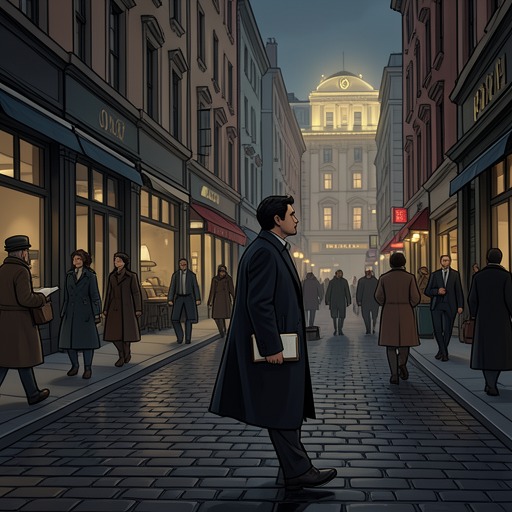
Byron’s connection with the narrator is described as a brief friendship, but it has practical weight. When he sees the narrator looking exhausted in Curzon Park, he asks what is wrong. The narrator looks toward the statue of Sir Hariram Goenka without answering; Byron persists and takes the narrator’s hands, apparently trying to work out the cause of the distress. The gesture marks a change from the self-promoting detective of the business card to a friend who notices another person’s difficulty and tries to respond.
His optimism also shapes how he understands their relationship: he believes that, in this kind of work, one cannot know in advance who may be able to help whom. The thought is borne out in both directions. Byron’s investigation may help the narrator find a place, but later Byron himself asks for the narrator’s assistance.
An Unfinished Matter
In a later conversation, Byron says that someone had sent for him and that he is still trying to accomplish what was asked. The available account does not specify the task, but he tells the narrator not to become impatient because something will change soon. He then asks for help, reasoning that the narrator will have to get to know Marco Polo well. The exchange leaves Byron’s work unresolved while establishing a new connection between the narrator and Marco Polo. Byron’s narrative function rests in that double movement: he opens a possible path for the narrator and, in turn, recruits the narrator into an undertaking of his own.