Anindo Pakrashi
ChowringheeAnindo Pakrashi is the young heir to Madhab Industries, a man formed between two sharply different expectations: his own love of art, literature, and personal freedom, and his family’s preparation of him to lead an industrial enterprise. The contrast grows more striking as the narrative moves from the shy, thoughtful visitor who slips away to the Hotel Shahjahan to the stern-faced young industrialist in newspaper photographs. His story makes succession more than a transfer of business responsibility: it is also a narrowing of the imaginative life he once hoped to pursue, and a source of conflict when he falls in love with Karabi Guha.
Identity and family background
Anindo is the son of Madhab Pakrashi and Mrs. Pakrashi, and the nephew of Phokla Chatterjee. Phokla recalls that when Anindo’s mother once wrote asking him to suggest a name for her child, only Anindo came to mind: a name embodying the irreproachable person Phokla himself had not been. That ideal sits uneasily beside Phokla’s confession that he had introduced his nephew to drinking. Looking at Anindo with affection and taking his hand, Phokla still sees him as an innocent boy. Anindo’s family name thus carries competing inheritances: an uncle’s regret and hope, and the demanding future of the Pakrashi business.
His home life is closely supervised. Anindo says that his mother dislikes smoking, and that his father was unhappy when he took charge of the company. His father would have preferred him to enjoy a few more years of freedom and travel through history, geography, and literature; his mother disagreed. Business succession is consequently not presented as a choice made in conditions of equal family influence. His father’s reservations coexist with his mother’s determination to keep him on the path toward responsibility.
The private reader and the industrial heir
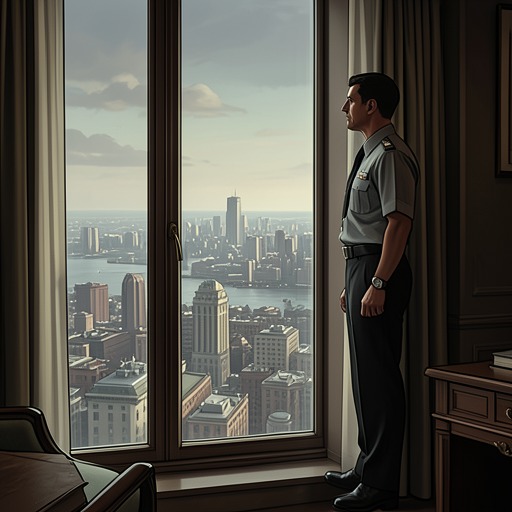
Before newspaper images fixed him as an industrialist, Anindo often escaped from home to visit the Hotel Shahjahan simply to talk. The narrator remembers him as quite different from the hard, expressionless face shown in contemporary photographs. Anindo describes the demands of taking over the company as a kind of resistance test rather than an education. The distinction conveys how thoroughly practical preparation has displaced the broader intellectual and personal formation his father had wanted for him.
His interests are not casual embellishments to that private self. He loves painting, but lacks time for it; when he passes an artist painting on the Maidan, his thoughts turn toward the work. Reading Eliot, Pound, and Auden had once become an addiction, and he also read Bengali poetry, especially Jibanananda Das, Premendra Mitra, and Samar Sen. Samar Sen’s poetry sometimes made Anindo sad, prompting him to ask his mother whether people in their country truly suffered so much. She explained poetic sorrow as a convention and argued that ordinary, prosperous lives would not persuade readers to spend money on poetry. Her answer gives Anindo an early encounter with the gap between art’s representation of suffering and the comfortable life he knows, while also showing how his mother interprets the world for him.
Anindo has a playful identity among colleagues at the central office. He reveals that his nickname is Kajol and that his friends call him Kajla-didi. They greet him with a teasing verse about the moonlit bamboo grove and the poet still being awake. The joke preserves a version of him that his public role threatens to erase: a young man known not only for his position but also for his poetic interests and his companions’ affectionate mockery.
Business, family maneuvering, and Karabi Guha
Anindo’s growing responsibilities bring him into Hotel Shahjahan affairs. When Karabi Guha is arranging preparations for foreign guests, she says that she will confirm the arrangements by telephone and asks whether he knows Anindo. The narrator knows him only superficially, but Karabi’s call establishes that Anindo is already becoming an important figure in the preparations surrounding Madhab Industries. He is expected to inspect arrangements for the foreign visitors, even though Karabi anticipates that the favored son of a wealthy family may impose his preferences on the hotel’s furniture and layout. Her irritation reflects the unequal pressure placed on hotel staff to satisfy powerful guests.
The industrial negotiations also make Anindo’s absence valuable to his rivals. Karabi discovers that Agarwalla has obtained Madhab Industries’ detailed plan and intends to meet the German representatives separately, hoping to secure the project for himself. Agarwalla wants the meeting to happen while the Pakrashis are away. Phokla Chatterjee is supplying him with information and has promised to keep Anindo from coming to the hotel that evening, with Agarwalla willing to pay whatever is needed. Anindo is therefore caught in a contest whose information and timing are managed by others: his uncle’s drinking and movements can be exploited as instruments in a commercial maneuver against his family.
The newspaper account of the German delegation makes that family maneuvering public. When Anindo returns the next day, the papers report that representatives of German industry have arrived in Calcutta and mention Madhab Industries. They say Madhab Pakrashi missed the reception at Dum Dum Airport because of ill health and that Mrs. Pakrashi was occupied caring for him. Anindo explains that his mother arranged the press notice through the company’s public-relations officer, Mr. Sen: his father had wanted to attend, but his mother insisted that Anindo should be given the opportunity, so his father had to appear ill. The episode shows the family’s business strategy operating through a carefully managed public appearance, while Anindo himself describes the arrangement rather than claiming it as his own initiative.
Love, suspicion, and narrative significance
Anindo’s relationship with Karabi shifts the story from professional proximity to personal conflict. Satyasundar Bose tells the narrator that Anindo wants to marry her and describes him as the heir apparent to Madhab Industries, deeply in love with the hostess of suite number two at Hotel Shahjahan. The narrator responds with hope, imagining Karabi as someone who could offer shelter from the oppressive heat of Anindo’s life, and Anindo as someone who might bring life to what he calls the desert of her heart. That hopeful reading is immediately shadowed by the risks of the match: Bose warns that the situation is delicate, while Mrs. Pakrashi suspects that Karabi is blackmailing her son and has exploited his innocence to compromise him.
The conflict leaves Anindo’s private intention vulnerable to competing interpretations. To the narrator, his wish to marry Karabi is an expression of love that could enlarge both their lives; to his mother, it appears to be evidence of manipulation. Meanwhile, his public identity as a future industrial leader makes the relationship consequential beyond the couple themselves. Anindo is presented neither only as the poetic young man who escapes home to talk nor only as the businessman whose family negotiates with German representatives. The tension between those selves is the point: his artistic inwardness survives, but increasingly under the pressures of succession, public image, and family control.