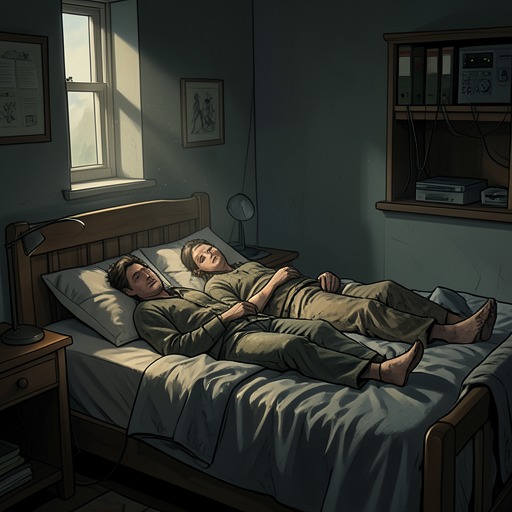
Marian Booth
ChowringheeMarian Booth’s brief appearance in the Hotel Shahjahan’s history reveals the human cost hidden behind the hotel’s promises to guests. At forty-five, she arrives in Calcutta to find that her age makes her an unwanted substitute in a fraudulent recruitment scheme. The hotel refuses her work, while the account remembers her not only as the target of a commercial deception but as a caretaker who had looked after Jane Grey during their voyage.
Identity and Arrival
The hotel’s own newspaper advertisement announces that Marian Booth and Jane Grey will arrive at Kidderpore aboard the SS Hawaii on September 22. It promises that the two women will spare no effort to satisfy guests’ pleasures and comfort, then adds that they will be locked up during the day and after their work at night. The boast makes confinement part of the hotel’s public sales pitch: the women are presented as attractions for guests, while their restricted movement is advertised as a means of protecting the establishment’s reputation.
The promise conceals the circumstances of Booth’s arrival. Silverton learns at the pier that she is forty-five. He has spent a fortune bringing her to the hotel, but does not feel able to tell her the problem there. The account stresses the mismatch between the hotel’s expectations and the woman who has actually arrived; Booth is judged against the commercial value assigned to a younger recruit, rather than encountered on terms of her own.
The Recruitment Fraud and Its Consequences
Silverton later explains the crisis to Hobbs: the hotel has been defrauded. An agent had selected and spoken to a girl, and had even seen her aboard the ship, but at some point the younger woman was replaced by Booth, who then left. By the time the deception comes to light in Calcutta, there is no practical way to undo it. The hotel’s anxiety is not simply about the money already spent. Silverton fears that word of the expense and failed recruitment will jeopardize the future of the Hotel Shahjahan.
Booth is caught in the consequences of a scheme whose details place her at the center of the hotel’s problem without establishing that she devised it. Silverton summons her and refuses her request for a chance to work. She pleads that sales will not suffer if she is allowed to stay, but he remains unwilling. The exchange makes the hotel’s judgment unmistakably economic: Booth asks to be assessed by what she can do, while Silverton measures her against the anticipated returns of the woman the agent had originally chosen.
Booth and Jane Grey
When Silverton summons Jane Grey, the eighteen-year-old is exhausted from the voyage and has fallen asleep. She rubs her eyes as she comes before him, and Hobbs recalls reading tragedy in her face. Jane says she had been worried about herself and had left home without knowing whether she would ever return. Her uncertainty gives the journey a personal cost beyond the hotel’s failed investment: she is young, far from home, and entering work in a place whose conditions she cannot yet understand.
Jane’s account of Booth complicates the older woman’s position in the story. Before leaving the room, Jane says that she has never known anyone kinder and that Booth cared for her throughout the voyage. The detail stands in sharp contrast to Silverton’s treatment of Booth as an unsuitable expense. Within the short recollection, Booth’s care for Jane is the clearest evidence of her character, offered by the younger woman whose arrival the hotel still accepts.
Aftermath and Narrative Significance
A few days later, Hobbs hears that Booth has joined the women in Kidderpore. The account does not explain the conditions of her life there, so her fate beyond this reported move remains unstated. Jane, meanwhile, serves whisky in the Hotel Shahjahan bar. Hobbs hears that hundreds of English gentlemen and Bengali babus crowd the bar to receive drinks from her. Their different destinations sharpen the reversal: the hotel rejects Booth, while Jane becomes part of the very scene of guest service the advertisement had promoted.
Booth’s story also unsettles the polished language of hotel reputation. The advertisement turns women’s availability and confinement into assurances of guest pleasure and institutional respectability; the events behind it expose fraud, age-based rejection, and the restricted choices left to the women caught in the arrangement. Yet the narrative does not reduce Booth to the failed recruitment. Jane’s testimony preserves an intimate counterweight to the hotel’s accounting: on the voyage, Booth cared for someone more vulnerable and younger than herself. That act of kindness survives in Hobbs’s recollection even as the hotel’s records of the women are shaped by profit, reputation, and the places to which they are sent.