Bogstad's Wood
Bogstad's Wood is the forested area on the outskirts of Christiania where the starving narrator spends a desperate night after being locked out of his lodging, a key location that dramatizes his physical and psychological collapse. It is the site of his most abject surrender to the elements, a place where the city's last protections fall away and he confronts the raw, indifferent forces of nature and his own failing body. The wood functions as a threshold between the urban world of social possibility and a state of pure, animalistic survival, marking a decisive low point in his downward spiral.
Location and Setting
Bogstad's Wood lies beyond the built-up districts of Christiania, reachable only after a long, wearying tramp through streets that grow progressively quieter and more desolate. The narrator reaches it after a day of fruitless wandering and humiliation, having been turned away from the fire brigade watch-house and from the home of an acquaintance. The wood itself is described as a place of dampness and gloom: the ground is sodden, the air cold, and the darkness absolute. It is a marginal space, neither fully wild nor domesticated, a no-man's-land where the city's laws and comforts no longer apply. The narrator notes that he has "the entire environs of the city at my disposal" before settling on the wood, a phrase that underscores the irony of his freedom—it is the freedom of the utterly dispossessed.
The Night in the Wood
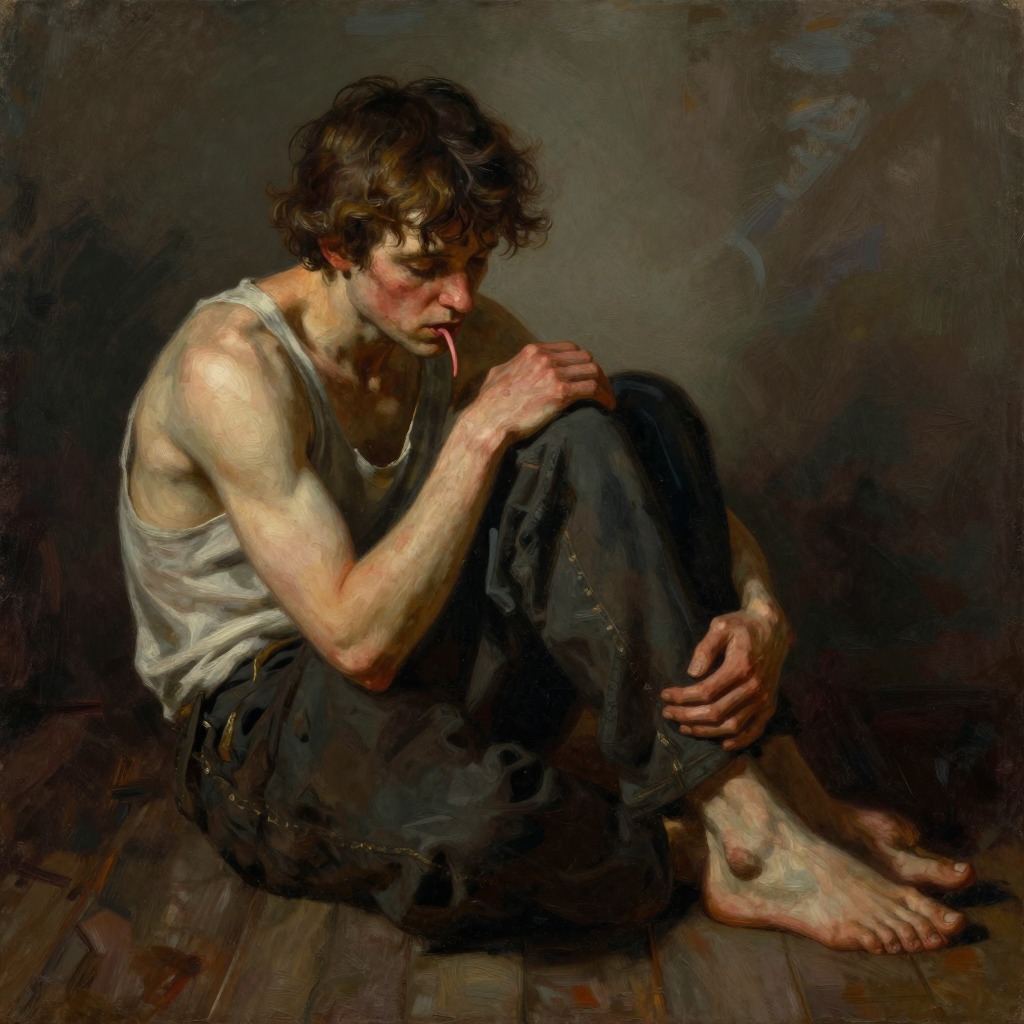
The narrator's night in Bogstad's Wood is a concentrated ordeal of physical suffering and mental disintegration. He gathers heather and juniper leaves to make a bed on a slight declivity, opens his parcel to take out the green blanket borrowed from Hans Pauli, and lies down. His ear, swollen from a whip-lash, prevents him from lying on one side. He pulls off his shoes and puts them under his head, with the paper from Semb's on top. The "great spirit of darkness" spreads a shroud over him, and he listens to the "everlasting song, the voice of the air, the distant, toneless humming which is never silent"—a sound that begins to bewilder him, seeming like a symphony from the rolling spheres. He fights and wrestles with anger and fear until nearly dawn, then falls asleep. When he wakes, it is broad daylight, and he feels that it is going on towards noon. He shivers like a dog, his feet are benumbed, and water runs from his eyes as if they cannot bear the daylight. The wood offers no shelter, no comfort, only the raw confrontation with cold, hunger, and the terrifying vastness of the night.
Consequences and Aftermath
The night in Bogstad's Wood has lasting physical and psychological consequences. The narrator wakes with a "singular sense of confusion" darting through his head, a feeling that something has slid aside in his inner self, or that a curtain or tissue of his brain has been rent in two. He is not unconscious, but the experience accelerates his decline. The damp cold seeps into his bones, and he later reflects that the night in the sodden fields may have contributed to the fresh, painful perceptions that assail him. The wood becomes a reference point for his worsening condition: when he later considers sleeping out again, he recoils, remembering the endless walk and the cold. The wood is the place where the city's last pretense of order falls away, and he is reduced to a creature of pure need, shivering, weeping, and listening to the terrifying hum of the universe. It is a space that reveals the fragility of the human subject when stripped of all social and material support.
Narrative Significance
Bogstad's Wood serves as a counterpoint to the urban spaces of Christiania—the parks, the churchyards, the streets where the narrator still clings to the hope of work or charity. In the wood, there is no possibility of intervention, no editor to accept a manuscript, no acquaintance to lend a shilling, no policeman to offer a cell. It is a space of absolute solitude and absolute exposure. The wood's indifference mirrors the narrator's growing sense of cosmic abandonment, and his night there prefigures the later, more extreme episodes of homelessness and delirium. It is a place where the narrative's central themes—hunger, madness, the search for meaning in a meaningless world—are stripped to their barest form. The wood is not a refuge but a void, and the narrator's survival of that night is less a triumph than a postponement of the inevitable.