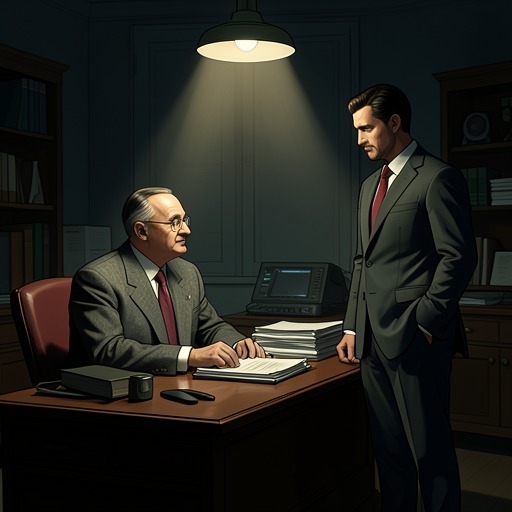
Alger Hiss
TrumanAlger Hiss’s transformation from a respected public official into the center of a national political controversy exposed how quickly an accusation could reshape the meaning of a government career. Whittaker Chambers’s charge that Hiss had belonged to a Communist network reverberated through Washington, and Hiss’s later conviction for perjury intensified the dispute. The case reached beyond Hiss himself: it became a test of how officials, the press, and Congress would interpret an allegation, a criminal verdict, and the personal loyalties that endured after both.
Identity and Public Career
Before the accusation, Hiss was known as a prominent figure of the New Deal generation. Chambers identified him as president of the Carnegie Foundation, a former member of the administration’s circle of rising young officials, and a veteran of fourteen years in the State Department. Hiss had served under both the Roosevelt and Truman administrations. Those credentials made the charge consequential: it was directed not at an obscure outsider but at someone associated with influential public institutions and two presidential administrations.
That standing also shaped the controversy’s stakes. Chambers, then an editor at Time, told the House Un-American Activities Committee that he had served in an underground Communist organization in Washington and that Hiss had been part of its leadership. His testimony did not merely accuse Hiss of an abstract political sympathy; it placed him within an alleged network operating inside the capital. The claim immediately collided with Hiss’s established public identity, turning his career and government service into questions to be reassessed in the light of Chambers’s account.
Accusation, Trial, and Conviction
On August 4, Chambers’s testimony sent shockwaves through Washington. Officials were described as stunned, and Sam Rayburn warned a reporter that the investigation carried political danger. The episode quickly became entangled with arguments over whether the congressional inquiry was pursuing a genuine security threat or using the language of espionage for political ends. At a press conference the next day, Harry S. Truman agreed with a reporter’s suggestion that the spy scare was a distraction from inflation and objected that people who did not deserve it were being slandered. His remarks addressed the investigation broadly rather than naming Hiss, but they placed the President on record against what he viewed as reckless accusation.
The controversy continued beyond the initial hearings. On December 15, Hiss was indicted for perjury. After a second trial, he was found guilty on January 21; the case established that he had lied about passing secret documents. On January 25, he was sentenced to five years in prison. That conviction gave the affair a concrete legal outcome, but it did not erase the political argument over the broader allegations or settle how the case should be understood. Hiss’s story in the book is therefore marked by a distinction between Chambers’s accusation of membership in a Communist network and the specific offense for which Hiss was convicted: perjury concerning the passage of documents.
Acheson’s Friendship and the Administration
The case became a crisis for Dean Acheson because Hiss was not simply a former colleague. At his confirmation hearings the previous year, Acheson had acknowledged that Hiss was his friend and said that friendship was not easily given or withdrawn. Hiss’s brother Donald was a partner in Acheson’s law firm and had served as Acheson’s assistant when Acheson was an Assistant Secretary of State. When Hiss’s conviction and sentence renewed public pressure, reporters asked Acheson whether he would distance himself from his friend. He publicly said he would not turn his back on Hiss, even while Hiss pursued an appeal.
Acheson had considered his response beforehand; it was not presented as an impulsive defense of Hiss’s innocence. His position concerned the responsibility of each person to decide how to act toward someone he had known and served with, according to his own principles. That distinction did not protect him from the political consequences. Joseph McCarthy seized on the statement in the Senate, asking whether Acheson’s refusal to abandon Hiss meant he would likewise refuse to turn his back on other Communists in the State Department. A personal declaration of loyalty was recast as an accusation about the administration’s security judgment.
After the press conference, Acheson went to see Truman and offered to resign. Truman supported him, drawing a comparison to his own attendance at the funeral of Tom Pendergast, a friend who had recently left prison. As Acheson understood Truman’s response, their shared willingness to show loyalty to a friend made Acheson’s meaning clear to the President. The exchange shows how the Hiss affair reached into the administration’s private relationships while also becoming a public test of its political resilience. Truman’s support did not resolve the dispute over Hiss; it demonstrated that Acheson would not be left to face the fallout alone.
Political Meaning and Narrative Role
The book presents Hiss as a figure whose significance lies both in the charges against him and in the reactions those charges produced. His government service made the accusation politically potent; the perjury conviction made the matter harder to dismiss as mere partisan theater; and Acheson’s public loyalty gave opponents a new target. At each stage, the controversy shifted in scale—from testimony about an alleged network, to a criminal case, to a dispute over the conduct and credibility of senior officials.
The resulting narrative does not treat the conviction as a complete answer to every political claim made about Hiss. Instead, it keeps distinct the accusation, the proven basis of the perjury case, and the competing interpretations imposed on both. Chambers’s testimony helped turn the issue into what Rayburn called political dynamite, while Truman’s response and Acheson’s refusal to disown a friend show how the case tested the boundaries between public office and personal judgment. Hiss thus becomes a point of pressure in the broader account: his name links the fear of Communist infiltration to the political weaponization of that fear and to the personal costs of refusing to sever an old association.