Harriet Louisa Young
TrumanHarriet Louisa Young was a Kentucky-born wife, mother, and farmstead keeper whose long life bridged the Young family’s precarious beginnings in Missouri and the establishment of a substantial Blue Ridge homeplace. Her story is marked by practical resilience: she raised children through uncertain frontier years, managed the farm during her husband’s absences, and endured wartime seizure and displacement. To her grandson Harry S. Truman, she was both a beloved family presence and a living link to an earlier world.
Background and Family
Born in 1818, Harriet Louisa Gregg came from a Scotch-Irish family whose members belonged to the Long Run Baptist Church, a prominent congregation near Simpsonville, Kentucky. She married Solomon Young in January 1838. Their first child was born the following year; a second arrived in 1841, the spring the couple began their journey west. The timing suggests that Harriet Louisa was nursing the younger child during the boat trip up the Missouri River.
The book contrasts her quiet, steady manner with Solomon Young’s sociability and appetite for talk. Harriet Louisa was remembered for her imperturbable disposition and abundant red hair, and family accounts described her as someone who neither complained nor lost heart. Her composure was not simply a private quality: on the frontier, where the household’s security depended on labor, judgment, and readiness to endure setbacks, it became part of the family’s means of survival.
Establishing the Blue Ridge Farm
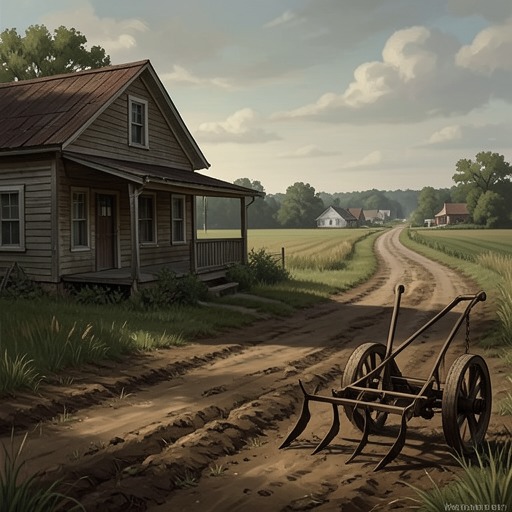
The Youngs first settled on a farm called the Parrish place, near the Missouri River and within the projected boundaries of Kansas City. Shortly afterward, possibly in response to the 1844 flood, they claimed public land on high ground near Hickman’s Mills, about sixteen miles south of Independence. The site, known as Blue Ridge, offered fertile, well-drained soil suitable for grazing and for growing corn and wheat.
The initial claim was only eighty acres, the minimum allowed under the Land Act, and Solomon paid the minimum price of $1.25 an acre. To secure title, the family had to occupy the land. While Solomon rode the seventy miles to the land office in Clinton, Missouri, Harriet Louisa stayed with their two young children in a shelter made of fence rails and brush. Family stories recalled the household’s scant equipment as a gun, an axe, two small children, and a blanket. The scene conveys the exposure of those first years without making the family’s eventual success seem inevitable.
The household and its holdings grew. Six more children were born, including Martha Ellen Truman, and the family acquired additional parcels, built a house and barn, and made Blue Ridge its homeplace. Solomon’s farming and livestock ventures brought frequent financial setbacks as well as eventual prosperity. His overland freighting expeditions took him away for extended periods, leaving Harriet Louisa responsible for the home and its work. The record does not detail the routines of that responsibility, but it places her at the center of a household whose land, property, and children continued to expand.
The Civil War and Displacement
The war exposed the farm to repeated incursions by Union forces. In a formal claim filed in 1902, Harriet Louisa recorded that forces under five different officers had come to the property on five occasions, beginning with James Henry Lane in May 1861. Her recollections and those of children who witnessed the events described losses beyond the animals itemized in that claim: soldiers killed livestock, took food and household possessions, and required her to bake for them. In one episode, they threatened her fifteen-year-old son Harrison while trying to discover where Solomon had gone; when he said his father was away with a wagon train, the soldiers eventually released him. The conflicting accounts—the formal inventory and the family’s remembered detail—show how much of the household’s wartime experience had to be reconstructed after the fact.
In August 1863, an order required most civilians in Jackson, Cass, and Bates counties to leave their homes unless they could meet specified conditions for remaining near Union posts. Although Solomon had signed a loyalty oath more than a year earlier, the family was still made to leave. They were allowed one wagonload of possessions. Martha Ellen Truman later remembered walking north behind the wagon as the family went into exile in Kansas City. For the Youngs, the order turned a farm built up over years into a place they could no longer inhabit.
Grandmother, Death, and Inheritance
Harriet Louisa’s presence endured in the stories passed down to her grandchildren. She once told of facing a group of Native Americans who had come to the door asking for honey while Solomon was away; she sent a large dog out, and they left. In later years, Harry S. Truman remembered her sitting quietly in the sunshine, smoking a corncob pipe. These recollections place her at once in the family’s frontier past and in the intimate routines of his own youth.
Harriet Louisa died in December 1909, shortly after her ninety-first birthday. Her death was the first loss to affect Harry S. Truman directly, and he later remembered that Christmas as the saddest he had known. Her will left the farm to Matt and Harrison, while excluding her five other children from a share of the land on the stated grounds that they had not contributed to its work and had already received money gifts. The decision provoked a family dispute. It also made the farm’s history—built through years of labor, separation, and displacement—an immediate question of inheritance and competing claims within the family.