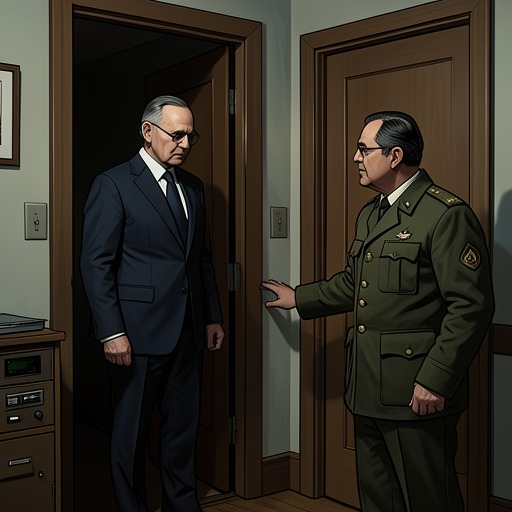
Donald Dawson
TrumanDonald Dawson, Harry S. Truman’s administrative assistant in charge of personnel, became one of the most visible White House figures implicated in the 1951 Reconstruction Finance Corporation (RFC) controversy. The inquiry placed his access to the administration under suspicion, but its testimony also complicated the charge: Dawson was accused of exerting influence over the agency, yet the evidence described in the hearings did not establish that he had tried to affect an RFC loan. His episode exposed the tension between Truman’s loyalty to his staff and the public demand that the administration answer for apparent favoritism.
Position in the White House
Dawson’s official responsibility was personnel: as Truman’s administrative assistant, he oversaw staffing matters and occupied a position from which contact with government agencies could carry weight. The RFC, meanwhile, distributed low-interest government loans to businesses. The Senate subcommittee’s preliminary report, issued in February 1951, raised concerns about favoritism and influence in the corporation’s operations, bringing Dawson into a controversy that reached from the agency to the White House.
The inquiry’s suggestion of an influence network involved several people close to the administration. Alongside Dawson, it implicated Democratic Party chairman William Boyle and E. Merl Young, a former RFC examiner and Dawson’s friend. Young’s wife, Loretta, worked at the White House as a stenographer and assistant to Truman’s secretary, Rose Conway. Dawson’s association with Young therefore joined a personal connection to a visible institutional one: Young could enter the White House after work to pick up his wife, using the access afforded by her pass.
Allegations and the appearance of influence
Newspaper accounts said Dawson had been unduly active in supporting applicants for RFC loans and had exercised considerable influence over some of the corporation’s directors, allegedly trying to dominate the agency. A particularly damaging account from RFC director Walter L. Dunham concerned personnel rather than loans: Dunham testified that Dawson had told him to clear top RFC personnel matters with the White House. Dunham’s telephone log recorded 45 calls from or about Dawson, evidence of frequent contact that intensified concern about the administration’s reach into the agency.
Those contacts appeared within a wider pattern. Dunham’s log recorded 151 calls from William Boyle or his office, mostly urging Dunham to meet a “very dear friend” in connection with an RFC matter. Yet Dunham also stressed an important limit: Dawson had never tried to influence him on an RFC loan. The distinction did not erase questions about personnel pressure or access, but it kept the evidence from demonstrating the specific loan intervention suggested by the broadest public allegations.
The controversy was made more vivid by Young’s cultivated connection to Truman’s family. Although unrelated to the President, Young had for years allowed people to believe that he was related to Truman through Solomon Young and Harriet Louisa Young. He looked enough like Truman to be mistaken for his son. His supposed kinship, friendship with Dawson, and former RFC position made him appear to trade on associations that could open doors in Washington.
Young’s wife’s mink coat sharpened that impression into a memorable symbol. She had received a $9,540 pastel mink coat paid for by the attorney of a firm that had obtained an RFC loan. The coat did not establish that Dawson had arranged a loan or personally benefited from it, but it helped turn the inquiry’s complicated allegations into an easily grasped image of influence and access. Because Boyle, Dawson, and Young all came from Missouri, the affair also revived charges of government by cronies and recalled Truman’s earlier associations with the Pendergast political organization.
Testimony and contested judgment
As Dawson, Young, Boyle, and many other witnesses testified, the hearings exposed a difficult boundary between illegal conduct, impropriety, and familiar political maneuvering. Some corporations of questionable stability had received multimillion-dollar RFC loans, apparently too often through political influence. But the accumulated testimony did not make every allegation equally clear. Dunham’s account presented a specific claim about White House involvement in personnel decisions, while his qualification that Dawson had not pressed him over loans limited what that claim could prove.
Dawson denied wrongdoing. He acknowledged staying without charge at a Miami hotel on three occasions and said he understood that such arrangements were common, noting that some senators were also on the hotel’s free list. He claimed not to have known that the hotel had received a $1.5 million RFC loan. His smooth, confident manner, as described in the account of the hearings, did not settle the question of propriety; nor did the testimony establish the strongest accusations against him. Senator William Fulbright told him that the hearings were not intended to embarrass him and described him as necessary background. Paul Douglas later judged that Dawson had made a good showing and that only minor peccadilloes had been proved against him.
Truman’s response and narrative significance
Truman’s response revealed how strongly he resisted interpreting the conduct of his associates as serious wrongdoing. He told staff that the affair was political and directed at him, said he could not see that Dawson or Boyle had done anything seriously out of line, and refused even to reprimand them. He also described himself as liking people and being reluctant to regard anyone as evil or beyond redemption. That disposition shaped the political stakes: the question was not only what Dawson had done, but whether the President could distinguish personal loyalty from the need to answer public suspicion.
When Fulbright and Douglas came to the White House to urge Truman to clean house and permit Dawson to testify, they found the President subdued rather than combative. Douglas told him that he had been loyal to friends who had not been loyal to him. Truman looked toward the rain-darkened window before quietly conceding that Douglas might be right. The exchange marked a contrast with his earlier anger at the committee: confronted directly by Democratic senators, he did not defend Dawson with the same force.
Dawson’s account in the book is consequently less a resolved portrait of a proven criminal than a study in proximity, access, and presidential judgment. His personnel role, reported calls, friendship with Young, and acceptance of free hotel stays supplied grounds for scrutiny; Dunham’s testimony and the hearing’s assessment limited the claims that could be sustained. The episode also showed the political cost of Truman’s instinct to protect associates: even where wrongdoing remained disputed, his refusal to reprimand Dawson helped revive the charge that his administration was governed by personal connections.