Harry Vaughan
TrumanHarry Vaughan moved from campaign supporter to one of Harry S. Truman’s closest White House companions. A reserve officer who served as a military liaison and then as presidential military aide, he helped address the lack of security arrangements for the vice president and remained a familiar presence through Truman’s presidency. His loyalty brought him unusual personal access and protection; the same closeness became a source of political embarrassment when a Senate investigation raised questions about his use of that access.
Political Supporter and Campaign Worker
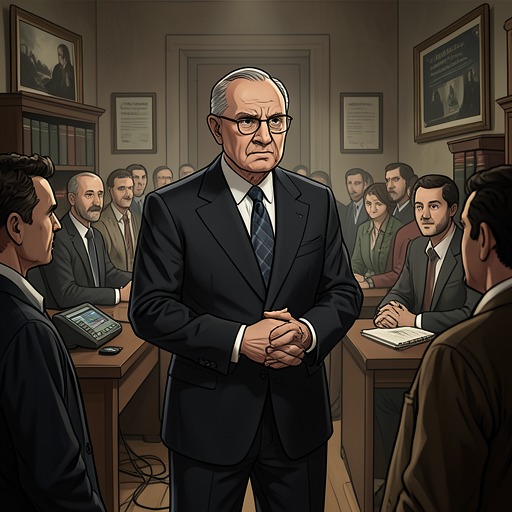
Vaughan appeared among the small number of serious supporters at the opening strategy meeting for Truman’s 1940 reelection campaign. The outlook in St. Louis was bleak: many invitees did not attend, and those who did offered little confidence that Truman could win. Vaughan, alongside John Snyder and others, nevertheless stood by the campaign. His support was practical as well as personal. Vaughan and Snyder found what little money they could and established a headquarters in borrowed space in the Ambassador Building. The campaign borrowed clerks and furniture, struggled to pay for postage, and at one point lacked even enough money for a hotel room, leaving Truman to sleep in his car.
The episode foreshadowed the kind of service Vaughan would provide throughout Truman’s political life: not the high-profile work of a policy advocate, but personal presence and resourcefulness when the circle around Truman was small. In 1941, when Truman brought him to Washington, Vaughan became both Truman’s secretary—then the title for an administrative assistant—and a liaison between the Senate committee and the military services. His reserve rank, then lieutenant colonel, suited the liaison assignment. He later left to serve on active duty with the Army Air Corps, returning to become Truman’s military aide.
Aide, Confidant, and Military Presence
Vaughan’s role grew as Truman moved from the Senate to the vice presidency and then the presidency. After returning from active duty, he was among the first military aides assigned to a vice president. He also drew attention to a practical vulnerability: Truman had no security detail. Vaughan brought the concern to the Treasury secretary, helping prompt the assignment of a Secret Service agent. The new arrangement became part of the daily routine. A black Mercury limousine carried Truman between home and the Capitol, while Vaughan’s initiative had helped ensure that a Secret Service officer rode along.
During the transition to the presidency, Vaughan remained close at hand. When Truman went to the White House on the evening of April 12, 1945, he told Vaughan where he was going and asked him to keep it quiet. Truman then hurried through evening traffic in the Mercury, still without a Secret Service guard. The detail captures both the informality of their working relationship and the unsettled arrangements surrounding the sudden transfer of power.
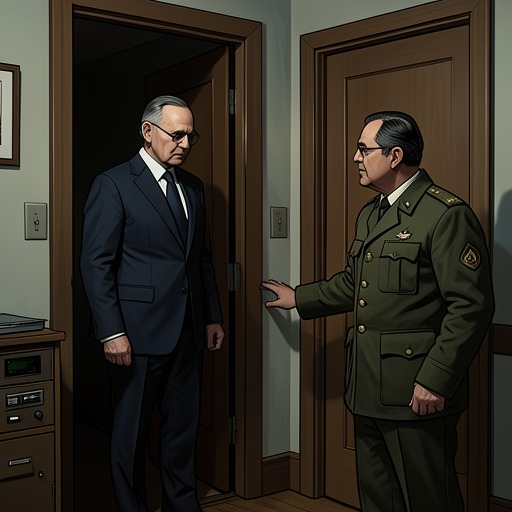
In the official household, Vaughan’s manner made him an unusually personal presence. Truman made him a brigadier general, a promotion that some observers regarded as incongruous, but Vaughan’s importance did not depend on military stature alone. He was an expansive, easygoing companion whose stories and earthy humor suited Truman’s tastes. Truman tolerated little criticism of him, and Vaughan’s recurring professions of loyalty reinforced a bond that colleagues could see was unusually strong. He was also present in the small routines of the presidency: among the familiar staff around Truman during ordinary working days, and later part of an all-male cruise party aboard the presidential yacht with Truman and several close associates.
Loyalty, Access, and Boundaries
Vaughan’s closeness to Truman did not mean that the president approved of every action he undertook. When Vaughan brought Truman FBI telephone taps concerning the wife of a White House aide, Truman rejected the material and said he did not authorize such surveillance. Yet Vaughan later sought a tap on Thomas Corcoran, a former Roosevelt aide whom he suspected of working against Truman by leaking damaging material. Vaughan presented White House security as the justification, but the surveillance was political in purpose. Truman disliked the practice and distrusted J. Edgar Hoover, yet consented to the tap. It produced nothing of consequence, while Hoover continued to regard Vaughan as a friend within the White House.
This episode reveals a tension in Vaughan’s position: his proximity made him a channel through which the president could encounter information and political concerns, but it could also carry those concerns past the boundaries Truman otherwise professed. The distinction between personal loyalty and proper use of official access became still more consequential when Vaughan’s dealings with Washington intermediaries came under public scrutiny.
Scandal and Truman’s Defense
In 1949, Vaughan became a focus of a Senate subcommittee investigation into people who charged commissions for claiming to secure government contracts or favorable treatment. Witnesses alleged that he had used his general’s rank, White House telephone, and personal connection to Truman to help such intermediaries reach officials. One of the men involved was an old friend of Vaughan’s who had often been seen in the West Wing. Summoned before the committee, Vaughan maintained that he had merely been doing people a courtesy by directing them to officials who could hear their cases.
The inquiry placed Truman’s loyalty to Vaughan under a harsher public test. When a columnist attacked Vaughan for accepting a decoration from Argentina’s dictator, Truman responded angrily and insisted that decisions about members of his staff belonged to him. That defense expressed his determination not to let outside pressure dictate whom he retained, but it also tied the president more closely to Vaughan as criticism mounted. Truman was reluctant to dismiss anyone and interpreted the uproar less as a warning about Vaughan’s conduct than as an attack on himself. The account judges that his failure to recognize Vaughan as a serious liability was a mistake.
When Vaughan offered to resign, Truman refused to accept the offer. He told Vaughan that they had come into the White House together and would leave together. The response made their mutual loyalty explicit, but it also showed how personal attachment could limit the president’s ability to separate a friend from the public responsibilities of the office.
A Familiar Figure in a Difficult Presidency
Vaughan’s public image became increasingly entangled with the word cronies. He began holding press conferences and making speeches of his own, and his boasts about trading a watch at Potsdam and his comparison of Truman’s plainness with Roosevelt’s sophistication drew attention to an aide who seemed to have become too prominent. Such episodes contrasted with his earlier usefulness as a campaign worker and military liaison: the trusted companion was now also a conspicuous representative of the president’s inner circle.
Even during the Korean conflict, Vaughan’s presence shaped how some Americans interpreted events. Letters to Truman complained that Vaughan appeared to be running the situation, reflecting public frustration and anxiety about the war. The allegation was not evidence that Vaughan controlled policy, but it shows how his high visibility could blur the distinction between personal access and official authority. Later, as Truman considered whether to seek another term, Vaughan urged him to run, and Truman’s cautious response left Vaughan convinced that he would. Vaughan also spoke candidly about how quickly the deference attached to his title might disappear once he left office.
Vaughan’s narrative role is therefore double-edged. He embodied the personal trust and informal companionship Truman valued, and his support had roots in the difficult 1940 campaign. He also demonstrated the risks of allowing friendship and access to become inseparable from public business. At the end of Truman’s 1952 announcement that he would not run again, Vaughan noticed that Bess Truman looked as if she had drawn four aces. The observation places him once more within the intimate circle around Truman, but by then his closeness was inseparable from the controversies it had helped create.