Edward Jacobson
TrumanEdward Jacobson was Harry S. Truman’s Army canteen partner and one of the close friends Truman made while serving in the 129th Field Artillery Regiment. A former Kansas City clothing-store clerk, Jacobson became the practical manager of their successful camp business. After the war, the two joined forces again in a men’s furnishing store; its collapse brought years of debt, but did not end their friendship.
Identity and Army Service
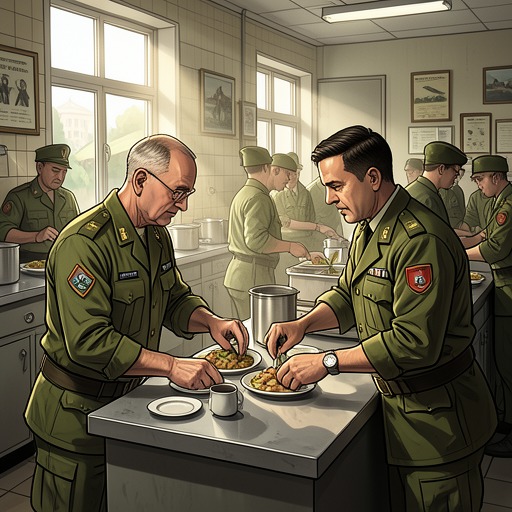
Jacobson had worked as a clerk in a Kansas City clothing store before enlisting. At Camp Doniphan, he served as a sergeant in the regiment and partnered with Lieutenant Truman in running its canteen. The partnership brought together Truman’s initiative and Jacobson’s retail experience. Truman acknowledged that Jacobson ran the operation, and the distinction matters: the venture’s success was not simply a matter of a popular officer lending his name to a camp shop, but of Jacobson managing its daily business.
Their friendship took shape amid the routines and separations of Army life. Each day, Truman wrote to Bess Wallace, while Jacobson wrote to his sweetheart, Bluma Rosenbaum. When Jacobson went into town to replenish supplies, he mailed both letters. That small repeated task made him a companion in Truman’s private life as well as a business partner: the two men’s correspondence with the women they loved was folded into the practical work of keeping the canteen stocked.
The red 1911 Stafford automobile (Lizzie), brought by Truman to camp and stripped down for use as a truck, became a visible sign of the partnership. With Truman driving and Jacobson beside him, it carried supplies through camp, trailing dust. The vehicle was at once an improvised delivery truck and a recurring image of their shared enterprise.
The Canteen Partnership
The regiment’s canteen sold everyday goods: candy, sodas, cigarettes, tobacco, shoelaces, and writing paper. To give the operation working capital, each man in the regiment was assessed two dollars, producing an initial fund of $2,200. Truman and Jacobson quickly developed what the account describes as a busy business, taking in between $500 and $900 a day. They expanded beyond the canteen, adding a barbershop and a tailor shop.
After six months, the business had paid $10,000 in dividends. Its success made the partners popular throughout camp and strengthened their belief that they made an exceptional business team. The canteen also brought Jacobson wider recognition: he became known to nearly everyone there. Virgil Thomson, who enlisted in the same regiment and later recalled Truman as one of its most effective officers, was among those who remembered the camp’s military community.
The partnership also unfolded amid antisemitic humor. Some officers teased Truman by calling him a “lucky Jew” and “Trumanheimer.” Truman responded that he supposed he should be proud of his Jewish ability. The episode shows Jacobson’s identity becoming a public part of the camp’s banter, while Truman’s answer treated the success as something the partners had earned rather than as a joke at Jacobson’s expense.
Jacobson was one of the half dozen or so men Truman counted as real friends at Camp Doniphan. Their closeness did not depend only on the canteen’s profits: their shared correspondence, regular work, and reliance on one another made the partnership personal. But business remained central to their bond, and the confidence they gained from the canteen’s success would shape their decision to try again after the war.
The Haberdashery and Its Failure
A month before Truman married Bess Wallace in June 1919, he and Jacobson leased a downtown Kansas City store. Jacobson had served with another battery in France, but the two men had seen one another occasionally and reunited after returning home on the Zeppelin. They decided to open a men’s furnishing store, convinced that their wartime success had been only a beginning. The decision came quickly, perhaps impulsively; the account suggests that Truman may also have hoped the business would impress Bess and her mother.
The store failed in 1922. The partners discussed their options and chose not to file for bankruptcy together, preferring to pay creditors as best they could over time. The business was about $35,000 in debt. Jacobson went on the road selling shirts and tried to meet his share of the obligation, but after three years he could no longer keep up and was forced to declare personal bankruptcy.
The consequences fell unevenly but lasted for both men. Some time after the collapse, when the two met for lunch downtown, Truman noticed Jacobson’s frayed suit, gave him money, and told him to buy new clothes. Truman himself continued paying on the store’s debts fifteen years after it closed; those obligations left him short of money for twenty years. The failed venture thus became more than a bad business decision: it tested whether their wartime trust would survive when the profits were gone and the liabilities remained. The evidence records no break between them; instead, it preserves the gesture of Truman helping his friend when Jacobson’s circumstances were visible in his worn clothing.
Friendship, Business, and Social Distance
The account distinguishes the goodwill between the two men from the social distance surrounding their households. Jacobson’s wife sensed that Truman’s in-laws regarded the family as socially elevated and that antisemitism helped explain why the Trumans could not comfortably bring Jewish friends into their home. The narrative qualifies this as her impression, noting that Truman seldom brought any friends to the house on North Delaware Street. It describes a boundary between Madge Wallace’s private world and the wider world outside it, rather than presenting the perceived exclusion as a documented confrontation between the families.
Jacobson’s importance in Truman’s life is therefore carried by recurring, concrete acts: managing the canteen, mailing the letters, sharing the red truck, opening a store together, and remaining connected after its failure. The partnership moved from a camp venture that paid dividends to a shop burdened by debt, yet its end as a business did not erase the friendship. Jacobson’s story also accompanies a turning point in Truman’s circumstances: by the time local politicians approached Truman about running for eastern judge of Jackson County, the haberdashery was already doomed. The evidence does not make Jacobson an architect of Truman’s political career, but it places their failed enterprise in the immediate background of Truman’s move from retail partnership into county politics.