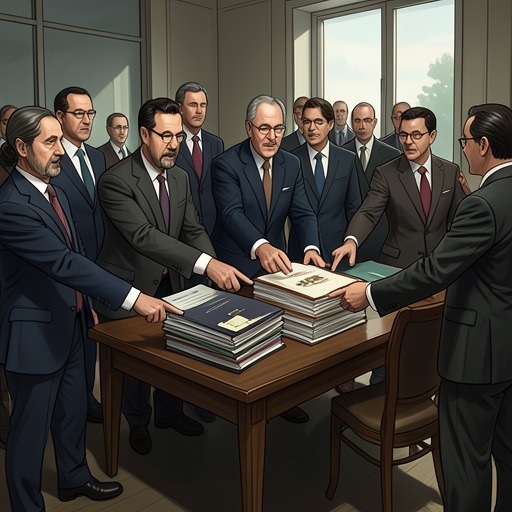
Hugh Fulton
TrumanHugh Fulton was a young Justice Department lawyer whom Harry S. Truman recruited to staff the Senate Special Committee to Investigate the National Defense Program, soon known almost entirely as the Truman Committee. His importance lay not in becoming its public face but in giving its inquiries a tenacious legal and investigative presence: he helped examine how defense work was performed, how records were manipulated, and how officials defended costly decisions.
Recruitment and qualifications
Truman hired Fulton on the advice of Attorney General Robert Jackson. Fulton was thirty-five and had just secured the conviction of a federal judge for fraud. He was a striking figure—over six feet tall, rotund, apple-cheeked, and often wearing a black derby—and his piping voice contrasted with the seriousness of the work he was brought in to do. He asked for a salary of $9,000, more than half the committee’s entire appropriation. Truman agreed, confident that if the committee produced results, money would be found.
The appointment reflected Truman’s recognition that an investigation needed capable staff, a lesson he had drawn from earlier railway inquiries. Fulton was an early riser and steady worker, bright and tenacious; in retrospect, the book describes him as a superb choice. His value was not simply that he could question witnesses. He brought experience with fraud prosecutions to a committee confronting the practical problem of how to test claims made by people and institutions responsible for national defense.
Building an investigative staff
For several months Fulton was the committee’s only paid staff member. The shortage was partly addressed by borrowing assistance from executive agencies, while the committee gradually assembled investigators with different backgrounds. Matthew Connelly had worked on a Senate investigation of campaign expenses; Harold Robinson was a former FBI agent; Agnes Strauss Wolf was the only woman in the group; and Morris Lasker was a recent Yale Law School graduate. George Meader would later serve in Congress. William Boyle had risen through the Pendergast organization in Kansas City, from precinct captain to acting director of the city police, while Fred Canfil worked out of Truman’s office in the Federal Building in Kansas City.
Fulton’s central place in this operation did not mean that the committee’s work belonged to him alone. Its findings were to be reported as the work of the full committee, not as the product of an individual senator or its chairman. Some observers later described Fulton as the committee’s driving force, but the book explicitly distinguishes that reputation from the reality: Truman himself supplied the drive. Fulton’s contribution was substantial and visible, but it took shape within a collective inquiry directed by the senator and conducted by a wider staff.
Questioning the steel witnesses
The committee’s inquiry into falsified steel tests shows Fulton’s method in action. Investigators found that at least five percent of production at the Irvin Works, a Carnegie-Illinois rolling mill in Pennsylvania, failed to meet Navy specifications but was being labeled and delivered as though it did. Chemical analyses and tensile-strength results had been altered. The mill’s chief specifications examiner testified that when the actual analysis of a batch of steel was unknown, staff might invent one for the record book.
Fulton pressed the examiner to explain how the false entries were recorded. The witness said that the fabricated analyses were written in pencil while ordinary entries were in ink, and that a prefix letter was often placed before them. Asked what the letter meant, he answered that it meant fake. This contradicted his earlier explanation to an investigator that it meant phone; under oath, he said he had been a stranger to the investigator and had felt pressed for an answer. Fulton’s questions made the recordkeeping practice, and the witness’s shifting account of it, concrete for the committee and the public.
The testimony also exposed how far the practice extended. Assistant metallurgist David B. Ireland, Jr., said that he had learned to fake tests at another Carnegie-Illinois mill and had become skilled enough to fool a Navy inspector when one was present. When the testimony turned to whether inferior material had been sold to the government under false representations, Fulton added evidence that cheating had been possible even with a Navy inspector standing there. The company representative resisted the implication that the steel was inferior for its eventual use, but conceded that specifications should be followed. Truman’s response made clear that the committee was not treating technical complexity as an excuse for falsified records.
Canol and the committee’s wider reach
Fulton also did much of the questioning when the committee examined Brehon B. Somervell about the Canol project. Alongside Senator Harley Kilgore, he questioned Somervell during a four-and-a-half-hour session while Truman listened quietly. To close the day, Truman read a letter from the Navy Department stating that a search of its files had found no communication showing that the Navy had been asked for an opinion on Canol or invited to participate. Somervell replied that he had never claimed to have asked the Navy and argued that the project was not a Navy matter. Truman countered that it could concern the Navy because ships consumed substantial quantities of oil. The exchange showed the committee testing a defense project’s rationale against the available record rather than accepting its sponsor’s characterization.
Across these inquiries, Fulton’s importance came from disciplined persistence: clarifying how evidence had been produced, following contradictions under oath, and helping the committee examine decisions with large costs. His work did not make him the committee’s sole author or leader. Instead, the account places him within an investigation whose staff capacity he helped create and whose direction remained Truman’s. The distinction matters: Fulton was remembered by some as the engine of the committee, but his effectiveness was part of a larger operation in which Truman set the course and the committee presented its findings collectively.