Harry S. Truman
TrumanHarry S. Truman’s life traced a path from a crowded family home in Missouri to the presidency at a moment when decisions about war, peace, and the structure of government had consequences far beyond the country. The biography presents him as a man formed by family, history, and public work: someone who believed individuals made history, yet repeatedly found himself responding to forces he had not set in motion. His political authority was never automatic. He built it through local administration, congressional investigation, public persuasion, and, at crucial moments, the willingness to act within the limits he believed the office required.
Family, Home, and Historical Imagination
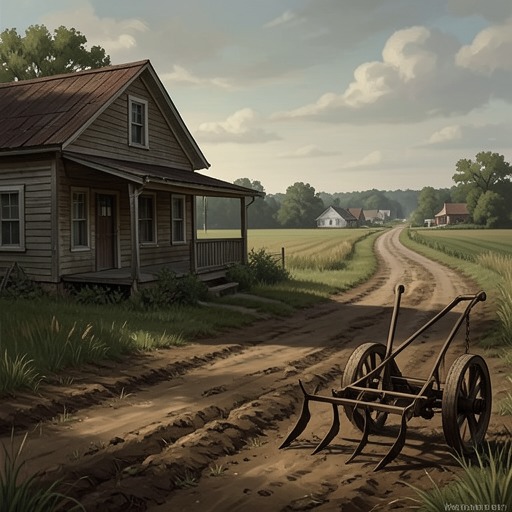
The date was May 8, 1884. When Harry was three, the Young homeplace became the setting for many of his earliest observations of the world. His maternal grandfather, Anderson Truman, also moved into the house, where he had a room upstairs. A place was made for Cousin Sol, one of the fatherless Chiles grandchildren. With Harry’s immediate family, his bachelor uncle Harrison, his aunt Ada, a hired girl, several hired hands, and a near-constant flow of relatives and neighboring children, the household seldom held fewer than fourteen or fifteen people. Three generations shared one roof on the Blue Ridge land that Solomon Young and Harriet Louisa Young had claimed years earlier. The early home was therefore not simply a private family setting; it was a busy social world in which children, adults, work, kinship, and visitors were brought into close contact.
History became a lasting intellectual passion. Truman read standard works on ancient Egypt, Greece, and Rome, but his interest was not merely in distant settings or dramatic episodes. He understood history as part of lived human experience, and later described his desire as a search for reliable facts and instruction. From his reading he drew a conviction that men made history, rather than history making men. This belief would remain an interpretive key to his public life: he looked for the actions of particular people behind large events, and he saw leadership as a matter of choosing and accepting responsibility rather than simply being carried along by circumstance.
Within a year of his graduation from Independence High School, a calamity struck the Truman family. The biography marks it as a break in the security of his boyhood and the small-town life he had loved, without making the loss merely a private incident. The sudden change redirected the family’s course in ways they could not have anticipated. In retrospect, that rupture stands beside the later upheavals of his public career: again and again, a settled life gave way to a larger set of obligations.
From Private Commitments to Public Office
Truman’s early life included a long attachment to Bess Wallace. In November 1913, after years of uncertainty, Bess told him that if she ever married, she would marry him, and confirmed her promise in a letter. They agreed to keep their engagement secret. The episode mattered to him as a personal turning point: the book describes him as suddenly buoyed by her commitment and newly optimistic, while Bess regarded him as enigmatic. Their relationship later became part of the private framework behind a public career that repeatedly took him away from Independence.
In 1917, participation in the war in Europe was far from inevitable for Truman. He was thirty-three, beyond the age limit in the new Selective Service Act, had been out of the National Guard for nearly six years, and had eyesight below the armed services’ requirements. He was also the sole supporter of his mother and sister and, as a farmer, was expected to remain on the farm as a patriotic duty. The biography emphasizes the distance between these reasons to stay home and his eventual choice to serve. By July 1918, after his regiment moved from Angers to Camp Coëtquidan for final training, he learned that he would command a battery. He had four guns and 194 men under him. The appointment fulfilled his highest ambition, but it also frightened him: the new authority arrived together with immediate responsibility for a substantial unit.
Local politics offered another route into leadership, this time through a political organization and the work of county government. Truman accepted the offer to run for eastern district judge in 1922 without hesitation. At Mike Pendergast’s Tenth Ward Democratic Club, Mike publicly introduced him as a candidate with a good war record and a respected family. Truman valued the judicial title and the standing it gave him as he walked to and from the courthouse. When he later ran for presiding judge, the alliance between the Pendergasts and Joe Shannon had been repaired; Truman ran unopposed in the primary, and the Democratic slate won in November. The office gave him real authority at last.
As presiding judge, Truman served two consecutive four-year terms, from January 1927 to January 1935. His work won support across political and professional lines, including from civic leaders, businesspeople, fellow politicians, the press, and students of government. His election margins grew from 16,000 votes in 1926 to 58,000 in 1930. That record did not mean he simply followed the interests of his political patrons. When voters approved a road-bond issue, Truman intended to keep his promise to withhold favoritism in contracts; Tom Pendergast soon discovered that the commitment was real. The clash revealed an important boundary in Truman’s local political life: he had risen through a machine, but he did not regard every obligation to it as overriding his obligation to the voters.
The Senator: Investigation, Loyalty, and Political Risk
After his county career, Truman decided to run for Congress, despite Bess’s preference for a secure, well-paid collector’s position and for remaining in Independence. He told her that Congress might offer him power on a national scale. In January 1935, Bess and their daughter watched from the visitors’ gallery in the Senate as he walked with Bennett Clark to take the oath of office. His movement from county administration to the Senate did not erase his local ties, but it placed him within a national institution where his ambitions and loyalties would be tested in public.
One such test came in 1938, when Truman delivered a bitter Senate attack on federal prosecutor Maurice Milligan and federal judges in Kansas City. He accused Milligan of corruption and charged the judges with political bias. The speech did little for Truman’s reputation and, as the biography observes, may have served chiefly to release pent-up anger and give Tom Pendergast some satisfaction. The episode complicates the image of Truman as a consistently measured public official: loyalty and indignation could lead him into a performance that did not serve his broader political interests.
The later investigations into corruption in Jackson County exposed the scale of wrongdoing around the political organization. Officials and associates were convicted of tax evasion; one executive involved in bribery was dead, and another, after giving a statement to the grand jury, died by suicide. Investigators never established the full amount stolen from the city. Henry McElroy’s bookkeeping concealed nearly $20 million, close to twice the city’s annual budget. Yet the inquiry produced no evidence that Truman had participated in illegal activity. Milligan, despite not being a particular admirer of the senator, later stated that suspicion had never pointed toward him. The contrast was stark: Truman had benefited politically from the local organization, and he had defended its interests in the Senate, but the investigations did not implicate him in its crimes.
A later political reversal left him determined to defeat Lloyd C. Stark and regain his Senate seat. Truman believed that history would be made in the Senate, and he regarded the contest as a test of who his genuine allies were. His persistence mattered because the role that eventually brought him national prominence was not secured by an uninterrupted ascent. He had to recover from political defeat and return to an institution where his capacity for oversight could become more consequential than his earlier partisan interventions.
On February 10, 1941, Truman rose in the Senate to propose a special committee to examine the awarding of defense contracts. The idea was his own, and the speech marked the beginning of his emergence from relative obscurity in national life. Hugh Fulton contributed notably to the committee through what Truman valued as his honesty of purpose, and some observers later credited Fulton with driving its work. The biography insists, however, that Truman himself supplied the central leadership. The committee’s importance lay not simply in its investigations but in the way Truman made scrutiny of public spending a source of authority: oversight could be forceful without being reducible to personal ambition or partisan attack.
Succession and the Burden of Decisions
Truman was not eager to become vice president. In 1943, when Senator Joe Guffey asked whether he would accept the nomination if needed, Truman rejected the possibility. The question returned during the 1944 Democratic convention, amid disputed recollections and uncertainty about Franklin D. Roosevelt’s intentions. Bob Hannegan showed Truman a handwritten note that Truman doubted Roosevelt had written; even after hearing that he was the choice, he remained unsure whether the message represented the President’s actual intent. The eventual decision stunned him. He accepted because the political situation required it, but the episode began not with a carefully pursued ambition but with confusion, reluctance, and an abrupt demand that he shoulder a larger role.
On April 12, 1945, Truman was told that Roosevelt was dead and took the presidential oath. The shock of succession was followed almost immediately by a practical decision. When the White House staff asked whether the San Francisco Conference on the United Nations would open on schedule in twelve days, Truman said that it would. Continuing the meeting gave the new administration an immediate commitment to the postwar institution and made his first presidential decision a public signal of continuity. At the same time, the scale of the office pressed in on him. He told associates that the weight of events felt as though the moon, stars, and planets had fallen on him.
His first address to Congress, on April 16, became an early test of whether he could command public confidence. The biography describes an initially favorable response from Congress, the press, and the public, even though he began before he was meant to. His practical manner did not eliminate the strain of office. At a press conference he moved briskly through several administrative changes, appointments, and resignations in five minutes, prompting laughter from reporters. Yet he also told his mother that pressure was making it difficult even to get his meals in, let alone attend to the work he wanted to do. The contrast captures a recurring feature of his presidency: visible decisiveness could coexist with the feeling that the demands of government exceeded the time and authority available.
Truman believed that meeting foreign leaders face to face could clarify what abstract policy concealed. At Potsdam, he wanted to know Joseph Stalin and Winston Churchill personally, to judge them and be judged in return. His faith in personal diplomacy rested on the idea that misunderstandings between people could make problems appear more intractable than they were. But personal contact did not dissolve conflicts over Europe or the terms of the postwar order. Truman later recalled that senior advisers agreed the atomic bomb should be used and that George C. Marshall had stressed the American casualties a ground invasion could bring. He said he reached his conclusion after long and careful thought, while disliking the weapon. By late July, a meeting involving Truman, Churchill, and their military advisers had settled the course: unless circumstances changed, the bomb would be used.
His decision did not amount to indifference toward the human cost. In responding to a proposal about Japan, Truman objected to wiping out whole populations and said he would not do so unless it was absolutely necessary. He described his object as saving American lives while retaining concern for Japanese women and children. On August 14, the answer reached him that Japan had surrendered. The book places this outcome within a remarkable concentration of presidential decisions: in only three months, Truman had confronted questions of war’s conclusion, the use of the atomic bomb, and the shape of postwar relations. He had believed since boyhood that individuals made history, but he had also been caught in a whirlwind of consequences he had not created.
Governing at Home and Abroad
Truman’s first major postwar domestic program made the breadth of his ambitions clear. His September 1945 message to Congress ran to 16,000 words and set out a 21-point program: among its proposals were greater unemployment compensation, a higher minimum wage, a permanent Fair Employment Practices Committee, tax reform, crop insurance, an extension of wartime controls, and federal support for a million new homes a year. Congress repeatedly rebuffed his requests. Rather than changing tactics whenever that happened, Truman often asked for more. His approach made conflict with Congress a defining feature of his presidency, but it also reflected his view that defeat in one encounter did not end the argument over national policy.
In foreign affairs, he tried to present American policy as both firm and fair toward the Soviet Union. The deterioration of relations with the Soviet Union, and fears that Soviet influence might spread beyond Europe, brought a new set of demands. On March 12, 1947, Truman addressed a joint session of Congress about aid to Greece and Turkey. His argument was urgent but not an unqualified endorsement of any government: he acknowledged that the Greek government was imperfect and that the United States opposed extremism on the right as well as the left. He requested $400 million for the two countries, contrasting the request with the $341 billion cost of the war. He warned that a failure of American leadership could endanger both world peace and the welfare of the United States. The speech established a lasting framework for intervention abroad, while exposing the cost and seriousness of the commitment it proposed.
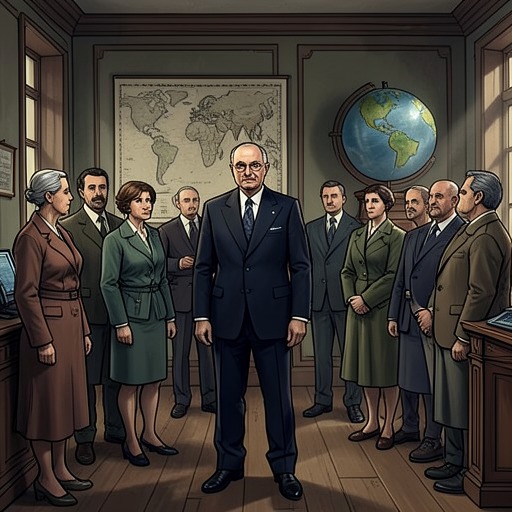
That same month, Truman established a Federal Employees Loyalty and Security Program, though he did so with misgivings. The juxtaposition is important: his administration presented support for vulnerable governments as a defense of political freedom, while also creating an extensive domestic screening system in response to fears of disloyalty. In June, with Truman’s approval, George C. Marshall delivered the address at Harvard that introduced a large-scale program of European recovery. The postwar agenda also included a reorganization of government itself. On July 25, Congress passed the National Security Act, which unified the armed services under a Department of Defense, established the Air Force as a separate service, created the National Security Council, and formally authorized the Central Intelligence Agency. Truman had sought the unification of the armed services since taking office; the legislation gave institutional form to a new national-security structure.
Civil rights became another measure of his willingness to spend political capital. In February 1948, Truman sent Congress a special civil-rights message based on the findings of his own commission. The biography identifies it as the strongest civil-rights program proposed by a president to that point and notes that no earlier president had sent a special message devoted to the subject. In May, after Israel declared statehood, Charlie Ross announced that the United States had granted de facto recognition eleven minutes later. These decisions involved different constituencies and different political risks, but both show Truman using presidential authority in moments when delay or caution would also have been a choice.
Truman’s authority was persuasive as well as formal. He relied on public addresses, congressional negotiation, and direct encounters, but those methods did not guarantee agreement. As the president of a minority administration after the 1946 elections, he argued that foreign policy had to be a national rather than a party program and said that he would judge proposals by the welfare of the people rather than political advantage. He also believed strongly in getting among the public. On campaign tours he enjoyed meeting local politicians and crowds, and he read the country’s response as a source of political knowledge as well as support. His style could appear plain, but it was part of a practical effort to convert personal contact and popular confidence into governing authority.
War, Limits, and the Use of Presidential Power
Truman’s response to the North Korean attack on South Korea showed how he joined military action to a larger argument about collective security. He reasoned that allowing a smaller country to be forced into submission would encourage stronger Communist neighbors and could lead toward another world war. His administration moved quickly: American arms and supplies were sent to South Korea, civilians were to be evacuated under American air cover, and the Seventh Fleet was ordered to the Formosa Strait. Truman described the decisions as actions taken for the United Nations. Because he believed the League of Nations had failed, he saw the United Nations as facing a first decisive test that it could not be allowed to lose.
As the conflict worsened, he resisted treating military escalation as synonymous with victory. On November 28, 1950, he presided over a National Security Council meeting that effectively decided not to let the crisis in Korea expand into a world war. The decision was as consequential as the original decision to intervene. Truman’s position was that a Korean victory was not worth risking a global war fought with atomic weapons; the purpose of limited war was to preserve peace rather than pursue victory without limit. He therefore accepted that military aims had to be bounded by the political danger of a wider conflict.
The conflict with Douglas MacArthur brought that principle into direct confrontation with military prestige. Truman did not immediately decide to dismiss him. Faced with political opposition and the public’s admiration for MacArthur, he first sent a restrained reprimand reminding the general that public statements had to be cleared with Washington. But when senior civilian and military advisers agreed that MacArthur should be relieved, Truman said he shared their view and instructed Omar N. Bradley to prepare the papers. He later rejected the description of his action as an act of courage, explaining it instead as a straightforward response to insubordination. The biography makes the institutional significance plain: the commander in chief’s legal authority had to be exercised in fact, even when the officer being disciplined had immense public standing.
Truman also faced domestic conflict over labor and the limits of executive power. In the coal dispute with John L. Lewis, he challenged the legality of another threatened strike and treated the contest as a fight to the finish. Years later, in April 1952, with steel mills scheduled to be struck, he ordered their temporary seizure through Executive Order 10340. He regarded the action as a last resort, not a permanent settlement. These confrontations show a president prepared to use executive authority forcefully in a crisis, but they also put the constitutional boundaries of that authority under strain. His willingness to act did not mean that every action would be accepted as lawful or final.
The pressures of office also accumulated privately. Truman sometimes wrote drafts he had no intention of delivering, using longhand as a way to get his anger and frustration onto the page. In a Cabinet meeting in May, he appeared to officials as a figure newly resolute, summoned to announce a decision rather than solicit opinions. The public and congressional response to his forceful action was immediate approval, and his standing rose. The contrast with periods when he seemed bewildered or inadequate is part of the biography’s account of his development: decisiveness was not a constant pose, but a capacity that became most visible when he believed the stakes demanded it.
Departure, Historical Record, and Later Life
Truman decided not to seek another term well before he announced the decision publicly. In November 1951, during a brief stay at Key West, he read to his staff a statement written the previous year and told them that he intended to release it in the spring. He insisted on secrecy for five months, giving those around him time to make their own plans. Once he had told them, he seemed relieved. His later campaign work for the Democratic nominee showed that leaving the contest did not make him indifferent to the result: once the campaign began, he entered it energetically and regarded the election as a referendum on his presidency.
His farewell address, delivered by radio and television from the Oval Office on January 15, 1953, looked back on the history he had been made to inhabit. The speech was simple and personal rather than ornamented, and it set out the changes reshaping the world and the role he had played since being summoned to the White House after Roosevelt’s death. He did not want the address treated as a nostalgic ending. The language of departure was tempered by his insistence that he was not finished. The next day, the transfer of office closed his presidency, but not his public life.
The material circumstances of his return to private life were stark. He traveled home without Secret Service protection, salary, or pension, with no federal support for staff, office space, or expenses. His only government income was an Army pension of $112.56 a month. Although he and Bess had saved some of his presidential salary, the amount was uncertain; in his final weeks in office he had needed a bank loan to tide him over. The biography uses these details to show how little institutional support former presidents then received, and how different the status of a former president could be from the authority of the office he had just left.
Truman devoted himself to writing his memoirs and establishing his library. The book project occupied more of his time than he had expected, and he complained to Dean Acheson that it had made him a slave. Its weaknesses, in the biography’s assessment, came partly from the number of people involved: the finished work sometimes lacked Truman’s vitality and distinctive voice. He had approached it more as the recording of history than as the telling of his own story. The library, by contrast, became the focus of his later life and an unqualified success. These parallel projects reveal the difference between his two efforts to preserve the past: one mediated account of his own experience, and one enduring institution devoted to the presidential record.
In Independence, he returned to a familiar daily rhythm. Before dawn, usually around 5:30, he rose when the courthouse clock sounded, opened the front door, and retrieved the Kansas City Times from the walk. His post-presidential life also brought a steady stream of speaking invitations, two or three hundred a month, and friends described him as radiating happiness at home. Harry S. Truman died at Research Hospital and Medical Center in Kansas City on December 26, 1972, at 7:50 in the morning.
The biography’s final portrait holds ordinary virtues and world-historical consequence together. Truman spoke plainly, valued hard work and decency, and trusted the people whose company he enjoyed on the campaign trail. Yet the author rejects any reduction of him to a simple ordinary man. The qualities associated with his Missouri background—wit, warmth, common sense, and friendship—coexisted with the determination and judgment required to make decisions about war, civil rights, and the reach of presidential authority. His life thus returns to the conviction formed in his reading: individuals make history, but they do so amid consequences that no individual can entirely control.