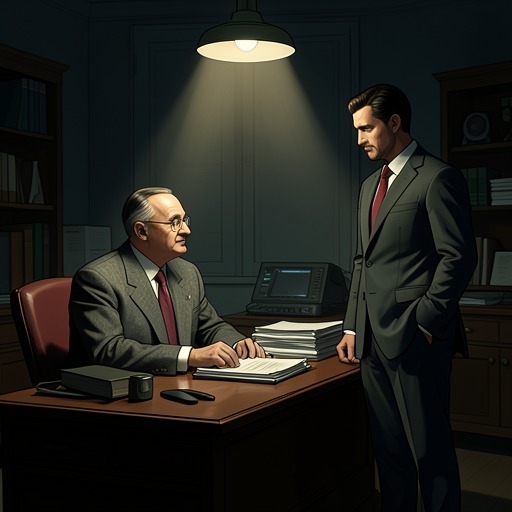
Whittaker Chambers
TrumanWhittaker Chambers enters the account as a former Communist whose testimony transformed a congressional inquiry into a national political crisis. In 1948, he accused Alger Hiss of having been his accomplice in a Communist network, an allegation that stunned official Washington and drew an immediate, dismissive response from Harry S. Truman.
Identity and Public Role
Chambers was a former Communist and an editor of Time magazine. The book identifies him through his appearance before the House Un-American Activities Committee, where his past and his claims placed him at the center of a widening spy scandal. It gives little detail about his life beyond that public role; his significance here rests on what he alleged and the political consequences of saying it.
The Hiss Accusation
On August 4, Chambers testified that he had served for a number of years in an underground Communist organization in Washington and named Alger Hiss as a member of the group. Hiss, the book notes, had been president of the Carnegie Foundation and had served for fourteen years in the State Department, as well as holding posts in the Roosevelt and Truman administrations. Chambers’s accusation therefore implicated not an obscure figure but a former government official associated with the New Deal and the highest levels of public service.
The charge rocked the capital. Washington was described as stunned with anger and disbelief, and Sam Rayburn warned a reporter that the investigation carried political dynamite. Chambers’s testimony thus made the alleged spy network a public crisis before the account establishes the accusation as fact: it reports his claim and its reception, not an independent confirmation of the charge.
Truman’s Response and the Scandal’s Political Force
At a press conference the day after the testimony, Truman was asked whether the congressional spy scare was a red herring intended to distract attention from inflation. He agreed, arguing that the hearings diverted Congress from its work and slandered people who did not deserve it. When reporters asked whether they could quote him, he said they could, further intensifying the political consequences of his response.
The episode places Chambers at the junction of testimony, press coverage, and partisan conflict. His accusation brought the possibility of Communist infiltration into immediate public view; Truman’s dismissal of the hearings as a diversion made the controversy itself a test of judgment and credibility. The account’s emphasis falls on this collision: a former Communist’s explosive charge, a stunned capital, and a President willing to make his skepticism public.