Henry L. Stimson
TrumanHenry L. Stimson, the elderly Secretary of War, was a key adviser to Harry S. Truman during the investigation of wartime mobilization and the decisions surrounding the atomic bomb. His relationship with Truman moved between secrecy, suspicion, and consequential trust: Stimson guarded information about projects he considered exceptionally sensitive, yet ultimately brought the new weapon’s implications and the responsibility for its use directly to the President.
Identity and wartime role
Stimson entered this account as one of the country’s senior civilian officials, responsible for the War Department during a conflict in which military power and industrial production were expanding at extraordinary speed. His influence rested not simply on his office but on the combination of military experience, access to secret programs, and willingness to advise the President on choices whose consequences could reach far beyond the immediate war.
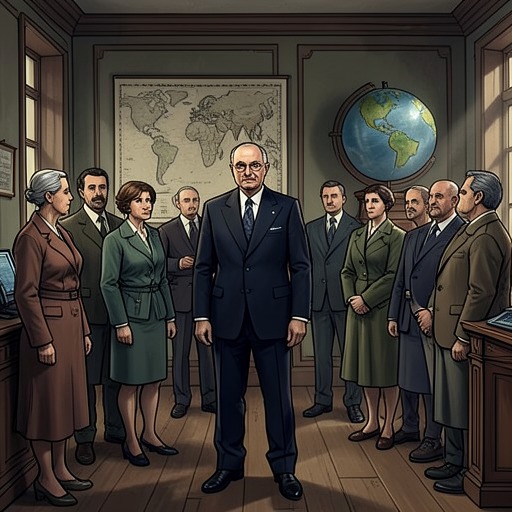
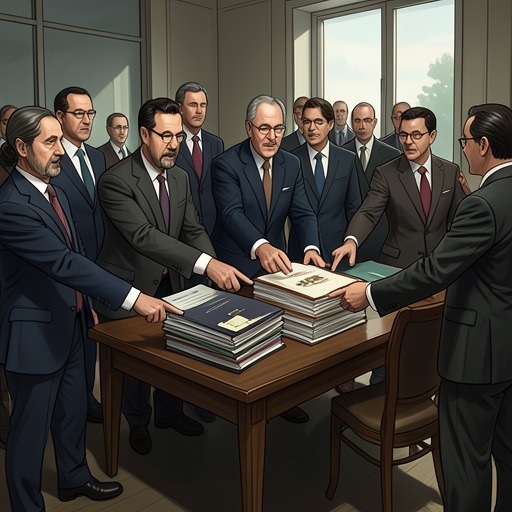
On April 15, 1941, he appeared before the investigating committee with a dozen of the highest-ranking military and civilian officials, including Chief of Staff George C. Marshall. When the committee discussed seniority in the Army, Marshall argued for selective promotion, saying, “You give a good leader very little and he will succeed,” while a mediocrity given ample resources would fail. Stimson’s presence placed him among the officials whose testimony helped the committee examine how the country was preparing for war. Years later, Truman said that his respect for Marshall began at this first hearing, an early instance of the committee’s work shaping relationships that would matter in the administration of the war.
Stimson also became a witness to Truman’s working style after Truman took office. Following a Cabinet meeting, he praised the President’s prompt decisions and businesslike conduct: Truman moved through each matter without the prolonged deliberations Stimson had experienced in earlier conferences, allowing the group to cover more business than expected. That assessment helps explain why Stimson could bring Truman difficult questions directly, even when their relationship was not free of friction.
Oversight, secrecy, and civilian authority
The committee’s investigations brought Truman close to the boundaries of wartime secrecy. For some time, its staff investigators had encountered unexplained expenditures linked to the Manhattan Project, a secret undertaking larger even than the Canol Project. On June 17, 1943, Truman telephoned Stimson. Stimson said that he personally knew about the matter and was among only a handful of people in the world who did. He described it as a development of unique importance. Truman accepted that assurance and stopped pressing for details, trusting Stimson’s judgment without being told what the project was.
That confidence did not settle every dispute between them. Later, Truman sought to have a member of the committee staff, General Frank Lowe, informed about Hanford Works. Stimson believed he had an agreement with Truman to keep the information restricted and refused. His diary recorded deep irritation: he described Truman as a nuisance and untrustworthy, and said that the Senator had threatened him with dire consequences. Stimson resolved that Truman was not to be told more. The episode shows how the same oversight role that had fostered trust could also put the two men at odds: Truman pressed for information in his capacity as investigator, while Stimson treated control of access as essential to protecting a secret program.
Their disagreement sat within a broader argument about who should direct the war effort. Stimson backed Donald M. Nelson and held that control of wartime mobilization should remain in civilian hands. He watched generals and admirals gain influence over industry and agriculture as military contracting expanded; in the first six months of 1942, such contracts added $400 billion to the economy, according to the account. In a broadcast for The March of Time that fall, Stimson called civilian control the foremost issue of the day and warned that its consequences could shape the country’s postwar political and economic structure. His distinction was direct: “The function of generals and admirals is to fight battles,” he said, “and to tell us what they need to fight battles with.” Military expertise mattered, but in his view it did not confer authority to govern the nation’s economic life.
Bringing the atomic question to Truman
When Truman became President, Stimson initially disclosed little. At an early meeting, he said it was time for the administration to close ranks, then remained behind to tell Truman that a new explosive of unbelievable power required urgent discussion. He offered no details, leaving Truman no better informed about the weapon itself. The secrecy that had protected the project therefore also shaped the new President’s first days in office: Stimson signaled the stakes before he revealed the substance.
On April 23, Stimson wrote that he needed to speak with Truman as soon as possible about a highly secret matter. Alone with the President, he took a several-page typewritten memorandum from his briefcase and waited while Truman read it. Stimson had finished writing it that morning. The memorandum introduced the atomic bomb not merely as an instrument that might shorten the war but as a force capable of changing history. Stimson asked permission to establish a special select committee to study the implications of this new force and advise the President. Truman agreed.
Stimson’s concern was at once practical and historical. At the committee’s final meeting, he urged those present to consider the bomb not simply as a new weapon but as a revolutionary change in humanity’s relationship to the universe. He and others warned that the project might threaten civilization; another possibility was that atomic energy could become a source of extraordinary benefit. Neither outcome was known. Stimson’s advice thus widened the question before Truman: the decision concerned not only how to end the war but what kind of political and moral world would follow the weapon’s arrival.
He also raised a moral warning about the manner of its use. Stimson told Truman that he did not want the United States to outdo Hitler in atrocities. At the same time, he worried that conventional raids might devastate prospective targets so thoroughly that the bomb’s destructive power would lack a fair background for comparison. The juxtaposition struck Truman as odd enough to make him laugh, though he said he understood. Stimson’s account of the dilemma held two concerns together: avoiding an atrocity and preserving the bomb’s capacity to shock Japan into surrender.
Stimson was explicit about the limits of the committee’s authority. Its role was advisory; responsibility for the recommendation to the President rested with him. He believed a tremendous shock was necessary to obtain genuine surrender from the Emperor and Japan’s military advisers, and reasoned that a decisive demonstration of American destructive power could save many more American and Japanese lives than it cost. He told Truman that senior military advisers shared the view that the weapon’s shock value would stop the war. These were Stimson’s conclusions and forecasts, not certainties: he understood that the judgment belonged to him, and that its consequences could not be known in advance.
The decision, its limits, and their final exchanges
The book’s account places the decisive discussion at a meeting on July 24, 1945, in the dining room at Number 2 Kaiserstrasse, where Truman, Winston Churchill, and their military advisers sat together. The decision, as the account reconstructs it, was that the bomb would be used within weeks unless an unforeseen development intervened. Truman later told Arthur Compton that the decision came on the same day he informed Joseph Stalin. In his diary, however, Truman had described his hardest decision to that point as whether to invade Japan proper or bomb and blockade it, without mentioning S-1. The contrast captures how the President’s written account of the immediate strategic choice could leave the secret weapon outside the frame even as its use was nearing decision.
Stimson continued to intervene on the selection of targets. When he arrived in Berlin with messages that preparations for the final operation were nearly complete and that target cities had to be decided, he asked Truman to remove Kyoto from the list. He explained that although it held military importance, it had been Japan’s former capital and was a shrine of Japanese art and culture. Truman agreed that Kyoto would be spared. Hiroshima, a southern headquarters and depot for Japan’s homeland army, headed the approved list.
Truman’s own written instructions set out the limits he intended to impose: the bomb was to be used against military objectives, soldiers, and sailors, not women and children; neither Kyoto nor Tokyo was to be targeted. He also intended a warning statement giving Japan a chance to surrender, though he doubted it would do so. The instructions expressed a distinction between the weapon’s terrible power and the purpose for which he said it should be used. Stimson’s advocacy of a shock powerful enough to compel surrender had helped shape the recommendation; the target discussion shows him also pressing for restraint within that policy.
Stimson had not been invited to travel to the final Big Three conference, in consideration of his health, but he was acutely aware that last-minute developments concerning S-1 could be decisive. He chose to go to Berlin on his own initiative, arriving ahead of Truman. His appearance there, followed by the discussions over Kyoto and the timing of use, continued the pattern of his wartime role: he guarded the secret, advised the President, and tried to influence the application of a weapon whose larger consequences he had already warned might transform history.
The relationship ended the war years with an expression of public respect. On September 21, the day of Stimson’s retirement, Truman presented him with the Distinguished Service Medal at a small gathering in the Rose Garden. It was also Stimson’s seventy-eighth birthday and his last day in Washington. Truman later wrote to Bess that if anyone in government deserved the medal, it was that good man. The ceremony did not erase their conflict over secrecy, but it gave their association a final note of gratitude: a President who had once accepted Stimson’s assurance without knowing what lay behind it now publicly honored the official who had carried the atomic question to him.